
ARTICLE
From Vox Ferus to Canine Posthuman:
Becoming a Singing Dog
Jelena Novak
Sound Stage Screen, Vol. 4, Issue 1 (Spring 2024), pp. 35–70, ISSN 2784-8949. This work is licensed under a Creative Commons Attribution-ShareAlike 4.0 International License. © 2025 Jelena Novak. DOI: https://doi.org/10.54103/sss27255.
Last year I ran into a dog in the VR opera Songs for a Passerby (2023). [1] It was an unexpected encounter. A digital dog, with its full range of vocal sounds, guided the listening spectator through the piece. Only one person could experience this VR opera at a time. It lasted for thirty minutes, and there were actually two physical “stages” for it—two gray carpets laid out in an emptied space in the Studio Boekman of the Dutch Opera and Ballet in Amsterdam. Equipped with a VR helmet and visor installed on my head by an assistant, I was ready for Songs to begin. Instruction for taking part in it were familiar: like in Michel Van der Aa’s VR opera Eight, if I felt unease or panic, I was instructed not to mess with the equipment, but simply to raise my hands. [2]
“In Songs for a Passerby—a VR opera by Celine Daemen about our tenuous relationship with the transitory nature of reality—you will autonomously walk through a musical dreamscape shown in a VR headset. You are following your own 3D mirror image and on the way you will pass by various scenes: a dying horse, a choir of murmuring people, two playing dogs.” [3] One question that often arises is how much the experience of such a piece as an opera is shaped by the fact that it is labeled as an opera, rather than simply being viewed as a VR experience. Indeed, in Songs, the melodious singing is less prominent than in Michel van der Aa’s two VR operas, Eight and From Dust. Still, the concept of VR opera fits the piece well, as there is a deep sense of vocality woven throughout. As Daemen explains in the “behind the scenes” video, the singers are exploring melodic material through mantra-like repetitive murmuring texts (in Dutch). “In this piece, there is no real division between sound and music. All the entities you encounter—whether it’s a dog, a rock, or a person—are sounding entities.” [4] Singing and chanting are omnipresent.
After an introductory cast list, akin to what one often finds in a movie theater before the opening scene of a film, a virtual dog appears. It whines, wags his tail, barks, flatters, and sniffs around me. It looks as if it wants me to follow. The dog leads me through the virtual opera as a kind of narrator, introducing me to its own language. The sound of a passing train can be heard nearby. Everything is dark, gray, like some sort of ghetto, reminiscent of the atmosphere in Alfonso Cuarón’s 2006 film The Children of Men. People can be seen walking down the street, their murmur is audible, yet unintelligible: whispers can be heard, but the words are indistinguishable. Like a dog, I don’t really understand the meaning of the words, but I intuitively feel and decipher the intentions behind them. Those people are going somewhere, but it’s unclear where; I observe them. I ascend the labyrinth-like old city fortress. At one of the resting places lies a horse, in its death throes. I cannot see my hands or feet in that virtual walk. I cannot touch the horse, nor can I help in any way. I try to put my arm on his back, but it is in vain. The dog is by my side.
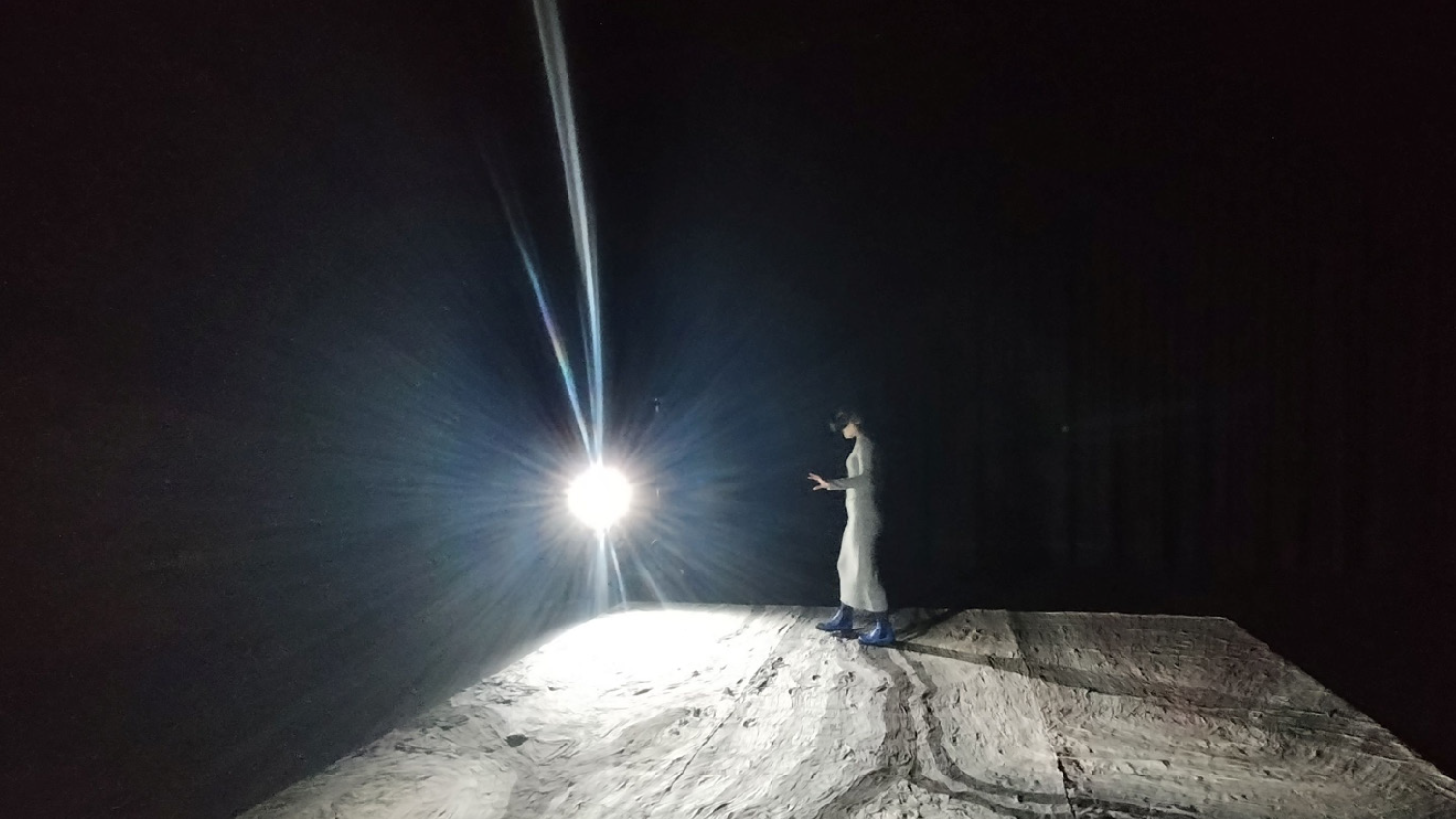
Fig. 1 – The author of the text attending the VR opera Songs for a Passerby , led by the virtual dog. The picture was taken by one of the performance assistants with Novak’s phone.
The interaction with the dog is continuous. It is both my guide and guardian while wandering around this unknown place. If something holds my attention for too long, a dog appears and signals it is time to move forward. Several times, I manage to activate a grid that indicates that I am reaching the boundaries of the designated space. The grid on the screen signals that I should go back, which makes me feel like a dog on a leash myself. In that case, the dog appears and, through its behavior, suggests that I move on and follow. The music is composed of whispers, singing, incantations, sounds of water and rocks, fire, and machines. I hear a drone tone; the music sounds mystical, with a murmur of incomprehensible voices over the drone. Some of the music sounds like a fragment of Hildegard von Bingen’s hymns. Over the houses’ rooftops, I see a train passing by.
Suddenly, I am on the train and have some sort of interaction with the passengers sitting in it, including a dog of a different breed from the one that was guiding me. In that moment, my thoughts go to Louis Andriessen visiting a museum in Belgrade: he excused himself as he wanted to run through the exhibition “like a dog,” alone, led by his impulse, not following the paths of the assumed museum hierarchy. The train passengers talk about identity, about memory. Before I know it, I am outside the train and continue climbing through the city-fortress.
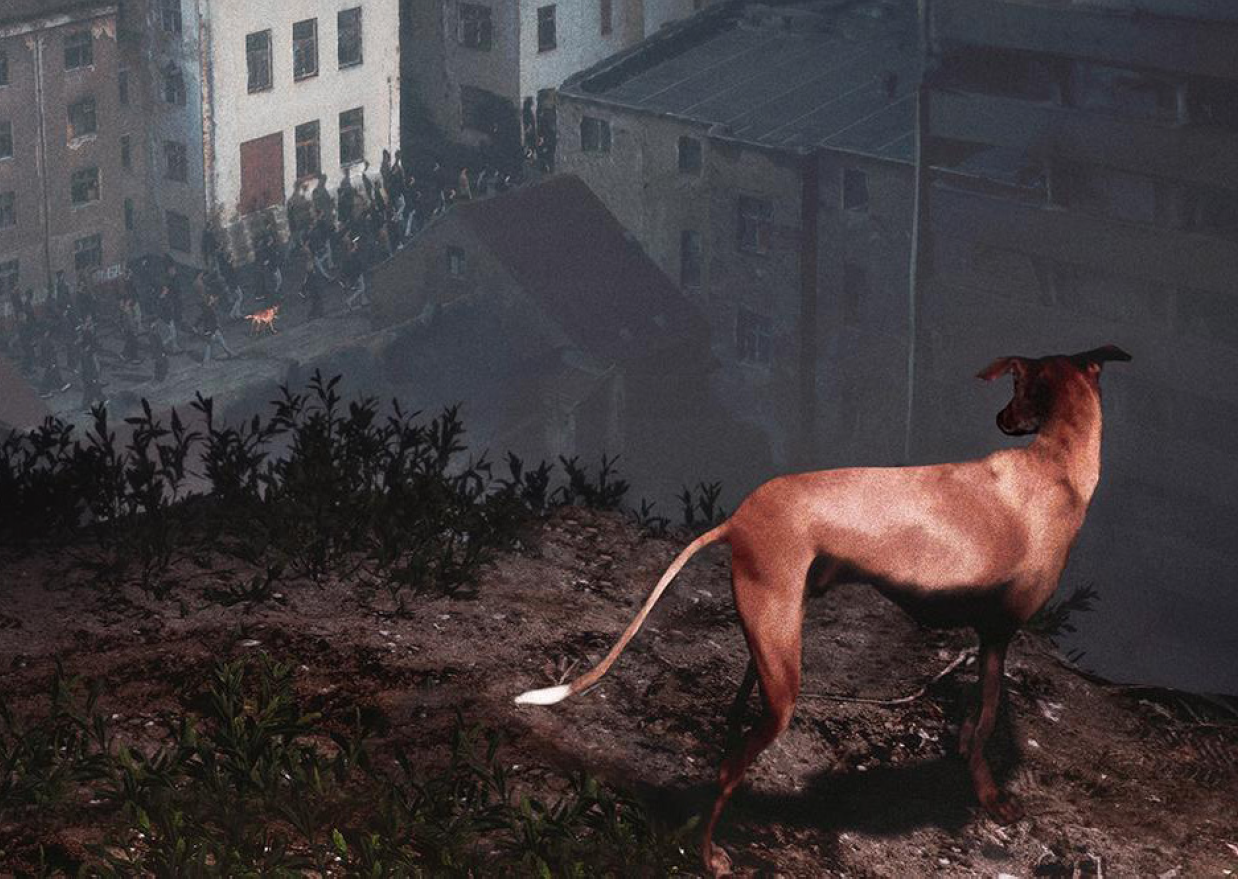
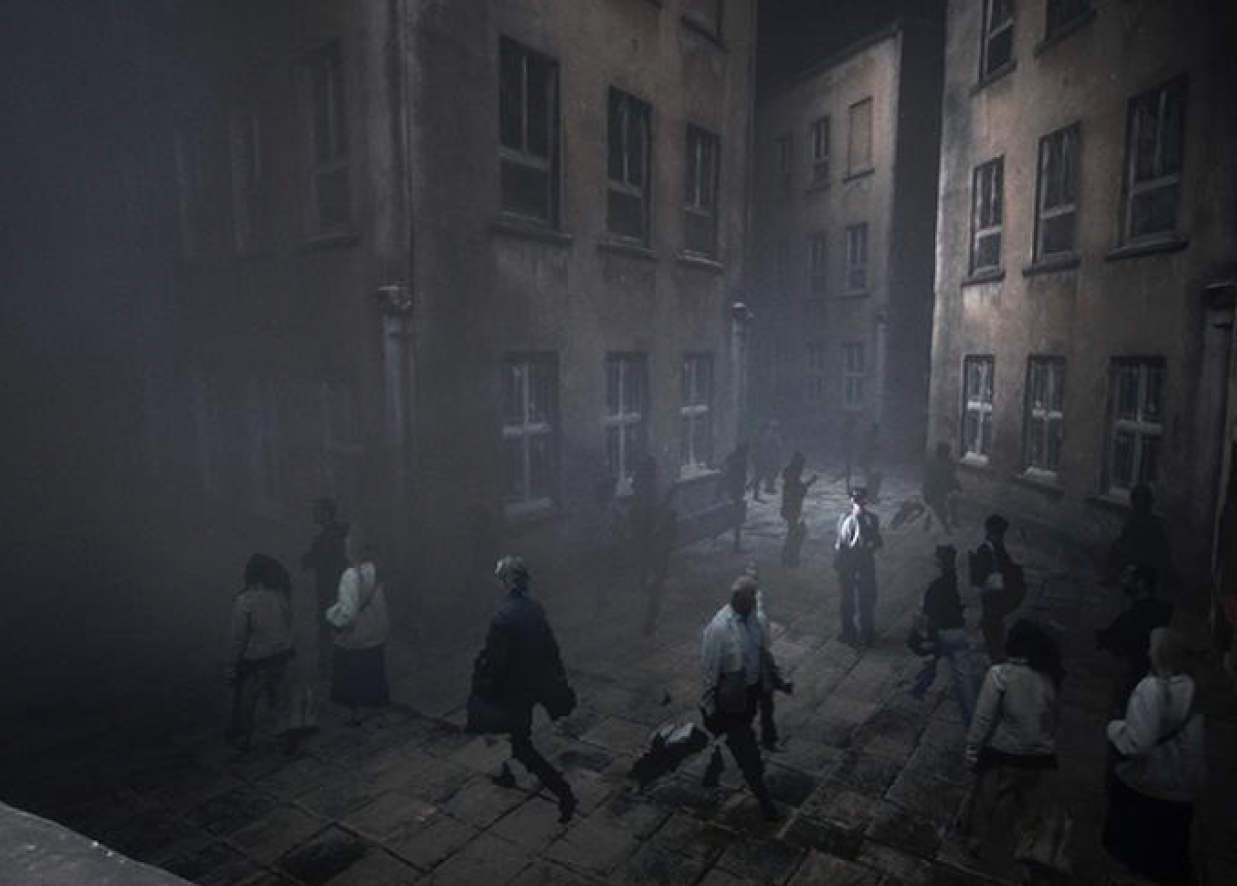
Figg. 2 and 3 – Songs for a Passerby (2023) by Celine Daemen, Olivier Herter, Aron Fels, Asa Horvitz, and Wouter Snoei. Video stills.
Suddenly, in the visor, I see myself in real-time, with the VR equipment on my head. Confronting my appearance in the VR environment places me in the human sphere, in parallel to that of a dog. The dog is there, and I feel (or imagine) that we share a common language. The dog is leading me to the top of the settlement and fortress. There, I confront myself in reflection: there are two of us. Eventually another dog appears, of the same breed as my companion. They play eagerly and joyfully, clearly happy to be together. The vocal sounds of the two dogs playing stay in my memory as an echo of the entire event. Their voices sing in their own manner. A dog’s “song” is somewhat distinct from its other vocalizations, characterized by a certain tendency toward melodic expressivity in the vocal particles exchanged with its own kind. At least, that’s how it remains in my memory, as if they started to build some melodious tissue together. “Sounds pass us by, pass through us, grabbing our hearts and minds for a moment, and remain only as memories.” [5] My ears stay tuned for the dog’s song.
“Human is constitutively inhuman” asserts Bojana Kunst, [6] aligning with Giorgio Agamben’s claim that “homo sapiens … is neither a clearly defined species nor a substance; it is, rather, a machine or device for producing the recognition of the human.” [7] All the dog voices performed, invented, imagined, barked, sung, heard, and suggested by the examples in this text might also be understood as kinds of mechanisms for producing the recognition of the animal within the human, and as vocal and audible machines for reinventing the human–animal divide.
In his novella The Metamorphosis (1915), Franz Kafka explores precisely what interests me about the subject of animal voice: hearing the non-human in the vocal sphere. Salesman Gregor Samsa wakes up one day in his room only to discover that his body has been transformed into that of a huge insect. While his family members try to figure out why he remains in his locked room, he struggles with the shock of his new existence, initially pretending that everything is fine. However, when he starts talking to his family through the locked door, they become aware that something has truly gone wrong:
Gregor was startled when he heard his own voice in reply; no doubt, it was unmistakably his previous voice, but merging into it as though from low down came an uncontrollable, painful squealing which allowed his words to remain articulate literally for only a moment, then stifled them so much as they died away that you couldn’t tell if you’d heard them properly. [8]
Though Gregor at first assumes that his voice and ability to speak have remained the same as when he had a human shape, his voice pitch, and articulation have changed to the point where his ability to speak becomes disfigured. He still understands human speech, but humans have difficulties understanding the words he is saying. His voice becomes animal-like, monstrous. [9] When they hear it, it becomes obvious that Gregor might be at a point of no return. [10] Later, the shock of finally seeing Gregor in his insect form confirms the horror, but it is his monstrous “voice” that truly triggers distress. [11] I am interested in how we hear this divide between human and animal, human and monster, human and machine, human and non-human. How do we sense and detect it? How do we learn to feel it, and is that divide indeed truthful or viable? How does voice transformation sound during the process of “becoming animal”? [12]
Imagining the non-human voice, I discuss the reworking of the demarcation line between human and animal through the vocal sphere referring to the dog as an “animal of interest.” In contemporary visual art, music, and opera I noticed several recent examples where the figure/construct/representation of the dog and dog–human relation serves as the central motor of the piece. Thus, I shall focus on representations of humans that “go out of themselves,” acquiring animal characteristics. I am especially intrigued by how this “going out of human” reflects on the voice, if there is something that could be called animal voice, and what its characteristics would be.
Starting from the example of a feral child raised by dogs and the illuminating performance-art pieces by Oleg Kulik, in which the artist performs as a dog, I arrive at the analysis of the representation of the dog/animal vocal figure in two Alexander Raskatov’s operas: A Dog’s Heart (2008–09), based on Mikhail Bulgakov’s 1925 short story, and Animal Farm (2023), based on the famous novel by George Orwell. I am especially interested in the vocal perspective of “The Posthuman as Becoming-animal” in light of Rosi Braidotti’s commentary. [13] I will also refer to the philosophy of human–animal issues discussed by Oxana Timofeeva. [14]
And why dogs? In her book on posthuman, Braidotti reminds us of Deleuze’s classification of animals into three groups: those we watch television with, those we eat, and those we are scared of. While this classification could be expanded—for example, where do animals used for experiments, including those sent into space, fit in?—I am intrigued because dogs encompass all three categories: they are among the most common domesticated and pet animals, their meat is consumed in various parts of the world, and they can also evoke fear as wild dogs, fighting dogs, street dogs, or sick dogs. There are even famous dogs that have ventured into space for experiments. This ubiquity of dogs in the human world places the figure of the dog in the spotlight, particularly concerning the realm of the vocal sphere.
Let’s take feral children as a first example. The etymology of the word “feral” evokes meanings such as wild, untamed, uncultivated, brutal, and savage qualities that stand in stark contrast to a norm. This norm implies being tamed, cultivated, civilized, compassionate, and well-behaved. However, the norm also defines those who establish it—humans. It represents a conventional view of humanity: placing humans at the top of the species hierarchy, distinguished by their supposed superiority in being tamed, cultivated, and norm-setters, among other things.
Feral children are humans neglected by their parents and left to be raised by animals. These rare children imitate the gestures, poses, sounds, and behavior of their “parent animals” to such an extent that their animality calls into question their belonging to the human sphere. Even when placed in “normal” human circumstances, their behavior may remain adapted to animal norms, and these children often experience lifelong impairments, especially in the domain of language. One such example is the case of Oxana Malaya from Ukraine, who was neglected by her alcoholic parents and raised by dogs until the age of six. She imprinted the behavior and “vocabulary” of dogs. [16] When authorities discovered Oxana, she was walking on all fours, barking, making sounds, and exhibiting bodily movements typical of dogs. She did not react to her reflection in the mirror and was unable to speak.
Several documentary films featuring various scientists have been made about Malaya. For the scientific community, feral children pose cutting-edge questions and provide valuable insights, as they are seen as rare “experiments” that would not be ethically feasible to conduct in society. Reflecting on Oxana Malaya’s case, one of the scientists involved, James Law, then a professor of language and communication at City University, London, cautions that “part of being human is being brought up by humans.” He poses an intriguing and somewhat controversial question: “If you are not brought up by humans, are you completely human?” [17] I’m intrigued by what might be considered “completely human” in an era of solidarity with “nonhuman people,” as advocated by Timothy Morton. [18]
Discussing Malaya’s case, scientists explain that if/when the evolution of language skills in cases of feral children is omitted in early childhood, later it is much harder to learn to talk since the brain restructures its language resources, so to say. [19] And as the use of language is one of our strongest points of difference with animals, feral children stay on the edge of the human/animal divide. Braidotti claims that “Post-anthropocentrism displaces the notion of species hierarchy and of a single, common standard for “Man” as the measure of all things. In the ontological gap thus opened, other species come galloping in. This is easier done than said in the language and methodological conventions of critical theory. Is language not the anthropological tool par-excellence?” [20] In Oxana Malaya’s case, she managed to learn to speak and distance herself from her dog-like voice and behavior. Her experience underscores the complex interplay between language, identity, and the human–animal divide, leaving Braidotti’s question open and reverberating.
Another question raised by cases like Malaya’s is why witnessing feral children’s behavior and hearing their “wild voice,” vox ferus, is so unsettling. Why don’t we experience the same disturbance of seeing Malaya acting and sounding like a dog when we observe, for example, a dog “singing,” as in Laurie Anderson’s 2015 movie Heart of a Dog? What exactly disturbs us when we see a girl howling and barking? Does this “monsterization of the human” question something profound about our own identity?
Watching the video of Oxana Malaya I note a kind of ontological de-synchronization between what I hear and what I see at the same time, in a sense similar to what Heiner Goebbels discusses in his “aesthetics of absence” when he talks about the mismatch between visual and acoustic “stage.” [21] It makes me think about the notion of voice-body that Steven Connor discusses as a double mirror mechanism: The voice is projected by the body, but it also reflects back onto the body that produces it; it is this very process that constitutes identity. [22] It is a sort of figurative “catch.” The howling and barking animal voice is produced by the human body and in the process of reflecting itself back to the body’s identity, the human is seen with interference, “monsterized” into animal. Because of this interference, Malaya’s identity stays continually trapped in the process of “becoming animal,” which is never accomplished. She will never be “completely human,” as James Law would say, as she is not “completely a dog.” Her existence is perpetuated in a limbo of becoming.
The extremely skillful performance of her vocal apparatus within the context of dog sounds plays a decisive role in this “becoming,” as her vocalizations sound much more convincing as a dog than as a human, despite her physical appearance leaning towards the human side. This interplay between seeing and hearing the transformation into dog is challenging to grasp, and it makes the case of Oxana Malaya and her canine voice so compelling. This desynchronization fundamentally redefines the conventional understanding of what voice can be. As I shall discuss further, Alexander Raskatov focuses precisely on this divide, this striking desynchronization, when composing the voice of a dog turned into human in his opera A Dog’s Heart .
Before focusing on Raskatov’s opera, let me first discuss the work of Ukrainian-born Russian artist Oleg Kulik, which investigates the role of the artist as a dog. He portrays himself as a proletarian artist, distinct from being merely human: he is a dog. Using powerful mechanisms, Kulik strongly challenges the boundaries between the human and animal respective worlds. The process of “becoming an animal,” as seen through the desynchronization between canine vocality and the human body producing it, serves as the primary driving force behind Kulik’s series of performance art pieces. In these works, Kulik acts as a dog, appearing naked with a collar around his neck, barking, growling, howling, and whining. He usually performs alone, although he’s sometimes accompanied by a “master”—the person holding his chain. Depending on the circumstances, Kulik presents himself in different guises: as an anarchist on the street, provoking confusion, fear and aggressively wandering around as a mad dog; [23] in front of the gallery, policing the entrance like Cerberus guarding the gates of the underworld; [24] and inside the gallery, as a prisoner kept in a cage, where visitors can enter and confront him at their own risk. [25] In these three cases, Kulik, portraying the figure of the dog-artist, metaphorically represents various institutions of society: madness, police, and prison.
Braidotti notes that “since antiquity, animals have constituted a sort of zoo-proletariat, in a species hierarchy run by the humans.” [26] The idea of a dog as a proletarian is not uncommon for Russian art and especially literature in the first half of the twentieth century. For example, Mikhail Bulgakov’s story A Dog’s Heart particularly resonates with it. Looking back at the context of the communist revolution, Oxana Timofeeva suggests the idea of a “total transformation of the social and natural order towards emancipation and equality” and underlines that after the October Revolution in 1917, “the standards of a revolution ‘in nature’ and even of a ‘struggle against nature’ were continually raised in all spheres of the nascent Soviet society.” [27] With this in mind, Kulik’s decision to act as a dog in the art world also seems like a dialogue with the aforementioned tradition.
Kulik’s starting point is steeped in bitterness as he illustrates a reality in which the artist is treated as nothing more than a stray dog, an object for society’s cruelty. He embodies the dog, mimicking its sounds and movements, attempting to live as one, but solely within the context of the art world. What Malaya experienced firsthand, Kulik portrays through his impersonation. Kulik’s portrayal of the dog is far from the image of a cute puppy; instead, it embodies frustration, neglect, aggression, and unpredictability. It symbolizes the proletarian, viewed from the capitalist perspective—a figure best avoided unless absolutely necessary. He leaves a warning note, signaling that he should not be disturbed, and those who dare to approach him do so at their own risk. Playing with his “animal nature,” Kulik asserts that he is not accountable for any resulting consequences. Naked and unkempt, he barks, growls, and issues threats.
Observing Kulik in a documentary where he talks normally with his human voice, he appears as an entirely different individual. [28] Using his voice to produce animal sounds and projecting them onto his “becoming-animal” body introduces identity interferences and lays bare that identity within the political context of the art world and its hierarchies. The notion of the human as a “perfected animal” is a recurring theme throughout European history and culture (and beyond). Kulik’s “monsterization” of voice resonates with Timofeeva’s concept of “nature as a battlefield for class struggle,” particularly in the motives of Russian art following the October Revolution. If, as she elucidates, “a potential or actual transformation of one species into another—such as animals into humans—accompanied by the attainment of higher levels of consciousness and freedom” represents the theme prevalent in Soviet literature and poetry of the period and can be identified as revolutionary humanism, then Kulik’s activities could even be seen as counter-revolutionary. [29]
Starting from virtual dog’s whining and barking while leading me through VR opera, to Gregor Samsa’s voice, which served as a kind of proof that he had entered the realm of the monstrous, I examined the voice-body of Oxana Malaya and her vox ferus. I also discussed the voices that Oleg Kulik produced as a dog in his performances. Those cases of reinventing vocal divide in the human sphere lead me to the central case study of this article: the dog and animal voices in the operas A Dog’s Heart and Animal Farm by Alexander Raskatov.
As mentioned, A Dog’s Heart is based on Mikhail Bulgakov’s 1925 story, which narrates the peculiar transformation of a dog into a human. In the tale, the esteemed doctor Filip Filipovich Preobrazhensky adopts a starving street dog named Sharik. Unfortunately, the rescue is not motivated by the doctor’s grace, but by his scientific ambitions: he needs a “victim” for a pre-arranged experiment. After the dog recovers, Preobrazhensky operates on him, implanting the testicles and pituitary gland of a hardened drunkard who was killed in a skirmish. As a result, the dog undergoes a gradual transformation, standing up straighter, beginning to resemble a man, and ultimately becoming a citizen named Sharikov. Accidents occur when it becomes evident that Sharik’s behavior does not conform to social norms—he is impulsive, scratches, licks, and gasps; his voice is monstrous; he chases cats—and he does not adhere to rules. Similar to Oxana Malaya, the creature remains trapped in the limbo of becoming. Thus, the dimension of monstrosity permeates Bulgakov’s imaginary realm, resulting in discomfort. The depiction of a deregulated man may have served as a sharp satire aimed at communism, but it is also a critique against any totalitarian system attempting to mold individuals into standardized forms.
The way in which Raskatov and director Simon McBurney bring Bulgakov’s story to life is captivating. The opera opens with a somber scene: on a quiet and gray Moscow street, a starving stray dog wanders around in search of food on a snowy night. The blizzard is simulated with special stage effects, creating a realistic atmosphere. The dog is portrayed as a larger-than-life “skeleton marionette,” inspired by Alberto Giacometti’s 1951 sculpture Dog. It appears very thin, resembling a pile of bones—a dog skeleton—whose movement and animation are performed by four puppeteers visible on stage and two singers.
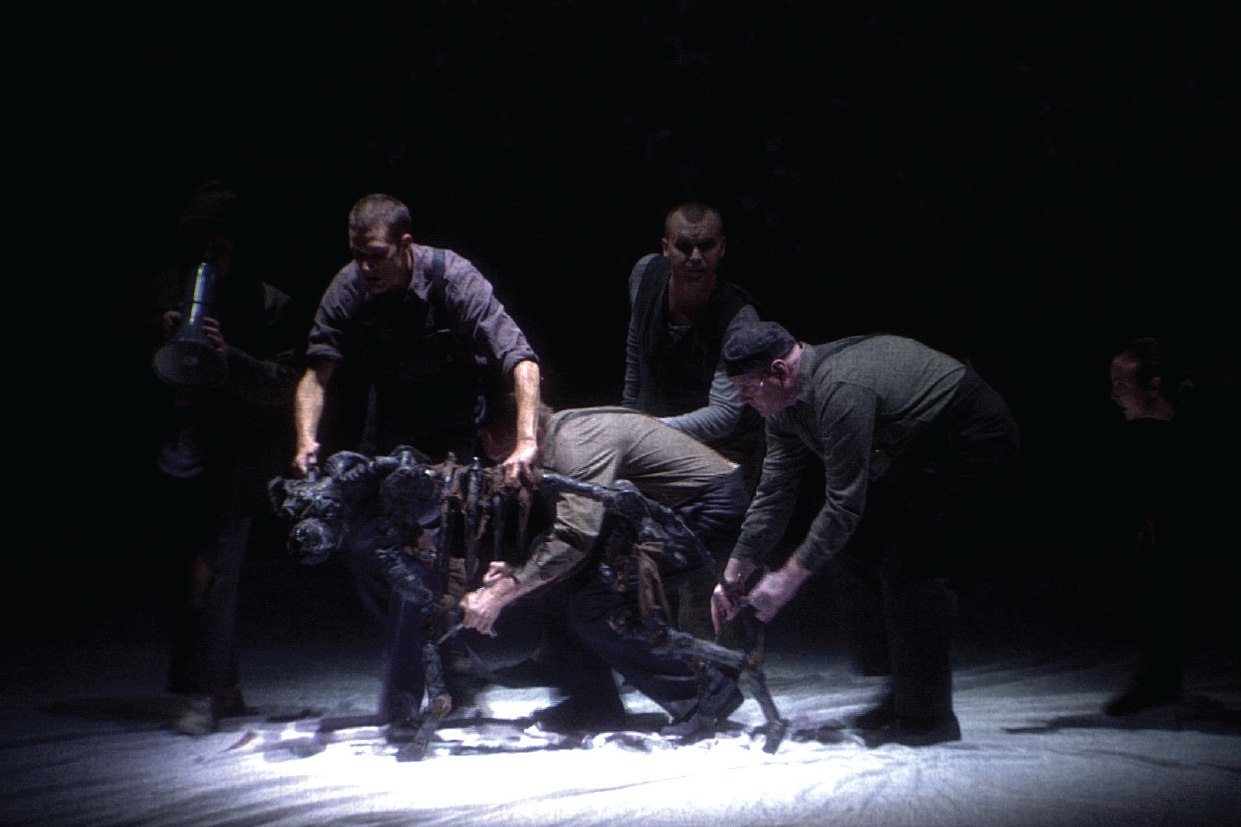
Fig. 4 – Alexander Raskatov’s Dog’s Heart, opening scene, video still, Nationale Opera&Ballet, Amsterdam.
The opening scene left a profound impression on me, becoming one of the most vivid moments I’ve ever witnessed in opera. The “skeleton marionette” of the dog is placed under the spotlight on stage. Initially lying alone, illuminated yet lifeless, in silence, it gradually comes to life as a puppeteer approaches and stands it upright. As the music emerges from the orchestra pit, the puppet seems to awaken: its eyes and nose gleam in a realistic way as it starts to respond to the music. The sequence of musical events unfolds rapidly, filled with staccatos, and the dog appears to listen with intention, exhibiting typical head movements as it adjusts the angle of its head to hear better.
After approximately two minutes into the performance, three additional puppeteers and one singer, Elena Vassilieva, join the spotlight. They are all dressed in neutral dark colors, allowing them to blend with the stage darkness as they readily conceal themselves around the dog. Vassilieva wears a hat and carries a megaphone to deliver Sharik’s “unpleasant voice” (as Raskatov marks it in the score), filled with staccatos, glissandi, howling, growling, and occasional barking. The voices produced by Vassilieva do not resemble the common vocal sounds of dogs. They sound as if she imagines being a dog, a dog as a machine that transforms the human voice.
The last performer to join this “collectively-performed” dog is a countertenor, representing its “pleasant voice.” [30] He enters the spotlight as the dog begins to move around, holding one of the puppeteers by her hand and mirroring her movements. He sings in a conventional operatic style, reminiscent of early music, with an exceptionally high voice. As they all move around, centered on the dog and its movements, the magic of becoming unfolds. Despite the live presence of six human performers on stage, choreographed and moving on and off the spotlight, I found myself completely absorbed by the dog puppet, eagerly anticipating its actions, sounds, and vocalizations. “We are the dog!” one of the puppeteers states in an interview. [31] The puppeteers fade into the background, and my attention is solely focused on the dog, as if it is real, sort of alive.
Raskatov’s portrayal of the dog encompasses both speaking and singing, growling and barking, with two distinct voices. The pleasant and unpleasant voices engage in dialogue for the most part, but there are occasions when they sing together simultaneously. It recalls how Kafka described the voice of Gregor Samsa, where the unpleasant voice would spoil the meanings of the words, while the pleasant voice would strive to keep them clear. Towards the end of the opera, when the dog Sharik transforms into the human Sharikov, he acquires a third voice, a basso buffo.
Austin McQuinn discusses the process of Gregor becoming an animal by quoting part of Kafka’s story that suggests how animal voice can be imagined, a process similar to the one Raskatov uses when giving a voice to Sharik:
Once Gregor loses his speech, he becomes less interested in everything else to do with the human world and begins to explore the possibilities of his new insect body by walking on the ceiling. In order to complete the zoomorphosis, Gregor must willingly sacrifice his sense of human consciousness and human language. [32]
It looks as if Raskatov is led by pure experimental impulses in finding a voice that can go beyond itself when creating the operatic character of the dog. I asked him why it was necessary for a dog to be portrayed by two voices. Here is his response:
One is a pleasant voice, a countertenor. The other is a dramatic soprano using a sort of megaphone, as you may recall. She sings through the megaphone with a style that in Italian is called rauco—a very rough sound—performing very high vorschlags (grace notes). It’s an incredibly difficult role to perform. In my first version, she also had to play the timpani. Many years ago, I wrote a piece called Ritual based on a text by the futurist poet Velimir Khlebnikov, in which the soprano—Elena Vassilieva—had to sing into a megaphone while simultaneously playing the timpani.
If you place the megaphone very close to the timpani, it creates a kind of Tibetan sound—but sung by a woman. Unfortunately, the stage director wasn’t keen on including timpani on stage because the effect was too strong. So, we decided—or rather, he decided—not to use the timpani and just kept the megaphone. This still produced an absolutely strange, ethno-techno sound, which everyone who attended the performance remembers. The third voice is actually Sharikov, representing the dog’s transformation into a man. So, basically the dog is performed by three singers. [33]
The division Raskatov establishes (between two performers), highlighting the “pleasant” and “unpleasant” spheres, is intriguing. While this could have been achieved with a single performer portraying both realms, Raskatov opted for two very distinct voices—a countertenor and a growling dramatic soprano with a megaphone. This choice implies the necessity to demonstrate that animals cannot be represented in opera in the same way as humans. “The unpleasant voice could be thought of as the voice that people hear from the outside (grrrrrh) and the pleasant voice could be thought of as its human side.” [34] The animal evokes the emergence of at least two singing identities, perhaps reflecting the contrast between the tamed and the untamed.
The pleasant and unpleasant voices engage in dialogue, jointly narrating the story and seamlessly passing the narrative line back and forth. This dynamic is evident from the opening lines of the libretto: [35]
Act 1, scene 1
(first atmosphere: night, hunger, pain, snowstorm)
An unpleasant voice
U-u-u-u-hu-hu-hu-u!
U-u-ho-oow da-a-ark!
I’m dy-y-ing!
Sno-o-owsto-o-orm!
A pleasant voice
I am dying, look at me!
Oh, glance at me.
An unpleasant voice
Uuu, mo-o-oans, ho-o-owls!
A pleasant voice
The snowstorm is moaning a requiem for me...
And I am howling with it.
An unpleasant voice
Uuu a-vi-i-ilain co-o-ook!
A pleasant voice
The cook – the villain in a dirty cap.
An unpleasant voice
U-uu wha-a-at an u-ugly no-o-se
A pleasant voice
What a fat mug!
An unpleasant voice
Uu, pro-o-ole-e-taw-bow-wow-ria-an!
A pleasant voice
A swine although a proletarian!
[36]
This brief excerpt from the libretto demonstrates the relationship between the two voices in the dog character. To convey the growls, howls, and other stylizations of dog sounds, the text of the unpleasant voice is fragmented into syllables, creating a stuttering effect that makes it difficult to understand, both when read or sung on stage. The dialogue implies the involvement of two distinct animal persona: one in distress—the unpleasant voice—appears to be shivering, perhaps even dying, under pressure and far beyond comfort, while the other—speaking in a normal tone—acts as a kind of singing narrator, discussing the same elements as the unpleasant voice (the snowstorm, cold, wind, and the cook who scalded the dog). However, this narrator does not exhibit the distress evident in the delivery of the unpleasant voice. Interestingly, without looking at the title screen, the text from either of these two voices cannot be understood, leading me to think that perhaps it is meant to be perceived solely on an auditory level, without comprehension of the words—as if the listener were an animal.
An integral part of being a dog is listening like a dog. In A Dog’s Heart , Raskatov prompts us to alter our mode of listening and our perception of the boundaries between man and animal through the portrayal of a dog. Earlier, I discussed the ontological desynchronization between the body and voice of Oxana Malaya. In interpreting the dog Sharik, this desynchronization becomes the central theme of the piece. The puppet dog’s movements are choreographed by four humans, while its voice is provided by two individuals—one imitating dog sounds through a megaphone, the other singing with a voice unheard in the animal world. Therefore, the entire “dog-machine” operates as a multi-layered desynchronized mechanism. It blurs the line between realism and bizarre, presenting perhaps the eeriest dog ever seen on stage. Similar to Giacometti’s sculpture, Raskatov’s dog grapples with the experience of being a dog—thinking, walking, sounding, and listening as one. It emerges as a sort of anatomical theater within theater, with its voice serving as the site where any strict definition fails. It becomes a mechanism of becoming, in a constant loop between the search for authenticity (the unpleasant voice) and the human as the measure of all things (the pleasant voice).
The differences inherent to the structure and content of the text are further emphasized in the music and musical interpretation of the dialogues. The unpleasant voice is consistently sung through a megaphone, while the pleasant voice is delivered without any amplification or alteration of its timbre and volume. This amplifies and reinforces the unpleasantness, positioning it prominently in the foreground, yet always keeping the pleasant voice as its counterpart. The composition and musical material of these two voices exhibit radical differences. The unpleasant voice is experimental in nature, characterized by excessive glissandi and delivered through the megaphone.
I found myself wondering why a megaphone was necessary. Did the composer have any political intentions or inspirations for its use? Despite my initial associations with the amplification of voices during rallies and protests, where it is used to enhance their power, Raskatov explains that the use of the megaphone is motivated by purely aesthetic reasons:
I didn’t have any political ideas. I was inspired by my own piece, Ritual , which I wrote ten or twelve years ago. But maybe you never really know what happens in a composer’s brain. Of course, by the end of the opera, I used sixteen megaphones—one for every soloist in the choir. They became like clones of Sharikov, and everyone had to sing a cappella through their megaphones.
Here, I did intend to depict a kind of crowd—a terrible, chaotic crowd. Not necessarily a revolutionary crowd, but a wild, uncontrollable one. I wanted to suggest what could happen to all of us if these Sharikovs kept multiplying. Step by step, the Earth would be overrun with Sharikovs. That’s what I wanted to convey. But my first impulse was purely artistic. I wanted to capture the idea of an angry, hungry dog at the very beginning of the opera. [37]
The second act, where the captivating dog turns into an unfit man, lacks the spectacle of the puppet singing dog, making it feel somewhat less dramatic. Bulgakov, Raskatov, and Kulik all pose the same question: are we deemed worthy as individuals only when we conform to the dictates of the ruling system? Or, akin to dogs, are we simply reliant on our masters? The answer, perhaps, lies in our ability to bark and observe. Questions arising from a similar perspective are notable in the second Raskatov’s opera, Animal Farm, where the unexpected manifestation of an unpleasant singing dog’s voice—just like in A Dog’s Heart—plays a fundamental role in understanding the human/animal divide.
“For Alexander Raskatov, the human voice, with its tonal mutability, is one of the most important means of expression,” asserts Raskatov’s publisher. [38] In his latest opera, Animal Farm (2023), with a libretto based on Orwell’s classic, the animals of the farm are depicted as they organize their society and attempt to transform the power structures that govern them.
One of the most striking visual elements of the production was the animal masks worn by the entire singing cast. These masks, though slightly exaggerated in size and style, were crafted from transparent materials, allowing the performers to move, breathe, and sing with ease. When asked why in his staging of the work characters gradually lose their animal-like appearance, Damiano Michieletto responded:
“Orwell’s book ends with a scene where the other animals peer into the farmhouse where the pigs have holed up, and they see that the pigs have started to look like the humans. In this production, the entire slaughterhouse has been transformed into a posh place and all the surviving characters on stage have become human. They enjoy themselves at a luxurious feast where animals are consumed. All their initial ideals have been forgotten.” [39]
In parallel with Michieletto’s staging, Raskatov was mostly interested in giving peculiar voices to both human and animal characters:
Together, the soloists of Animal Farm can be seen as a kind of vocal orchestra. Hardly any of the roles could be called supporting roles: each character has their own personality and development. I lay awake at night wondering how to find sufficient musical contrast between all those characters. Eventually I found a way. Before I started working on a part, I sat down in a chair and let the scene play in my imagination. That helped me find distinct characters. That’s how each character got their own texture and range, from extraordinarily high to extremely low.” [40]
Despite the various vocal effects to be found in various roles, the “catalogue of voices” is quite conventional in the operatic sense. [41] Watching the opera, with its grotesque scenes involving farm animals (most often pigs), I suddenly thought that I heard a voice of a dog as well: it was the same dog’s voice from A Dog’s Heart. [42] Indeed, it was dramatic soprano Elena Vassilieva, Raskatov’s spouse, who had already sang the “unpleasant voice” of the dog Sharik and was now present on stage in the role of Blacky. Dressed entirely in black formal attire, with short hair, she resembled a secret agent. Her gender appeared deliberately obscured by her costume, which featured a black coat, sunglasses, and trousers.
In the approximately seven-minute opening scene of the first act, Blacky sneaks onto the stage, moving between the cages where the other animals are kept. During the exposition of the horse, Blacky enters with the provocative question “Why is this?” Delivered in a bold, forte manner, the line is marked in the score as rauco (hoarse), a vocal quality reminiscent of the “unpleasant” dog voice from A Dog’s Heart. In response to Blacky’s question, the existing power structure is implicitly challenged and accused: “Because the produce of labour is stolen from us (…) summed in a word – man (…) Man is the only enemy we have.” All the animals take part in a vocal discussion of how unjust it is that man does not work for the produce but owns it.
As the animals discuss their situation, Blacky silently observes from the back of the stage, positioned behind the cages. The animals deliberate on how they will achieve wealth and freedom without humans. Meanwhile, at the front of the stage, a meat-grinding machine is illuminated, expelling minced meat. Nearby, a pig begins to sing, proclaiming a single, powerful message: “ Revolution!”
Suddenly, Blacky emerges at the front of the stage, embodying the unsettling energy of Sharik’s unpleasant dog voice. Moving with vigor, she shouts “ Revolution!” repeatedly in a rauco and forte tone. Then, shifting dramatically, she sings the word “ Revolution!” in the bright, agile voice of a traditional dramatic soprano coloratura. The choir of animals joins in, echoing the same word in unison.
“All animals are comrades! All men are enemies! We must not come to resemble them!” declares the pig in a commanding baritone. Soon after, the choir sings a cappella: “All animals are equal!” (repeated), their voices filled with hope for a golden future. Throughout this time, Blacky remains at the front-right corner of the stage. When the lights fade, she exits, and the scene transitions.
Vassilieva’s stage presence was striking, as she seemed to regulate the crowd on stage in a policing manner. During the performance, I wasn’t closely following the libretto, yet I was under the impression she was playing the role of a dog. My perception of both her canine-like stage presence and vocal expression was inherited from A Dog’s Heart. And that “inheritance” was no coincidence. Although there was no dog puppet on stage and her costume was different, the dynamics of her singing—balancing pleasant and unpleasant voice—closely resembled the vocal expression she had previously delivered as the dog Sharik. However, upon reviewing the roles of the animals in Orwell’s Animal Farm, I realized that the only character that could correspond to Blacky is Moses, the raven. Representing the Russian Orthodox Church, Moses speaks in metaphors to convey ideas about religion—for example, when presenting the utopian image of Sugarcandy Mountain.
There was a clear nod to the pleasant and unpleasant dog voices in Dog’s Heart . However, unlike that earlier work, this performance involved no ventriloquism with puppets and puppeteers, nor the use of a megaphone to further amplify and distort the voice. Instead, the contrast between the harsh, unpleasant voice of the dog and the more melodious voice of the raven clashed within a single body—Elena Vassilieva’s. Despite this vocal duality, her character, cloaked entirely in black, did not visually evoke the figure of either a dog or a raven. She didn’t wear a mask. Every aspect of her role was embodied in her voice alone.
***
In an anthropocentric world, with its artistic and cultural representational mechanisms, the reinvention of animals as humans is often perceived as a “natural” progression. In performing arts, for instance, where a ventriloquist dynamic arises—what we see (an anthropomorphic representation of an animal) versus what we hear (a human voice)—this humanized-animal construct becomes a widely accepted convention, a “make-believe” easily grasped even by young children, who quickly understand it as a social norm.
The reverse movement: the animalization of humans involves humans who begin to act, behave, and sound like animals—as Others, monsters, or, like in the cases discussed in this text, dogs. Unlike the humanized-animal construct, which aligns comfortably with cultural conventions, the animalized human —in which humanity is stripped away and projected into a “monstrous zone”—creates tension and provokes a sense of discomfort. This dehumanization unsettles our perceptions and introduces a friction that challenges established norms.
From the case of a feral child raised by dogs to performance-art pieces by Oleg Kulik and the dog/animal vocal figures in Alexander Raskatov’s operas, the presence of the dog is made audible in the voice, while the division between dog and human is performed and continuously reinvented. Artists and composers enact, re-enact, and perpetuate the artificiality and unsettling nature of this divide. The voice and movements of Oxana Malaya are obscure, Kulik’s dog double is unsettling, Raskatov’s Sharik is grotesque, and his Blacky is eerie and fun at the same time. Artists intuitively highlight the constructed nature of this divide in striking ways, often without consciously developing a theoretical framework for it—much like Raskatov, who described his process of inventing pleasant and unpleasant dog voices in A Dog’s Heart as intuitive rather than conceptual.
This grotesque interplay of pleasant and unpleasant vocal divisions, crafted by Raskatov and performed on the opera stage, perhaps offers the most vivid exploration of the human–animal divide in the singing voice. This divide is a construction—shaped by intentions, norms, and ideology—yet it is largely taken for granted. When Oxana Malaya uses her body and voice to perfectly imitate her canine parents, the sight is disturbing to the human eye/ear. This disturbance is consumed but rarely explained or contextualized. Kulik, like a wild dog, channels aggression, unpredictability, and fear—emotions the audience intuitively perceives as “wrong” when a human acts and vocalizes like a dog. Raskatov, in turn, makes a grotesque spectacle of the entire human–animal vocal game. He achieves this in a striking way: by creating a meta-voice—a voice about the voice—one that fragments into multiple characters, oscillating between the pleasant and the unpleasant. These voices expose the artificial and fluid boundaries between human and animal, revealing a continuous process of vocal becoming for both.
APPENDIX
Civilization Started with Voices:
A Conversation with Alexander
Raskatov
*
Jelena Novak: One scene particularly stood out to me in A Dog’s Heart (2010): the portrayal of the dog Sharik with four puppeteers and two singers. It was one of the most memorable scenes I’ve ever witnessed in any opera. Despite the presence of six performers on stage, I found myself completely absorbed by the dog, anticipating its actions, sounds, and vocalizations. It was as if the puppeteers faded into the background, and my attention was solely focused on the dog as though it were real. Perhaps this can lead us to discuss the concept of realism in opera, which I believe holds significance not only in your new work Animal Farm (2023) but also in A Dog’s Heart. Realism, both in a general sense and within the context of socialist realism, plays an important role. I wonder, what are your thoughts on realism in opera? Do you find it challenging? Do you believe it’s achievable?
Alexander Raskatov: Before answering your question—Elena (gesturing to Elena Vassilieva, soprano and the composer’s partner, who was present during the interview) sang the role of the dog. She performed the dog with an “unpleasant voice,” as if it was hungry. It immediately came to me that I should write the dog’s part using two voices. So that was the beginning of my thinking about this opera—that the dog needed to be represented with two totally different voices.
I don’t know if it’s socialist realism, maybe. I would call it a kind of paradox, which I think opera needs. Bulgakov was never a socialist realist. He wrote Heart of a Dog in 1925, and, as you know, it was strictly forbidden in the USSR. So, it’s already something far removed from socialist realism. Maybe it’s a kind of post-socialist realism; I’m not sure. I’ve never tried to classify this opera. My librettist, Cesare Mazzonis, called it a dramma giocoso. Maybe he was right.
JN: Why did you use two voices for the dog?
AR: One is a pleasant voice, a countertenor. The other is a dramatic soprano using a sort of megaphone, as you may recall. She sings through the megaphone with a style that in Italian is called rauco —a very rough sound—performing very high vorschlags (grace notes). It’s an incredibly difficult role to perform. In my first version, she also had to play the timpani. Many years ago, I wrote a piece called Ritual based on a text by the futurist poet Velimir Khlebnikov, in which the soprano—Elena Vassilieva—had to sing into a megaphone while simultaneously playing the timpani.
If you place the megaphone very close to the timpani, it creates a kind of Tibetan sound—but sung by a woman. Unfortunately, the stage director wasn’t keen on including timpani on stage because the effect was too strong. So, we decided—or rather, he decided—not to use the timpani and just kept the megaphone. This still produced an absolutely strange, ethno-techno sound, which everyone who attended the performance remembers. The third voice is actually Sharikov, representing the dog’s transformation into a man. So, basically the dog is performed by three singers.
JN: As a person, it’s a basso buffo.
AR: Yes, exactly.
JN: How did you get the idea to use the megaphone? Was it inspired by political demonstrations?
AR: No, no, I didn’t have any political ideas. I was inspired by my own piece, Ritual, which I wrote ten or twelve years ago. But maybe you never really know what happens in a composer’s brain. Of course, by the end of the opera, I used sixteen megaphones—one for every soloist in the choir. They became like clones of Sharikov, and everyone had to sing a cappella through their megaphones.
Here, I did intend to depict a kind of crowd—a terrible, chaotic crowd. Not necessarily a revolutionary crowd, but a wild, uncontrollable one. I wanted to suggest what could happen to all of us if these Sharikovs kept multiplying. Step by step, the Earth would be overrun with Sharikovs. That’s what I wanted to convey. But my first impulse was purely artistic. I wanted to capture the idea of an angry, hungry dog at the very beginning of the opera.
JN: This is very interesting because it raises the question: where is the boundary between man and animal? It’s an intriguing question. For example, if you think about the very definition of “voice,” it’s typically assigned to humans. But when you hear a bird sing, or a whale sing, it challenges that notion. Scientists usually don’t say that a whale has a “voice,” but they acknowledge that it can sing. It’s a kind of paradox.
AR: Yes, that’s right.
JN: I think you explore that paradox—perhaps unconsciously—but you make the question very relevant: Who can have a voice?
AR: Actually, I think the voice existed long before words. Civilization, I suppose, started with voices. Voices were present on this planet before words ever came into being. Words came much later.
At first, there were just sounds. When voices emerged, humanity began. And not just humanity—the animal world, too. Voice was the beginning of expression, though perhaps without meaning in the way we understand it now. Of course, voice is still incredibly important in nature. People, I suppose, once lived in caves, hunted mammoths, and used their voices in different ways to communicate. But we are far removed from that time.
Still, I remember, years ago, before I wrote Ritual, I bought a set of CDs called Le Voyage (in French). It contained recordings of music and vocal expressions from many different parts of the world. It was absolutely fascinating—extraordinary singing and playing of instruments, often combined. I was amazed to discover that hundreds, or even thousands, of years ago, people were already using such fantastic techniques, techniques that professional composers today are trying to rediscover. And they did it back then—for free, so to speak.
JN: Are you familiar with the work of Oleg Kulik? He created performances where he behaved as a dog. He comes from the world of visual arts and wanted, as I understand, to portray how difficult the life of an artist is. During his exhibitions or performances in galleries, he would appear naked and behave like a dog. He would even bite people. This figure of the dog is fascinating. Sharik is a stray dog, and the metaphor of stray dogs is especially present in Eastern Europe, particularly among Slavic nations. I think it’s always there, somewhere, this metaphor. Here in Holland, for example, you won’t find stray dogs—they simply don’t exist because dogs are sterilized.
AR: Maybe we’re all stray dogs. I don’t know. Living in Russia, especially now, there are so many people without homes, living in poverty. It’s very sad. When Bulgakov wrote this novel, you can imagine how many stray dogs, or even stray people—children without parents—were living on the streets just after the revolution. It was a horrible time. Maybe it was even more difficult for Bulgakov to describe what he saw in the streets of Moscow during that period. Who knows?
JN: What are your thoughts on political art? How do you feel about expressing political ideas through music?
AR: I have nothing against it. The most important thing is that political art today should work for the good of all humanity. There are ways to capture political realities—documentary cinema, for instance, can address what’s happening here, there, or elsewhere. But for more universal concerns, I believe music rises above specific events. Even though we live in times when we’re inspired—or affected—by what is happening around us, music must transcend the moment. Unfortunately, war is the most terrible thing, but wars have existed throughout history, in every era. There’s always been a war somewhere, and sadly, this seems to continue.
For me, art, including music, must preserve humanity and foster love for humankind. That is the most important thing, even in satirical works or politically charged pieces, like A Dog’s Heart. The aim should not be to provoke anger in the audience, but rather to inspire a sense of humanity. I think we’ve lost some of that. Music—especially experimental music—has, in some ways, moved away from this idea. But music, like literature, is responsible for portraying certain truths about life.
As for theater, there are, of course, works that rely on pure provocation or spectacle (épatage). You see this kind of superficial treatment of political themes. It’s not for me. I think we, as artists, must be professionally honest. It’s far too easy to create works that simply shock or speculate on political topics. That’s not genuine or professional art. We have to be honest with our craft and, most importantly, more human. This is more important than pointing fingers at a particular country today, another tomorrow. Take the wars in Yugoslavia—it was horrible. What’s happening now between Russia and Ukraine is absolutely insane. But that’s a separate conversation. We’ve all gone through suffering in various ways, and for many reasons, we don’t always talk about it. Still, I believe we need a truly humanistic attitude toward one another. That, at least, is my goal.
JN: When we talk about opera, I noticed on your list of works that you’ve written at least one more opera besides Animal Farm and A Dog’s Heart. So, you seem to have a strong interest in opera.
AR: I actually wrote two operas after A Dog’s Heart and before Animal Farm. One of them is GerMANIA (2018), commissioned by the Opéra de Lyon. It’s based on Heiner Müller’s play Germania , which was very difficult for me to work on. It’s also a kind of political satire about World War II, Stalin, Hitler, and so on. I think writing it took a toll on my health because there were some extremely challenging moments in the play, and then in the opera itself.
Around the same time, or maybe slightly later, I wrote another opera for the Mariinsky Theatre called Eclipse (2018). It was a commission from the Mariinsky Theatre and Valery Gergiev. It was performed four times in concert versions, including at the Montreux Festival in Switzerland, and there were plans to stage it. However, all of this was disrupted by the horrible events that followed, and the staging never materialized.
Now, I think that because Eclipse was written specifically for Russia and for the Mariinsky Theatre, it can’t really be performed anywhere else.
JN: You mean legally?
AR: Not legally—conceptually and musically. It was written for the Mariinsky, and my position is that it should either be performed there or not at all.
JN: When you think about the history of opera, what are some of the pillars of the genre that are particularly dear to you and that you perhaps have in mind when you compose?
AR: Opera has given us so many extraordinary examples. In different periods of my life, I’ve had different preferences. But, of course, the greatest example—the one we can only admire from afar without any hope of truly approaching—is Mozart’s Le nozze di Figaro. It’s the kind of ideal opera that, I believe, died with Mozart. After that, if I were to single out another exceptional case, it would have to be Verdi’s Falstaff, which is my favorite opera. It’s pure joy—like champagne. It’s not weighed down by heavy ideology, like Wagner’s monumental works. Instead, it offers a completely different perspective on the opera genre. Falstaff is brilliant, sparkling, and spectacular.
As a Russian composer, I’ve also always drawn from the Russian operatic tradition. For me, Mussorgsky and Shostakovich stand at the pinnacle, alongside Tchaikovsky, of course. Operas like Lady Macbeth of Mtsensk by Shostakovich are part of my musical DNA. But Mussorgsky is particularly significant for me.
JN: In both A Dog’s Heart and Animal Farm , you have animals singing. I read that, for Animal Farm, you put considerable thought into inventing distinct vocal styles for each group of animals. Can you elaborate a bit more about that?
AR: Yes, of course. Before starting, you need to be well-prepared. While working on the libretto, I realized that there were so many animals involved that it would be easy for them to blur together, especially with masks or costumes. So, I decided that each type of animal had to have its own distinct world, its own unique vocal effects. A common element across all the characters is their extensive vocal range. I felt that, in the 20th century, the orchestra had made much more progress in terms of its capabilities than the voice, which seemed to lag behind. I thought it was time to develop the voice in new directions, much like what had been done with the orchestra.
For each animal, I created specific vocal effects and techniques. I also established a kind of system. For example, Old Major—the Marx-like figure in the opera—is represented by a basso profondo with an extremely low range. Then there’s Napoleon, who is a simple bass, and Snowball, a tenor with substantial low notes. Squealer, on the other hand, has an extremely high, almost hysterical voice. Together, these voices form a sort of “pyramid of power” among the pigs. On the other end of the spectrum, there’s Mollie, the frivolous horse, who is an extremely high coloratura soprano. Her range goes up to an A-flat in the third octave, which is about a third higher than the highest notes written for Cunégonde in Candide. If you combine Mollie’s voice with Old Major’s lowest C, you span almost the entire keyboard, covering nearly all the octaves. This vast range was intentional. I wanted each character to have their own unique musical “corner,” with specific vocal techniques and effects that reflect their personality and role in the story.
JN: These are all trained voices in the tradition of lyrical and dramatic opera singing. No use of jazz idioms or folk singing styles?
AR: There is a scene between Pilkington and Mollie that has an old-fashioned, jazzy foxtrot feel. There’s also a parody of cabaret-style singing in one place for certain dramatic effects. But in general, the approach is very open—it ranges from speech, like in Singspiel, where there’s a mix of spoken dialogue and singing, to full arias. In some instances, speech is integrated directly into the scene because there’s no strict division between aria and recitative. For example, Napoleon might sing a cantilena in one moment but speak in another—it depends. For me, drama is the most important element of opera. It’s not a static genre. That’s why I use both techniques—speech and singing—freely, adapting them to the dramatic needs of the scene. Sometimes they even blend into cantabile passages.
JN: Do the voices you use for each character have gender-specific qualities?
AR: Yes, but not always in the traditional sense. Each animal has its own distinct vocal identity. For example, there’s a high coloratura soprano and a dramatic soprano. The soprano in A Dog’s Heart had a complex technique that blended elements of classical singing with influences from folk music. That role required a great deal of vocal agility and nuance.
When I was younger, I traveled across Russia with a group of Conservatory students to collect and record folk songs. That experience gave me a deep understanding of vocal traditions and their emotional power. It was very influential for me, and I sometimes draw on those techniques in my work. For instance, in Animal Farm, I included a contralto and even a travesti—a male singer performing a female role. So, the vocal assignments are quite varied.
JN: Does a soprano always have to be a woman?
AR: Not necessarily. In Animal Farm, there’s one case where a man sings a soprano part for a woman.
JN: How do you think about the role of the choir in opera? Does it represent the opinion of the people? And what about the choirs in Animal Farm?
AR: There are two choirs in Animal Farm: a children’s choir and a mixed adult choir. Their function is to react to the events unfolding in the story.
JN: Does the children’s choir bring a sense of naivety?
AR: Yes, exactly—freshness and naivety. It reflects the smaller animals, like ducks and hens, rather than the larger animals like horses. That’s why I decided to use a children’s choir for those parts.
JN: Do you use direct quotations in your music, like in A Dog’s Heart, where there were references to mass songs?
AR: I don’t specifically remember quotations in A Dog’s Heart , but there is one quotation from a revolutionary song in Animal Farm . However, I use it in a very paradoxical, satirical way—not as a straightforward revolutionary anthem. It’s just one quotation. There’s also a second quotation, a subtle nod to “Casta diva.”
JN: Can you tell me which revolutionary song it is?
AR: Yes, of course. It’s “Smelo, tovarishchi, v nogu!” (Comrades, let’s bravely march!)
JN: Regarding the traditional operatic repertoire, I’ve always been a bit puzzled by conventional stagings. For instance, when a singer, heavily made up and wearing a wig, stands almost immobile on stage and then produces this huge voice—it always felt disproportionate to me. No one ever really explained why it has to be that way. Of course, it’s part of operatic aesthetics. But later, I started discovering more and more operas that didn’t follow this tradition. How do you view the relationship between the body and the voice on the opera stage?
AR: Sometimes that’s true. For example, when a 60-year-old woman sings Juliet, it can look a bit strange. I remember at the Bolshoi Theatre in Moscow, there was a Tatiana in Eugene Onegin who also didn’t fit the conventional image. Visually, it might not align with expectations. But vocally? Sometimes it can still be magical.
In contemporary music, I think the physicality of the performer—how they look and move—has become much more important. Sometimes, it’s deliberately paradoxical. For instance, in Animal Farm, there’s a scene where an enormous man plays the role of Benjamin the donkey but sings with an incredibly high voice. When he’s dressed in a giant red robe, it looks absolutely absurd, but that’s the goal. It’s meant to create irony and paradox.
We’re living in the age of the stage director now. Directors often reinterpret classical works in completely new ways. Take Aida, for instance—it’s been staged hundreds of times in the past. How do you make it fresh? The level of past performances is so high, and we may no longer have the same kinds of voices as before. So, directors often reinvent the story visually and conceptually. Sometimes it works beautifully; sometimes it doesn’t. But that’s the trend—people want to see new interpretations of old works. That said, I believe we need more contemporary operas that can become part of the repertoire. That’s the real challenge. If we had new works alongside the Mozarts, Verdis, and Wagners, stage directors wouldn’t need to constantly come up with new tricks for old operas.
JN: A director friend of mine in Belgrade once said, “When you close your eyes, it’s all the same.”
AR: True, but many people come to see, not just to listen. That’s why we now use terms like “show” for an opera production. Opera isn’t just about sound anymore; it’s also a visual spectacle. Personally, I still prefer listening to a CD over watching a DVD, but the visual aspect has undeniably become more important.
JN: The staging of A Dog’s Heart was very closely tied to Simon McBurney’s ideas. Can you imagine this opera being staged by another director?
AR: Of course, I can. A Dog’s Heart isn’t entirely dependent on McBurney’s staging. The music exists independently of him, though there are elements in the staging that he specifically requested me to add—things I didn’t initially find necessary. These were more for his vision than mine. So, yes, it could be staged by someone else, though certain adjustments might be needed.
JN: How involved were you in the staging process?
AR: It was very different with Damiano Michieletto, who worked on Animal Farm. He’s a pure opera stage director, and for me, the atmosphere of the collaboration was much more pleasant. With McBurney, while I respect his incredible skill, the process was often stressful—unnecessarily so. McBurney discovered and changed things constantly, which made the process challenging for everyone involved. In the end, he achieved some remarkable results, but it wasn’t easy.
Michieletto, on the other hand, knew what he wanted from the very beginning. The process with him was lighter and more respectful of the music, which is extremely important to me. It’s hard to compare the two—they’re like a right hand and a left foot, completely different. But the collaboration with Michieletto felt more cohesive.
JN: Were you involved in the libretto-writing process for Animal Farm?
AR: Yes. The librettist, Ian Burton, gave me an initial version, but we only met twice because of COVID. His first draft was completely unusable for me. It was far too long, with extended phrases and a structure more suited to an oratorio than an opera. For example, the anthem “Beasts of England,” based on Orwell’s text, was repeated nine times—completely impractical for the stage. There was also a lack of direct speech, with too much reliance on descriptions like “he runs” or “she comes.” I asked for changes, and while Burton adjusted some parts, I realized I didn’t have enough time to keep requesting edits. I asked for his permission to adapt the libretto myself, and he agreed. Ultimately, I rewrote sections to fit my goals and even wrote two scenes myself, despite English not being my native language. So, I consider myself a co-librettist for this opera.
JN: I sometimes work as a dramaturg in opera, and I often see librettists—especially those inexperienced with opera—come in with huge, unwieldy texts.
AR: Burton is experienced, but even so, there were many elements I wasn’t happy with. That said, he was very accommodating and gave me carte blanche to make changes. I haven’t seen him since.
JN: Was it the idea of the director of Dutch National Opera to stage Animal Farm?
AR: Yes, it came from Sophie de Lint. She shared this idea with Michieletto, who had long dreamed of staging Animal Farm. Together, they approached me.
JN: And for A Dog’s Heart? Was it Pierre Audi’s idea?
AR: No, that one was my idea. Pierre Audi gave me carte blanche to choose the subject, and I chose A Dog’s Heart.
JN: Do you have plans for another opera?
AR: I do, but only in my head for now—it’s not written yet.
[1] I saw this VR opera on February 9, 2024 at De Nationale Opera & Ballet, Amsterdam. Its authors are: Celine Daemen, stage direction; Aron Fels, VR art direction; Asa Horvitz, composition music & sound; Olivier Herter, libretto; Wouter Snoei, sound & mix. Cast: Nadia Amin, Vincent van den Berg, Hans Croiset, Sterre Konijn, Misja Nolet, Carl Refos, Michaela Riener, Eleonora Schrickx, Georgi Sztojanov, Garbo, Micha, Raffie, Rey. It is produced by Silbersee.
[2] Protocols of seeing and participating in Michel van der Aa’s VR opera “Eight” are described in Jelena Novak, “Eight, aus Licht, and The Unbearable Lightness of Being Immersed in Opera,” The Opera Quarterly 35, no. 4 (Autumn 2019): 358–371.
[3] A quote from the piece’s presentation text on the Dutch National Opera and Ballet website, accessed January 15, 2025.
[5] Words by Asa Horvitz, composer and member of the authors team. See: program note for Songs for a Passerby, DNO, 2023.
[6] Bojana Kunst, “Restaging the Monstrous,” in: Anatomy Live: Performance and the Operating Theatre , ed. Maaike Bleeker, 211–22 (Amsterdam, Amsterdam University Press, 2008), 215.
[7] Giorgio Agamben, The Open: Man and Animal, translated by Kevin Attell (Stanford: Stanford University Press, 2003), 26.
[8] Franz Kafka, The Metamorphosis and Other Stories, Translated by Joyce Crick (Oxford: Oxford University Press, 2009), 31.
[9] See more about monstrous voice in Jelena Novak, “Monsterization of Singing: Politics of Vocal Existence,” New Sound 36, no. 2 (2010): 101–19.
[10] Naama Harel explores the human-animal barrier in Kafka’s work in inspiring ways. However, the book lacks insights surrounding voice and vocality in the context of posthumanism. Naama Harel, Kafka’s Zoopoetics: Beyond the Human-Animal Barrier (Ann Arbor: University of Michigan Press, 2020).
[11] For the same example of monstrous/animal voice in Kafka’s Metamorphosis , see Jelena Novak “Posthuman Voice Beyond Opera: Songful Practice of Holograms, Robots, Machines, and Vocaloids” in Contemporary Opera in Flux ed. Yayoi U. Everett (Ann Arbor, University of Michigan Press, 2024) 45–66.
[12] Gilles Deleuze and Félix Guattari explain this concept in the chapter “Becoming-Intense, Becoming-Animal, Becoming-Imperceptible,” in A Thousand Plateaus: Capitalism and Schizophrenia , trans. Brian Massumi (Minneapolis: University of Minnesota Press, 1987), 232–309. They understand this concept as a process of transformation, of creating relational, fluid identities. They introduce “ becoming-animal” as a way to rethink identity beyond human-centered categories. I learned of the Deleuzian concept of “becoming” via Austin McQuinn’s Becoming Audible: Sounding Animality in Performance (University Park: Penn State University Press, 2021).
[13] Rosi Braidotti, The Posthuman (Cambridge, UK: Polity Press, 2013), 67–76.
[14] Oxana Timofeeva, The History of Animals: A Philosophy (London: Bloomsbury, 2018).
[15] In Latin “Ferus” means wild, untamed, fierce.
[16] See: “Ukranian Girl Raised by Dogs,” accessed March 25, 2024.
[17] “Ukrainian Girl Raised by Dogs,” 2:03.
[18] Timothy Morton, Humankind: Solidarity With Nonhuman People (London: Verso, 2017).
[19] “Ukranian Girl Raised by Dogs.”
[20] Braidotti, The Posthuman, 67.
[21] Heiner Goebbels, “Aesthetics of Absence,” in (How) Opera Works , ed. Pierre Audi (Amsterdam, Amsterdam University Press, 2018), 154–162.
[22] For more about voice-body as a mirror mechanism see Jelena Novak, Postopera: Reinventing the Voice-Body, London, Routledge, 2015.
[23] See video “Mad Dog, or Last Taboo Guarded by Alone Cerberus,” Moscow, November 23, 1994, accessed April 15, 2024.
[24] See: Reservoir Dog, Kunsthaus, Zurich. March 30, 1995, accessed April 15, 2024.
[25] See video: I Bite America and America Bites Me by Oleg Kulik (1997), accessed April 15, 2024.
[26] Braidotti, The Posthuman, 70.
[27] Timofeeva, The History of Animals, 165.
[28] See, for example, “Interview with Oleg Kulik at the Saatchi gallery, Art Riot,” accessed March 22, 2024.
[29] Timofeeva, 165.
[30] In De Nederlands Opera and Ballet production the dog’s pleasant voice was performed by countertenor Andrew Watts.
[31] Statement by Mark Down in Raskatov’s A Dog’s Heart by Dutch National Opera , accessed November 4, 2024.
[32] Austin McQuinn, Becoming Audible, 130.
[33] Alexander Raskatov, interview with the author (Amsterdam, 2023). See appendix.
[34] Statement by Simon McBurney in Raskatov’s A Dog’s Heart by Dutch National Opera .
[35] Opera is sung in Russian language, as it is in the score, and the libretto that I consult is in the original Russian, and in parallel translated to English language.
[36] From an unpublished libretto of “Dog’s Heart” by Cesare Mazzonis, translation into English by Boris Ignatov. Courtesy of De Nationale Opera&Ballet, Amsterdam.
[37] Mazzonis, “Dog’s Heart.”
[38] “Alexander Raskatov,” Boosey & Hawkes, accessed February 1, 2025.
[39] Damiano Michieletto quoted from the Animal Farm Program booklet, Amsterdam, DNO, 2023, 77.
[40] Alexander Raskatov quoted from the Animal Farm Program booklet, Amsterdam, DNO, 2023, 65.
[41] As is written in the score in French, “rôles et tessitures” are as follows: Mollie, soprano colorature aigu; Young Actress (Pigetta), soprano lyrique léger; Blacky, soprano dramatique colorature; Muriel, mezzo-soprano colorature; Mrs. Jones, mezzo-soprano; Clover, contralto; Minimus, contre-ténor; Squealer, ténor aigu; Snowball, ténor (cantor); Benjamin, ténor bouffe (haute-contre); Mr. Jones, ténor; Boxer, baryton martin; Pilkington, baryton; Napoleon, basse; Old Major, basse profonde; Men from the van, Men of Jones, Men of Pilkington, Animals choir (Hens, Ducks, Goats, Cows, Sheep, Pigs), choeur d’enfants et choir mixte.
[42] The cast of Animal Farm: Mollie, Holly Flack; Young Actress (Pigetta), Karl Laquit; Blacky, Elena Vassilieva; Muriel, Maya Gour; Mrs. Jones, Francis van Broekhuizen; Clover, Helena Rasker; Minimus, Artem Krutko; Squealer, James Kryshak; Snowball, Michael Gniffke; Benjamin, Karl Laquit; Mr. Jones, Marcel Beekman; Boxer, Germán Olvera; Napoleon, Misha Kiria; Old Major, Gennady Bezzubenkov; Mr. Pilkington, Frederik Bergman; Two men of Mr. Jones, Alexander de Jong, Joris van Baar; Two men of Mr. Pilkington, Mark Kurmanbayev, Michiel Nonhebel; Two men from the veterinary car, Alexander de Jong, Mark Kurmanbayev.
* The conversation with Alexander Raskatov took place in Amsterdam on 13th of March 2023, before Jelena Novak saw the performance of the opera Animal Farm.