
REVIEW-ESSAY
Performing Eno: Generative Music as a Biopic
Review-essay of the generative documentary Eno, directed by Gary Hustwit. Brendan Dawes (director of programming), Mary Farbrother (director of photography). Generative software by Anamorph. Screened at Sheffield DocFest on Sunday, June 16, 2024.
Sound Stage Screen, Vol. 4, Issue 1 (Spring 2024), pp. 121–132, ISSN 2784-8949. This work is licensed under a Creative Commons Attribution-ShareAlike 4.0 International License. © 2025 Niccolò Galliano. DOI: https://doi.org/10.54103/sss28377.
It can be quite hard to summarize Brian Eno’s artistic arc, even for experienced connoisseurs of his recording catalog. Eno is a composer, a music producer, a singer/songwriter, and the alleged inventor of ambient music—or, at least, the term’s coiner. He has been an essential collaborator of groundbreaking pop artists such as David Bowie and the Talking Heads, but also of more mainstream acts like U2, Coldplay, and lately EDM’s rising star Fred Again. At the same time, he’s also praised in contemporary music circles: in 2023 he received the Golden Lion for lifetime achievement at the Venice Music Biennale “for his research into the quality, beauty and diffusion of digital sound and for his conception of the acoustic space as a compositional instrument.” [1] Interestingly enough, the festival’s statement did not mention his fundamental endeavor in popular music but rather presented him as a “traditional” composer within the lineage of avant-garde music and sound art. This is a revealing clue of Eno’s multifaceted artistic and human identity. He’s notoriously the author of the Windows 98 starting sound and an activist for Palestinian rights, a pop icon and a political thinker. The fact that he cannot be reduced to clear-cut and coherent traits is at the very core of his whole persona. Therefore, the idea of depicting him in an ever-evolving, always different biographical documentary seems particularly fitting.
Eno, the film, was directed by Gary Hustwit and premiered at the Sundance Film Festival in January 2024. As mentioned, it is no ordinary documentary. Every screening is unique and differs from the previous, because the movie is edited live by a special software tapping into a vast digital repository that includes archival footage, music videos, behind-the-scenes clips, and new interviews with Eno alongside former and current collaborators. Thanks to more than 500 hours of original footage granted by the musician’s personal archive, any episode in his life—whether a major achievement or some private moment—can surface at any point, suppressing traditional chronological continuity in favor of a layered temporality in which everything happens simultaneously. As a result, the movie is not a typical career-spanning documentary but can be better described as a philosophical journey into Eno’s artistic mind, exploring his perspectives on universal themes like creativity, technology, and politics.
This approach enables the film to avoid many clichés of the biopic genre, particularly the tendency to compress a complex life story into a conventional narrative structure. As noted in various reviews, Eno was never interested in participating in a biographical film about himself, often finding such projects unbearably one-dimensional. However, when he received a proposal from Hustwit—with whom he had previously collaborated on a film about designer Dieter Rams—to create a documentary inspired by the same generative principles rooted in his music, he became intrigued, as the project offered an opportunity to critically engage with his decades-long career without indulging in futile celebrations. The director had teamed up with digital artist Brendan Dawes to develop software that could edit sequences in real-time, resulting in multiple versions of the same film that varied with every screening. For the two of them, who co-founded the start-up Anamorph to produce the movie, mechanical reproduction is nothing more than a technical limitation, a by-product of how analog technology used to operate (reels as mass-produced physical objects, duplicated in hundreds of copies and projected in countless movie theatres, etc.). In contrast—at least according to this technology-enthusiast narrative—digital media allows us to envision cinema as a fluid art form, where the work constantly evolves rather than being merely reproduced. As Hustwit puts it, “We’ve created a system in which the film can create itself.” [2]
Due to these distinctive features, it would be impossible to discuss Eno without addressing its technological dimension. This is evidenced by the numerous reviews that, rather than focusing on the film’s subject, delve into its generative nature, try to explain it to the general public, and speculate on its upcoming potential within the film industry. An early article from Variety even erroneously mentions the film’s reliance on generative AI, tying it to the current AI-mania that has infiltrated every field of cultural production. [3] Actually, Eno does not use artificial intelligence models to generate audiovisual material from text prompts; however, the reference to cutting-edge technology is a symptom of its relevance in the public discourse. This revived interest in technology could be seen as a modern iteration of the “cinema of attractions,” the earliest experiments in cinematic expression when the functioning of the medium still had a major role in its attractiveness to the audience. Yet, in this case the form and content of the film intertwine, generating a fascinating and synchronous relationship. Eno’s concept of creativity is embedded in the film’s technology and interacts with it on multiple levels to create a self-sustaining meta-narrative. The very notion of “generative art” has been at the core of his work for decades, along with the idea of using machines as creative tools to cooperate with.
The musician’s first experiments with generative practices began in the mid-1970s, particularly with albums like Discreet Music (Obscure, 1975) and Ambient 1: Music for Airports (EG, 1978) where he used the tape machine to generate short loops of recorded sound out of various musical sources (piano, vocal parts, synths). In these compositions, the interaction between loops gave rise to unexpected melodic combinations, which were then re-processed through delay and echo effects, producing an ever-changing musical ambiance that, as he famously stated, was intended to be “as ignorable as it is interesting.” [4] Although this is generally regarded as the foundation of the ambient music genre, Eno’s approach—whether consciously or not—drew from principles circulating in the experimental music scene at least since the previous decade. In the manifesto Music as a Gradual Process, [5] Steve Reich had already explored the concept of processes through which a composition can evolve autonomously and progressively: examples of this style include Reich’s It’s Gonna Rain (1965) and Come Out (1966), as well as Alvin Lucier’s I Am Sitting in a Room (1968), pieces in which the resulting musical material emerges from the interplay between human and non-human agencies (in this case, the composer and the tape recorder)—thus giving birth to a “generative” work of art.
Of course, generative principles are not exclusive to experimental music, but permeate an entire approach found across twentieth- and twenty-first-century arts (and even earlier). Writers such as William Burroughs and Brion Gysin or visual artists like Sol LeWitt and Ellsworth Kelly developed autonomous systems to come up with cultural products that pushed the boundaries of conceptual art in its traditional form. Drawing on these experiences, in 2003 art scholar Philip Galanter gave a definition of generative art that has since become widely popular:
Generative art refers to any art practice in which the artist uses a system, such as a set of natural language rules, a computer program, a machine, or other procedural invention, that is set into motion with some degree of autonomy, thereby contributing to or resulting in a completed work of art. [6]
The most important aspect is that the artist gives up a degree of control to an external system, which can be either analog or digital, technical or conceptual. As Galanter explains, generative art is uncoupled from any specific technology: just as contemporary computer art, millennium-old basket weaving—created through memorized, humanly executed algorithms—could also be regarded as generative. What’s interesting is that this diversity of approaches is reflected in Eno’s artistic research as well, as he has consistently relied on generative techniques throughout his entire career. In the past fifteen years, he has been involved in developing iOS apps like Bloom (2008) and Reflection (2017) that give rise to endless musical compositions on the spot allowing users to contribute to the resulting material through touch-screen controls. However, Eno’s interest in generative methods is not fueled solely by the digital realm. Back in 1975, evidently inspired by the I Ching, he had already published his Oblique Strategies (together with artist Peter Schmidt), an experimental method for sparking creative ideas consisting of 55 cards, each featuring enigmatic phrases, suggestions, and prompts—like “Faced with a choice, do both” or “What are you really thinking about just now?” [7]
Eno, then, seems something of a culmination of this journey, applying generative principles not only to sound and visual art but also to a feature film. But how is the documentary related to the musician’s previous production? Does it play with Oblique Strategies too, composing itself every different time? The impression is that Eno flows in a musical way. According to Hustwit, individual scenes were edited leaving open possibilities about where they would fit in the narrative arc, thus supporting the generative process and its recombinant structurality. In terms of formal features, the film follows a loose three-part structure, with the beginning and end being relatively fixed, while the path between them is constantly recomposed. This is achieved through meticulous mapping of the footage combined with a sense of narrative that is coded directly into the technology. As Hustwit explains, “It’s not just metadata, it’s emotional data.” [8] The software—which was named Brain One, cleverly anagramming Eno’s name—uses a taxonomy of narrative elements to construct a story, establishing its rhythm and sense of progression. Mathematically, it can generate 52 quintillion possible versions before repeating itself. This means that no one, not even the director, can be certain of what’s going to be included in a specific rendition of Eno. To complicate this further, the material the software draws on is constantly being updated, with newly discovered footage added to the dataset, so that the movie is still evolving after its premiere and first runs of screenings—being, as I write, in its fourth generation.
The challenge of reviewing such an erratic movie arises again when transitioning from a discussion of its form to its content. Of course, I can only speak from my personal experience, having attended one screening at Sheffield DocFest in June 2024. The opening scene showed Eno at home, introducing the concept of generative composition and comparing it to a plant, where you sow the seeds and watch it grow on its own. From there, the software compiled a fascinating assortment of moments from his career presented in a non-chronological order, featuring the stories behind his most acclaimed records, his discovery of the EMS “Synthi” synthesizer in the early 1970s, his collaboration with David Bowie in Berlin, and a reflection on experiencing the past through his notebooks (“paying attention to what you’ve been paying attention to”). Generally speaking, the movie is suffused with a typical “Enoesque” atmosphere—part international wokeism with a touch of old political counterculture, part Apple intuitive user experience with sleek, polished aesthetics. At times, it feels like watching an uplifting version of a Black Mirror episode, where people’s relationship with technology is finally enhancing their lives rather than ruining them. We see Eno at his iMac getting angry at YouTube commercials, before listening to doo-wop songs from his childhood and praising the internet for its democratic potential to connect us to objects from our past. In other parts the tone gets rather philosophical, as the composer delves into existential questions such as “Why do we like music?” and “Why do we want art at all?”
As I learned only after the screening, midway through any rendition of the film, there is a scene where a different guest reads one of a dozen cards from the Oblique Strategies deck. The text then supposedly influences what follows in the movie, with live editing responding to the card’s input and creating a pivotal generative moment. In the version I saw, the reader was multimedia artist Laurie Anderson, who picked a card that read “Do nothing for as long as possible,” followed by a few seconds of her silently staring into the camera—arguably, the most Laurie Anderson thing she could have done. The immediately following sequence showed Eno’s encounter with new-age musician Laraaji, with whom he would later collaborate on the album Ambient 3: Day of Radiance (EG, 1980). Eno first saw him in New York, while Laraaji was playing the dulcimer in Washington Square Park. He simply stood there, listening to the soothing soundscape created by the instrument. After the performance ended, he suggested producing a record for him. Could this be considered an example of doing nothing as an artistic act, or am I seeing a connection between the two sequences where there was none?
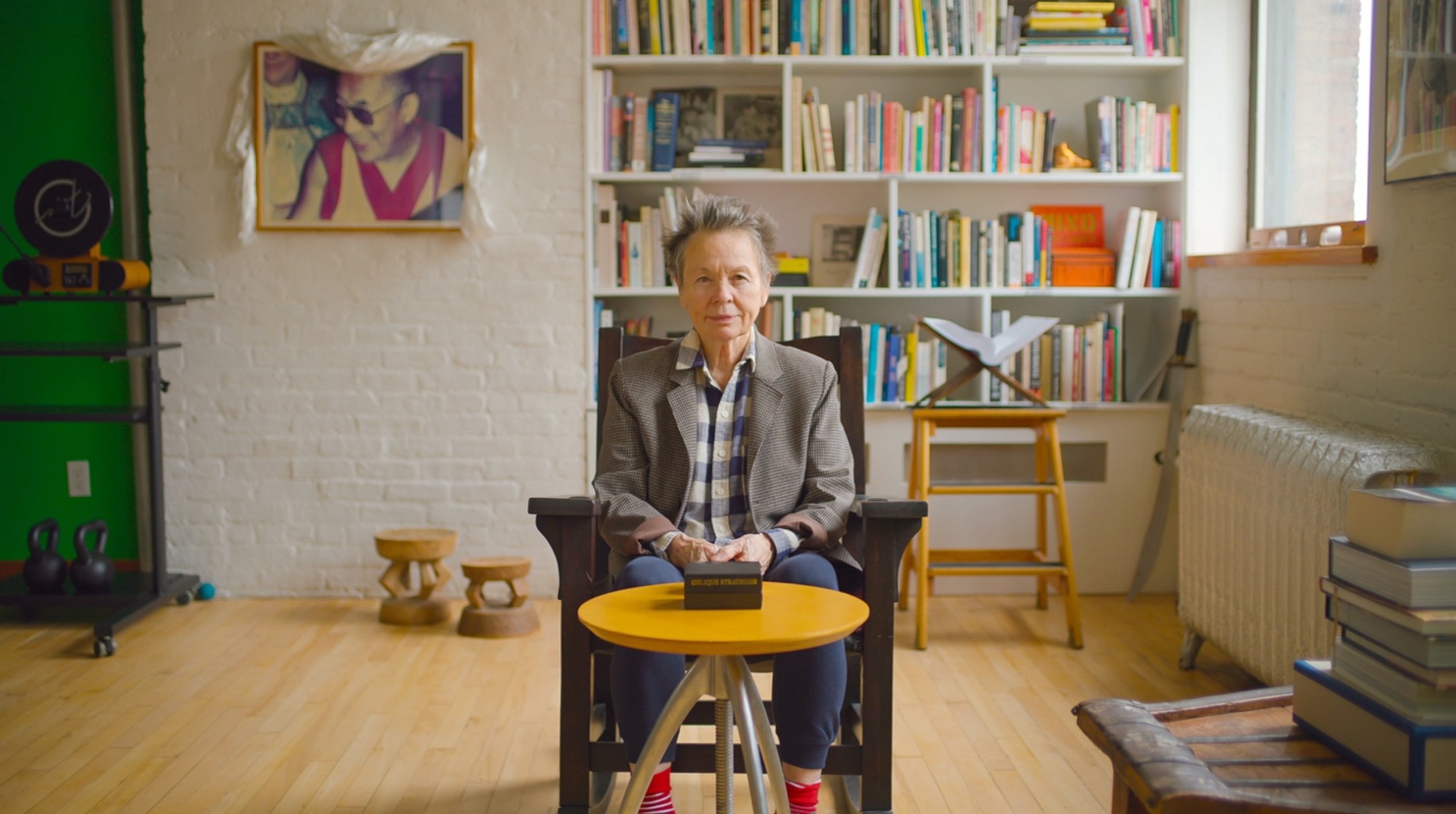
Fig. 1 – Laurie Anderson doing nothing. Still frame from Eno (2024). © Gary Hustwit.
This brings us to a key issue concerning the film. Ultimately, it’s the audience that seeks out patterns and assigns coherent meaning to Eno ’s narrative arc. One of the film’s greatest strengths is indeed its ability to transform the viewer’s experience from passive to active. Being aware of the film’s generative nature makes those who watch it more self-reflective about their role. As film critic and scholar Charlotte Kent observes, “What Eno made evident ... is that a generative film forces a viewer to be more aware of the contingency of their viewing.” [9] The spectator’s gaze turns towards itself. Of course, the audience needs to be somehow trained to recognize the technological elements embedded in the film, as they might easily overlook them. Therefore, various techniques are employed to make the technology noticeable. This is sometimes achieved visually through a collage technique, splitting the screen into a digital mosaic that reorders, crops, or repeats elements of a shot. Another approach directly addresses the editing. Each scene selected by the algorithm is in fact preceded by a real-time coding visual, showing the software choosing the sequence that is going to play next from the dataset. Interestingly, it does not only show what we’re about to see but also what the software is selecting from and all the alternatives that won’t be shown—which will remain only as filenames of choices that were not taken.
Such a manifest editing process clarifies Eno’s performative dimension, emphasizing the idea that the public is not merely watching a reproduction of the artwork but participates in something unfolding in a specific time and place—much like attending a concert or a theater piece. The film’s performative quality becomes even more apparent in special screenings where it is performed live by Hustwit, using a hardware rendition of Brain One assembled by the Swedish electronics company Teenage Engineering. Looking like a portable synthesizer, B-1 consists of two digital spinning reels—a remediation of an old tape machine—and a few basic controls: Play, Rewind, Record, and Generate, the latter being used to create the film’s editing in real-time. Yet, the controller is not intended as a tool for VJs to “remix” the documentary live. It certainly enhances the performative dimension inherent to Eno, placing a human performer at the center of the stage alongside the projected film; however, human agency does not take the lead and only serves to assist the self-sustaining generative editing. The performer can influence which major theme to explore, but ultimately it is still the algorithm that determines the specific scenes and their order.
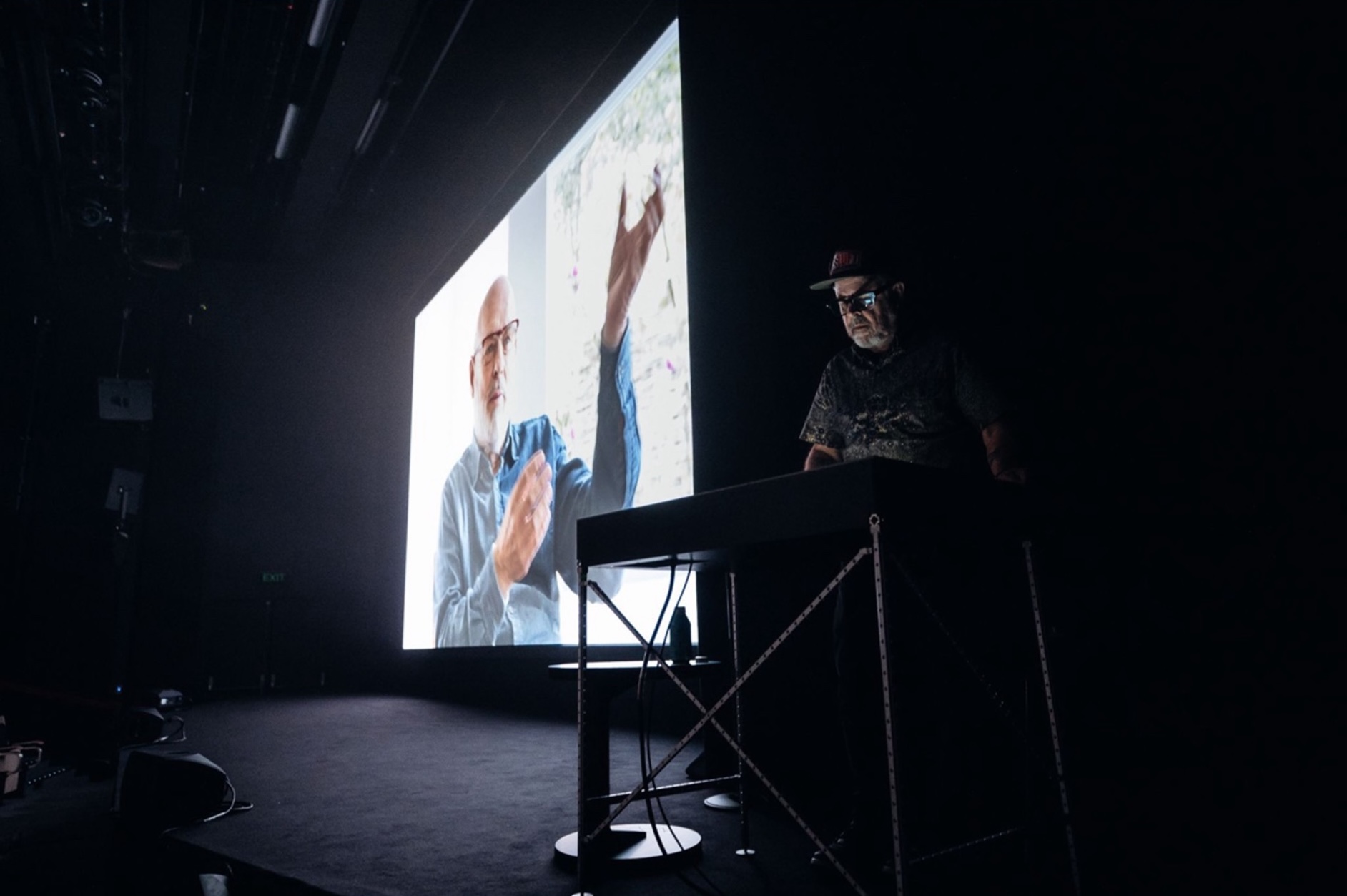
Fig. 2 – Gary Hustwit performing Eno live at Sydney Opera House. © Jordan Munns.
The outcome of this interactive performative practice transforms the generative film into a so-called autopoietic artwork in which content, form, and technology perfectly match. The notion of autopoiesis—which combines the Greek words αὐτόσ (self) and ποιεῖν (to make/create)—was introduced by biologists Humberto Maturana and Francisco Varela in their seminal research on the biological roots of knowledge. In simple terms, it is used to define living beings not as objects of observation, but as self-referential, self-constructing closed systems: “The being and doing of an autopoietic unit are inseparable, and this is their specific mode of organization.” [10] The product of any living thing appears then indistinguishable from the thing itself, with no clear separation between the producer and the produced. This can be fruitfully applied to generative art too. Indeed, over the past decade, the concept of autopoiesis has proven useful beyond biology, particularly in the fields of art and music, where it is used to analyze generative works as autonomous entities governed by their inherent processes and systems. [11] Eno’s internal order is defined by how the software works and, at the same time, the live editing becomes an integral part of the narrative arc, producing a mirrorlike interplay between the film’s content and software. Just like Brian Eno himself, Brain One is the protagonist of a story that is essentially telling itself. Of course, the autopoietic nature of the film does not imply its “livingness.” However, its performativity, the way it is presented and interacts with the footage replicate certain lifelike characteristics that are likely to resonate with the audience.
The biological recognition fostered by the film is further enhanced by its biographical subject. Compared to other generative works and despite its recombinant structure, what Eno seems to add is a strong sense of life narrative. Although the musician has repeatedly stated he’s not interested in a celebration of his career, while watching the movie we relive his life alongside him, experiencing both past and present the way he conceptualizes them. As Eno himself explains:
My own experience of thinking about the past and how things have evolved is that it changes every time I think about it. There’s never one story about your life. Different things become important at different times. Suddenly you realize that something you overlooked in the past was actually a very significant moment. [12]
The whole generative and autopoietic construction seems designed to thoughtfully replicate how time is perceived, in all its complexity and disorienting nature. Various moments in the musician’s life are presented seamlessly, almost like a re-enactment of human memory, capturing the way it moves from one temporal point to the other in a constant time travel through life experiences. This rhizomatic temporality is even intensified in Nothing Can Ever Be the Same, an experimental spin-off of Hustwit’s film consisting of a generative video installation that recontextualizes raw footage from Eno into a massive 168-hour audiovisual work of art. Created by director of programming Brendan Dawes, it originally premiered at the Venice Music Biennale in October 2023 and was shown again a year later at DOK Leipzig. While Hustwit’s documentary limits its technological scope to a few manageable elements, Nothing Can Ever Be the Same is sprawling: it abandons narrative structure entirely, pushing the generative element to the extreme with glitches, cropping, and unexpected cuts. The result feels like a fever dream, vividly reflecting the fragmentary nature of perception. [13]
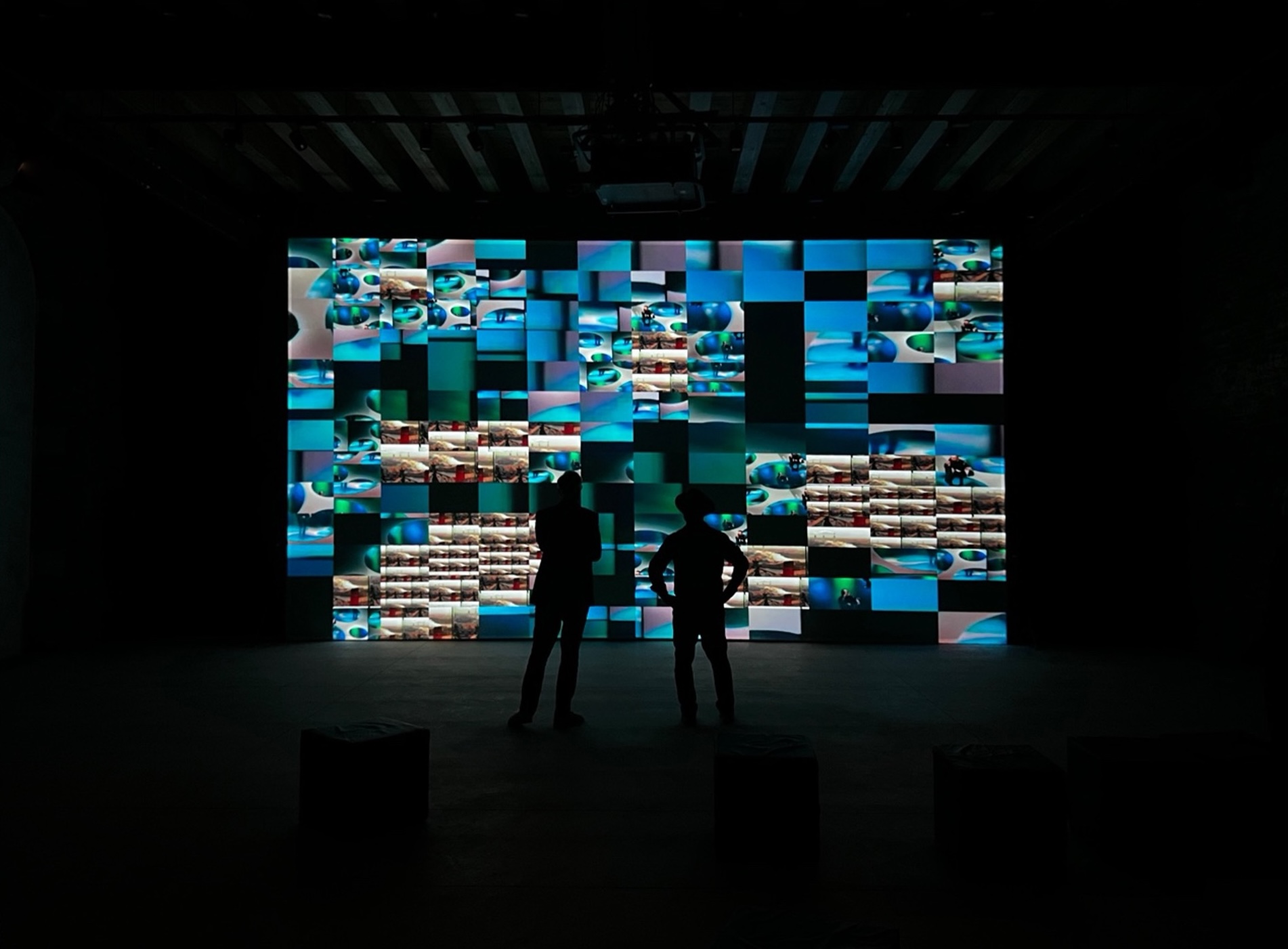
Fig. 3 – Brendan Dawes and Gary Hustwit in front of Nothing Can Ever Be the Same. © Biennale Musica.
But there’s something more. Autopoietic artworks are self-sufficient units, yet they still exist in complex environments alongside other entities. A generative film like Eno is also an object of observation, a piece of art meant to be watched; still, it interacts with its immediate environment on multiple levels. The software that creates the film, the director who performs it, and the public who attends the screening are all caught in a tight network of relationships, mutually influencing each other’s experiences. According to Norbert Herber, who studied the ontological implications of generative technologies, “Perturbations characterize the kinds of interactions that take place between a generative music system, the listener within the mediated environment, and the environment itself. All interactions are recurring, which leads to continuous structural changes.” [14] That’s how Eno’s performativity unfolds: as one exists in the environment of the screening, their presence resonates throughout, potentially affecting every other human or non-human actor also within it. Ultimately, this complex practice informs the very meaning of the film, and from the audience’s perspective it is a revolutionary change. New York Times critic Alissa Wilkinson explained that Eno’s inner sense lies in the performative practice the public engages with the generative technology: “It’s about how we, the audience, understand the world around us.”[15] Its interactive dimension forces us not only to seek new paths in storytelling, but also to question what is presented to us and relate it to our own living. In a way, it is still a “matter of time”—specifically Eno’s temporality, captured by the live editing and presented in the film, clashing with the viewers’ personal experiences.
After the screening I attended in Sheffield, the organizers held a Q&A session with Dawes and the director of photography, Mary Farbrother. As expected, most of the questions were about the film’s generative technology. One in particular stood out: a man, who said he had attended both UK premieres of the film—at the Barbican Centre in London and at Sheffield DocFest—used the word “heartbroken” to describe his experience. He felt heartbroken that he couldn’t see more of it, that remarkable scenes from the first screening didn’t reappear the second time, and that ultimately they were all gone forever. It was an important testimony to how Eno’s experience affects other participants: despite the claim that each screening is unique, from the public’s perspective they are all partial. But this is not necessarily a negative thing. Generative practices enable us to develop a constantly shifting perspective on a work of art, yet they also reveal the futility of trying to fully grasp it. By the end of one of Eno’s screenings, all that remains are the memories of what we have witnessed. Maybe the most important lesson this film offers is how to deal with memory, both in its personal and cultural forms. As Eno sings in the song that closes the documentary:
All I remember if gathered together would be
Solitary firework flashes over a fathomless sea.
I tried to recall all the treasures I found in those days
But the connection is weak and the moment is lost in the haze.
[16]
[1] “The 2023 Lion Awards for Music,” La Biennale di Venezia, accessed November 26, 2024.
[2] Val Cameron, “Film Director and Producer Gary Hustwit: Eno,” uploaded on January 27, 2024.
[3] Todd Gilchrist, “How AI Persuaded Brian Eno to Participate in Gary Hustwit’s Documentary About His Life,” Variety, January 16, 2024.
[4] Brian Eno, liner notes for Ambient Music 1: Music for Airports , EG AMB 001, 1978.
[5] Steve Reich, “Music as a Gradual Process,” Writings on Music, 1965–2000 , ed. Paul Hillier (Oxford: Oxford University Press, 2002), 34–6.
[6] Philip Galanter, “Generative Art Theory,” A Companion to Digital Art , ed. Christiane Paul, (Chichester: John Wiley & Sons, 2016), 151.
[7] Oblique Strategies, accessed November 28, 2024.
[8] “B–1 and the First Generative Feature Film,” Teenage Engineering , accessed November 28, 2024.
[9] Charlotte Kent, “Generative Film’s Potential: Eno,” The Brooklyn Rail (September 2024).
[10] Humberto R. Maturana, Francisco J. Varela, The Tree of Knowledge: The Biological Roots of Human Understanding , revised edition (Boston: Shambala, 1992), 49.
[11] Norbert Herber, “Musical Behavior and Amergence in Technoetic and Media Arts,” in The Oxford Handbook of Interactive Audio, ed. Karen Collins, Bill Kapralos, Holly Tessler, 364–84 (Oxford: Oxford University Press, 2014).
[12] Interview with Brian Eno and Gary Hustwit, The Ankler & Pure Nonfiction Documentary Spotlight , accessed December 16, 2024.
[13] Unfortunately, I did not have the chance to experience the installation live, but it was described to me by a friend who was at the Venice Biennale in 2023. A brief video extract can be found on Brendan Dawes’ website, accessed December 1, 2024,.
[14] Herber, “Musical Behavior and Amergence in Technoetic and Media Arts,” 369.
[15] Alissa Wilkinson, “ Eno Review: Creativity, 52 Billion Billion Ways,” The New York Times, July 11, 2024.
[16] Brian Eno, “All I Remember,” in Eno: Original Motion Picture Soundtrack , Opal Records 5584956, 2024.