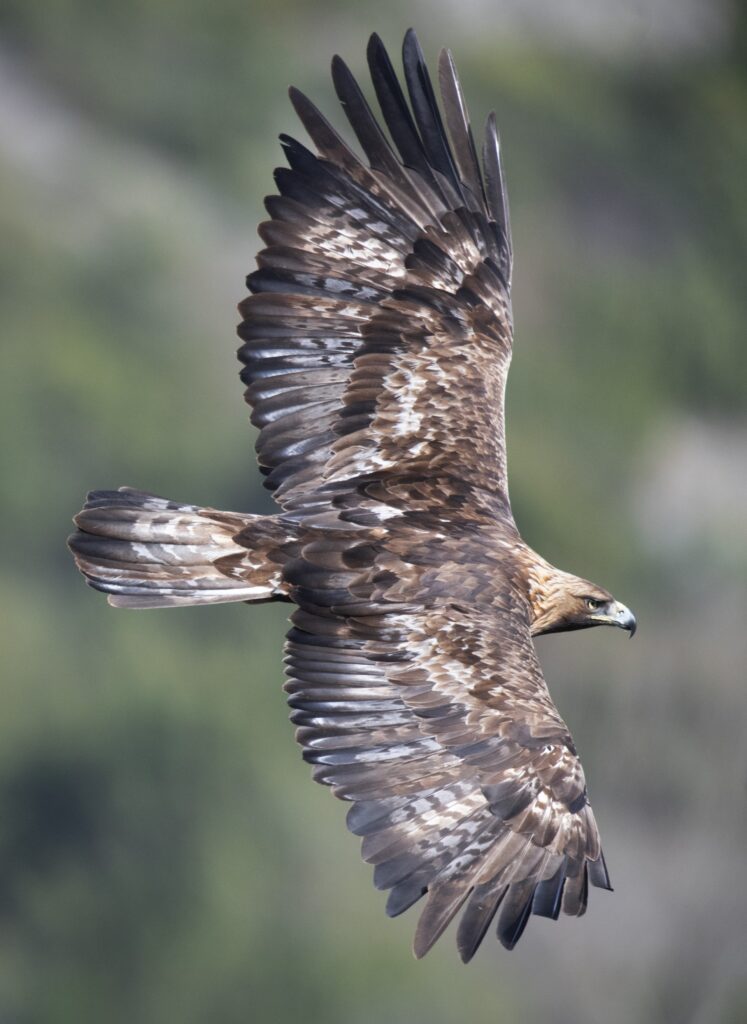
Territory selection of breeding Golden Eagles Aquila chrysaetos in a low-density population
DOI:
https://doi.org/10.30456/avo.2024102Keywords:
breeding behaviour, Central Apennines, birds of prey, raptors, population density, population dynamicAbstract
Territory selection by birds of prey is an essential process influencing survival and productivity. For Golden Eagle Aquila chrysaetos, research in Europe has focused primarily upon migrating and high-density populations, and rarely on the territory selection in low-density populations. We analysed Golden Eagle breeding sites in Central Apennines (Italy), spanning from 29 sites in 1980 up to 38 sites in 2020, verifying in 4 different years (1980, 1990, 2000 and 2020) their status of occupancy or vacancy, through cross-checking data from available literature and field observations. In the chosen years, each site was characterized by land use and neighbouring distances variables, to individuate the presence of a possible common selection process. The different protection status of each area (unprotected or Natural/National Parks) was tested, assuming that habitat protection could have positive effects on Eagles’ territory selection. The so obtained panel data was statistically analysed by means of t-test, χ2 test and probit models. In one hand, Golden Eagles in the Apennines showed a continuous recolonization of territories, including seven previously vacant and two undiscovered sites. On the other hand, half of the vacant sites remain unoccupied. Our results suggest that Golden Eagles, in a low-density population, tend to minimize the effect of lower quality habitats by choosing a breeding territory which can guarantee low intra-specific interferences: 35% of 2020 breeding pairs have, at least, one nearby vacant territory. Depending on the quality of the available breeding habitat, Individual Adjustment Hypothesis (IAH) supports or replaces Habitat Heterogeneity Hypothesis (HHH).
Downloads
References
Adams E.S., 2001. Approaches to the study of territory size and shape. Annual Review of Ecology, Evolution, and Systematics 32: 277–303.
Adler F., 1951. Yates’ correction and the statisticians. Journal of the American Statistical Association 46(256): 490–501.
Apollonio M., 2004. Gli ungulati in Italia: status, gestione e ricerca scientifica. Hystrix 15(1): 21–34.
Arcese P. & Sinclair A.R., 1997. The role of protected areas as ecological baselines. Journal of Wildlife Management 61(3): 587–602.
Artese C., Allavena S., Baliva S., Bernoni M., […] & Ricci F., 2017. Status of the Golden Eagle Aquilachrysaetos in Abruzzo. Avocetta 41: 77–80.
Bassi E., Facoetti R., Ferloni M., Pastorino A., […] & Andreotti A., 2021. Lead contamination in tissues of large avian scavengers in south-central Europe. Science of The Total Environment 778: 146130.
Barnes M.D., Craigie I.D., Harrison L.B., Geldmann J., […] & Woodley S., 2016. Wildlife population trends in protected areas predicted by national socio-economic metrics and body size. Nature communications 7(1): 12747.
Bocci A., Menapace S., Alemanno S. & Lovari S., 2016. Conservation introduction of the threatened Apennine chamois Rupicapra pyrenaica ornata: post-release dispersal differs between wild-caught and captive founders. Oryx 50(1): 128–133.
Borlenghi F., 2017. The Golden Eagle Aquila chrysaetos in the Apennines of the Lazio region (Central Italy): updates on its status. Avocetta 41: 73–75.
Borlenghi F. & Corsetti L., 1996. L’aquila reale Aquila chrysaetos nel Lazio meridionale (Italia Centrale): status, protezione e conservazione. Alula 3 (1-2): 37–47.
Borlenghi F. & Corsetti L., 2002. Densità e fattori limitanti dell’Aquila reale, Aquila chrysaetos, nell’Appennino Centrale. Rivista Italiana di Ornitologia 72(1): 19–26.
Borlenghi F., Cianconi M. & Ranazzi L., 2014. Evoluzione trentennale, status e parametri riproduttivi delle coppie di Aquila Reale Aquila chrysaetos nell’Appennino Laziale (Italia Centrale). Alula 21(1-2): 3–16.
Cardinale B., 2008. La pianificazione delle aree protette in Italia. Il caso del Parco Nazionale del Gran Sasso e Monti della Laga. In: Mauro G. (ed), L’economia della provincia di Teramo. Modelli produttivi e cambiamenti strutturali. Franco Angeli, Milano, pp. 205–233.
Caro J.S., Ontiveros D., Pizzarro M. & Pleguezuelos J.M., 2011. Habitat features of settlement areas used by floaters of Bonelli’s and Golden Eagles. Bird Conservation International 21(1): 59–71.
Casagrande S., Nieder L., Di Minin E., La Fata I. & Csermely D., 2008. Habitat utilization and prey selection of the kestrel Falco tinnunculus in relation to small mammal abundance. Italian Journal of Zoology 75(4): 401–409.
Chambert T., Imberdis L., Couloumy C., Bonet R. & Besnard A., 2020. Density dependence in Golden Eagle Aquila chrysaetos fecundity better explained by individual adjustment than territory heterogeneity. Ibis 162(4): 1312–1323.
Chiavetta M., 1995. L’Aquila reale Aquila chrysaetos nel Parco Nazionale d’Abbruzzo. Avocetta 19: 114.
Corsetti L., Fusacchia P., Marozza L. & Proietti M., 2011. I rapaci diurni (Falconiformes) dei Monti Lepini (Lazio meridionale). Alula 18: 33–46.
Cutini M., Flavio M., Giuliana B., Guido R. & Jean-Paul T., 2021. Bioclimatic pattern in a Mediterranean mountain area: assessment from a classification approach on a regional scale. International Journal of Biometeorology 65(7): 1085–1097.
Devictor V., Godet L., Julliard R., Couvet D. & Jiguet F., 2007. Can common species benefit from protected areas? Biological Conservation 139(1-2): 29–36.
Di Carlo E.A., 1980. Indagine preliminare sulla presenza passata ed attuale dell’Aquila reale, Aquila chrysaetos, sugli Appennini. Uccelli Italia 5: 263–283.
Dhondt A.A., Kempenaers B. & Adriaensen F., 1992. Density-dependent clutch size caused by habitat heterogeneity. Journal of Animal Ecology 61: 643–648.
Fasce P., Fasce L., Villers A., Bergese F. & Bretagnolle V., 2011. Long-term breeding demography and density dependence in an increasing population of Golden Eagles Aquila chrysaetos. Ibis 153: 581–591.
Fasce P. & Fasce L., 2017. A comment about meeting’s results. Avocetta 41: 93–95.
Ferrer M. & Donazar J.A., 1996. Density-dependent fecundity by habitat heterogeneity in an increasing population of Spanish Imperial Eagles. Ecology 77: 69–74.
Ferretti F., Corazza M., Campana I., Pietrocini V., […] & Lovari S., 2015. Competition between wild herbivores: reintroduced red deer and Apennine chamois. Behavioral Ecology 26(2): 550–559.
Forconi P. & Dancali S., 2005. Alimentazione dell’aquila reale Aquila chrysaetos in un’area dell’Appennino centrale. Avocetta 29: 183.
Garriga N., Santos X., Montori A., Richter-Boix A., Franch M. & Llorente G.A., 2012. Are protected areas truly protected? The impact of road traffic on vertebrate fauna. Biodiversity and Conservation 21: 2761–2774.
Geldmann J., Barnes M., Coad L., Craigie I.D., Hockings M. & Burgess N.D., 2013. Effectiveness of terrestrial protected areas in reducing habitat loss and population declines. Biological Conservation 161: 230–238.
Gordon D.M., 1997. The population consequences of territorial behaviour. Trends in Ecology and Evolution 12: 63–66.
Haller H. & Sackl P., 1997. Golden eagle Aquila chrysaetos. In: Hagemeijer W.J.M. & Blair M.J. (Ed.): The EBCC Atlas of European Breeding Birds, their Distribution and Abundance. T & AD Poyser, pp. 170–171.
Johannesen A.B., 2007. Protected areas, wildlife conservation, and local welfare. Ecological economics 62(1): 126–135.
Johnson D.H., 1980. The comparison of usage and availability measurements for evaluating resource preference. Ecology 61(1): 65–71.
Kays R., Parsons A.W., Bake, M.C., Kalies E.L., […] & McShea, W.J. 2017. Does hunting or hiking affect wildlife communities in protected areas? Journal of Applied Ecology 54(1): 242–252.
Kiffner C., Binzen G., Cunningham L., Jones M., Spruiell F. & Kioko J., 2020. Wildlife population trends as indicators of protected area effectiveness in northern Tanzania. Ecological Indicators 110: 105903.
Kim T.K., 2015. T test as a parametric statistic. Korean Journal of Anesthesiology 68(6): 540–546.
Kochert M.N., Steenhof K., Carpenter L.B. & Marzluff J. M., 1999. Effects of Fire on Golden Eagle Territory Occupancy and Reproductive Success. Journal of Wildlife Management 63(3): 773–780.
Kochert M.N., Steenhof K., McIntyre C.L. & Craig E.H., 2002. Golden eagle. The Birds of North America (684): 9.
Krüger O., Chakarov N., Nielsen J.T., Looft V., […] & Møller A.P. 2012. Population regulation by habitat heterogeneity or individual adjustment? Journal of Animal Ecology 81(2): 330–340.
Magrini M., Perna P., Angelini J., Armentano L. & Gambaro C., 2013. Andamento della popolazione di Aquila reale Aquila chrysaetos in un’area dell’Appennino Centrale tra il 1979 e il 2012. In: Mezzavilla F. & Scarton F. (ed.): Quaderni Faunistici. Vol 3. Atti Secondo Convegno Italiano Rapaci Diurni e Notturni: 188–196.
Martinez J.E., Pagan I. & Calvo J.F., 2006. Factors influencing territorial occupancy and reproductive output in the Booted Eagle Hieraaetus pennatus. Ibis 148(4): 807–819.
Mazzarano A., 2022. Territorial pairs, temporary settlement areas and potentially breeding sites for Golden eagle Aquila chrysaetos in the Ernici-Simbruini complex (Central Apennine, Italy): Preliminary results. Naturalista siciliano 46(2): 119–130.
Mazzarano A., 2023. Reduced competition on the territory to compensate its quality in the recolonization of the Golden eagle Aquila chrysaetos in Lazio. Naturalista siciliano 47(2): 289–305.
McGrady M.J., Grant J. R., Bainbridge I.P. & McLeod D.R.A., 2002. A Model of Golden Eagle (Aquilachrysaetos) Ranging Behaviour. Journal of Raptor Research 36(1): 62–69.
Parks S.A. & Harcourt A.H., 2002. Reserve size, local human density, and mammalian extinctions in US protected areas. Conservation Biology 16(3): 800–808.
Pedrini P. & Sergio F., 2001. Golden Eagle Aquilachrysaetos density and productivity in relation to land abandonment and forest expansion in the Alps. Bird Study 48(2): 194–199.
Pedrini P. & Sergio F., 2002. Regional conservation priorities for a large predator Golden eagle (Aquila chrysaetos) in the Alpine range. Biological Conservation 103: 163–172.
Pelorosso R., Boccia L. & Amici A., 2008. Simulating Brown Hare (Lepus europaeus Pallas) dispersion: a tool for wildlife management of wide areas. Italian Journal of Animal Science 7(3): 335–350.
Penny W.D., 2012. Comparing dynamic causal models using AIC, BIC and free energy. Neuroimage 59(1): 319–330.
Penteriani V., Gallardo M. & Roche P., 2002. Landscape structure and food supply affect eagle owl (Bubo bubo) density and breeding performance: a case of intra-population heterogeneity. Journal of Zoology 257: 365–372.
Ragni B., Magrini M. & Armentano L., 1986. Aspetti della biologia dell’Aquila reale Aquila chrysaetos nell’Appennino umbro-marchigiano. Avocetta 10: 71–85.
Reid R., Haworth P.F., Fielding A.H., & Whitfield D.P., 2019. Spatial distribution of undulating flight displays of territorial Golden Eagles Aquila chrysaetos in Lewis, Scotland. Bird Study 66(3): 407–412.
Sergio F., Pedrini P. & Marchesi L., 2003. Adaptive selection of foraging and nesting habitat by black kites (Milvus migrans) and its implications for conservation: a multi-scale approach. Biological Conservation 112(3): 351–362.
Spinelli I., 2009. Stima della densità relativa e selezione delle tipologie vegetazionali nella Lepre italica (Lepus corsicanus De Winton, 1898) nel Lazio. Tesi di Laurea Magistrale, Università Sapienza. Roma.
Spinetti M., 2018. L’Aquila reale - Biologia, etologia e conservazione. Cogecstre edizioni, Penne (PE), Italy.
Tack J.D. & Noon B.R., 2017. No Substitute for Survival: Perturbation Analyses Using a Golden Eagle Population Model Reveal Limits to Managing for Take. Journal of Raptor Research 51(3): 258–272.
Tallarida R.J. & Murray R.B., 1987. χ2 test. Manual of pharmacologic calculations: With computer programs. Springer Science & Business Media. Watson J., 2010. The Golden Eagle, Second Edition. T& AD Poyser, London, UK.
Watson A., Rae S. & Payne S., 2012. Mirrored sequences of colonisation and abandonment by pairs of Golden Eagles Aquila chrysaetos. Ornis Fennica 89: 229–232.
Whitfield D.P., Fielding A.H., McLeod D.R.A., Haworth P.F. & Watson J., 2006. A conservation framework for the Golden eagle in Scotland: Refining condition targets and assessment of constraint influences. Biological Conservation 130: 465–480.
Zocchi A. & Panella A., 1996. Monitoring of the Golden eagle Aquila chrysaetos population in the Central Apennines (Italy) in 1982–1991. In: Meyburg B.U. & Chancellor R.D. (eds.), Eagles studies. W.W.G.B.P. PicaPress, pp. 495–503.
Downloads
Published
Issue
Section
License

This work is licensed under a Creative Commons Attribution-ShareAlike 4.0 International License.
How to Cite
Published 2024-04-05