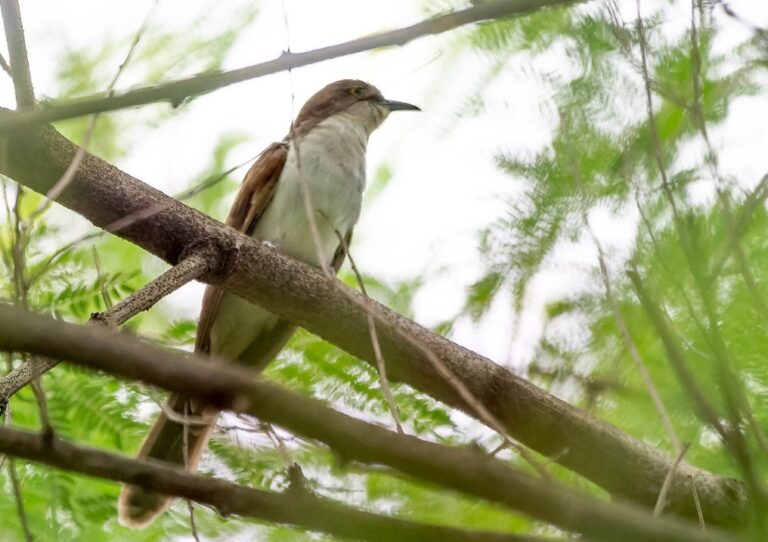
New extra-Amazonian records of the Black-billed Cuckoo Coccyzus erythropthalmus (Cuculidae) for Brazil
DOI:
https://doi.org/10.30456/avo.2024110Keywords:
Animal movement, Atlantic Forest, Conservation, Vagrant bird, Serra do Mar, Natural history, El Niño, MigrationAbstract
The breeding grounds of the Black-billed Cuckoo Coccyzus erythropthalmus encompass a wide area in northern North America. During the austral winter individuals migrate to non-breeding areas in South America. There had been only three known locations for the species in Brazil, two in the Amazon Forest and one in the Atlantic Forest. Here, we aim to present new records in Brazil and to organize the available literature recovering historical data. The new records are in the Southeast and South regions and thus represent the first documented records outside the Brazilian Amazon. These findings indicate an expansion of the area considered nomadic for the species. All extra-Amazonian records were made in strong El Niño years, a climate phenomenon that may be changing bird migration patterns in South America, which requires further investigation.
Downloads
References
Builes-Jaramillo A., Valencia J. & Salas H.D., 2023. The influence of the El Niño-Southern Oscillation phase transitions over the northern South America hydroclimate. Atmospheric Research 290: 106786. DOI: https://doi.org/10.1016/j.atmosres.2023.106786
Dean W., 2004. A ferro e fogo: a história e a devastação da Mata Atlântica brasileira. First edn. Companhia das Letras, São Paulo, Brasil. Erritzøe J., Mann C.F., Brammer F. & Fuller R.A., 2012. Cuckoos of the World (Helm Identification Guides). Christopher Helm, London, UK.
Hughes J.M., 2020. Black-billed Cuckoo (Coccyzus erythropthalmus), version 1.0. In: Rodewald P.G. (ed.), Birds of the World, Cornell Lab of Ornithology, Ithaca, NY, USA. https://doi.org/10.2173/bow.bkbcuc.01 (accessed 21 January 2023). DOI: https://doi.org/10.2173/bow.bkbcuc.01
IBGE - Instituto Brasileiro de Geografia e Estatistica., 2018. Instituto Brasileiro de Geografia e Estatística: Estimativas da população residente para os municípios e para as unidades da federação. Ministério do Planejamento, Desenvolvimento e Gestão, Distrito Federal, Brasil. https://www.ibge.gov.br/ (accessed 05 May 2023).
Koleček J., Adamík P. & Reif J., 2020. Shifts in migration phenology under climate change: temperature vs. abundance effects in birds. Climatic Change 159: 177–194. DOI: https://doi.org/10.1007/s10584-020-02668-8
Knudsen E., Lindén A., Both C., Jonzén N., […] & Stenseth N.C., 2011. Challenging claims in the study of migratory birds and climate change. Biological Reviews 86: 928–946. DOI: https://doi.org/10.1111/j.1469-185X.2011.00179.x
Lees A.C. & Gilroy J.J., 2021. Bird migration: When vagrants become pioneers. Current Biology 31: R1568–R1570. DOI: https://doi.org/10.1016/j.cub.2021.10.058
Lehikoinen A. & Virkkala R., 2016. North by northwest: Climate change and directions of density shifts in birds. Global Change Biology 22: 1121–1129. DOI: https://doi.org/10.1111/gcb.13150
L’Heureux M.L., Collins D.C. & Hu Z.Z., 2013. Linear trends in sea surface temperature of the tropical Pacific Ocean and implications for the El Niño-Southern Oscillation. Climatic Dynamics 40: 1223–1236. DOI: https://doi.org/10.1007/s00382-012-1331-2
Pacheco J.F., Silveira L.F., Aleixo A., Agne C.E., […] & Piacentini V. Q., 2021. Annotated checklist of the birds of Brazil by the Brazilian Ornithological Records Committee - second edition. Ornithology Research 29: 94–105. DOI: https://doi.org/10.1007/s43388-021-00058-x
Scherer-Neto P., Carrano E. & Ribas C. F., 2001. Avifauna da Estação Ecológica do Caiuá (Diamante do Norte, Paraná) e regiões adjacentes. In: Straube F.C. (ed.), Ornitologia sem Fronteiras. Incluindo os Resumos do IX Congresso Brasileiro de Ornitologia, pp. 352–353. Sociedade Brasileira de Ornitologia, Curitiba, Brasil.
Scherer-Neto P., Carrano E. & Ribas C. F., 2008. Composição e conservação da avifauna da Estação Ecológica do Caiuá, Noroeste do Paraná e regiões adjacentes. Cadernos da Biodiversidade 6: 32–45.
Schunck F., Barata F.L. & Silva M.A.G., 2022. Distribution, seasonality and habitat of Micrococcyx cinereus (Cuculidae) in the state of São Paulo, Brazil. Cotinga 44: 118–125.
Schunck F. & Cavarzere V., 2022. Review of non-Amazonian records of Blackpoll Warbler Setophaga striata in Brazil, including a case of wintering in the largest urban area in South America. Bulletin of the British Ornithologists’ Club 142: 310–322. DOI: https://doi.org/10.25226/bboc.v142i3.2022.a4
Sick H., 1997. Ornitologia Brasileira. Nova Fronteira, Rio de Janeiro, Brasil.
Silva J.M.C. & Santos M.P.D., 2005. A importância relativa dos processos biogeográficos na formação da avifauna do Cerrado e de outros biomas brasileiros. In: Scariot A., Souza-Silva J.C. & Felfili J.M. (eds.), Cerrado: ecologia, biodiversidade e conservação. Ministério do Meio Ambiente, Brasília, Brasil.
Somenzari M , Amaral P.P., Cueto V.R., Guaraldo A.C., [...] & Whitney M.M., 2018. An overview of migratory birds in Brazil. Papéis Avulsos de Zoologia 58: 1–66. DOI: https://doi.org/10.11606/1807-0205/2018.58.03
WikiAves., 2024. WikiAves - A encicloédia de aves do Brasil. https://www.wikiaves.org.br (accessed 18 Oct. 2023).
Whittaker A. & Oren D.C., 1999. Important ornithological records from the Rio Juruá, western Amazonia, including twelve additions to the Brazilian avifauna. Bulletin of the British Ornithologists’ Club 119: 235–260.
Yu Y., 2023. Categories of Climate Change and Impact on Bird Behavior. Highlights in Science. Engineering and Technology 69: 323–327. DOI: https://doi.org/10.54097/hset.v69i.12111
Xavier B.F. & Boss R.L., 2011. Estação Ecológica Maracá-Jipioca. In: Valente R.V., Silva J.M.C., Straube F.C. & Nascimento J.L.X. (orgs.), Conservação de Aves Migratórias Neárticas no Brasil. 1ed, pp. 28–32. Conservação Internacional, Belém, Brasil.
Downloads
Published
How to Cite
Issue
Section
License

This work is licensed under a Creative Commons Attribution-ShareAlike 4.0 International License.