Preliminary data on the activity of male and female common pheasants Phasianus colchicus during the breeding period in a Mediterranean area
DOI:
https://doi.org/10.30456/avo.2024115Keywords:
Phasianus colchicus, game birds, Galliformes, camera traps, Activity rhythmsAbstract
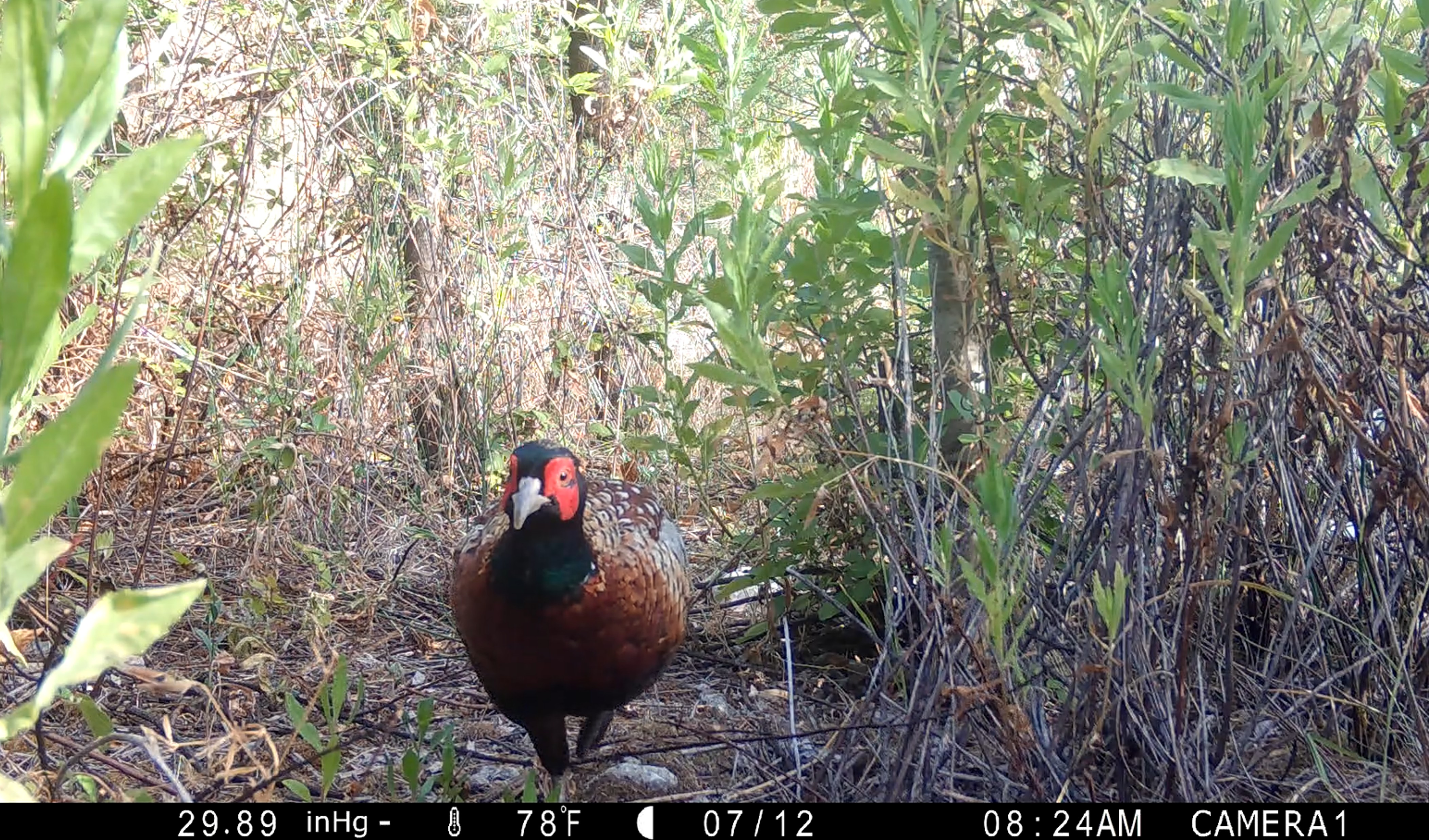
Assessing patterns of activity rhythms in wildlife is pivotal for species conservation. In this work, we aimed at determining the curve of activity rhythms of male and female common pheasants Phasianus colchicus in a Mediterranean area in central Italy. We used camera-trapping and we computed the inter-sexual temporal overlap of activity rhythms in the breeding period. We collected 129 independent records of common pheasants (males, N = 90; females, N = 39). Males were mostly active in the morning, whereas female activity was mostly concentrated at dawn and dusk, showing an intermediate overlap of diurnal activity rhythms (Δ1 = 0.55). Recorded patterns of activity rhythms confirmed the importance of ecotones for the conservation of this species, which represent an important prey for several native carnivores.
Downloads
References
Anile S., Mazzamuto M.V. & Lo Valvo M. 2022. Habitat Determinants and Density of the Endemic Sicilian Rock Partridge Alectoris graeca whitakeri on Mt. Etna, Sicily, Italy. Acta Ornithol. 56: 159-170. DOI: https://doi.org/10.3161/00016454AO2021.56.2.002
Ashoori A., Kafash A., Varasteh Moradi H., Yousefi M., Kamyab H., Behdarvand N. & Mohammadi S. 2018. Habitat modeling of the common pheasant Phasianus colchicus (Galliformes: Phasianidae) in a highly modified landscape: application of species distribution models in the study of a poorly documented bird in Iran. The European Zoological Journal 85: 372-380. DOI: https://doi.org/10.1080/24750263.2018.1510994
Ashrafzadeh M.R., Khosravi R., Fernandes C., Aguayo C., Bagi Z., Lavadinović V.M., Szendrei L., Beukovic D., Mihalik B. & Kusza S. 2021. Assessing the origin, genetic structure and demographic history of the common pheasant (Phasianus colchicus) in the introduced European range. Scientific Reports 11: 1-14. Doi: 10.1038/s41598-021-00567-1 DOI: https://doi.org/10.1038/s41598-021-00567-1
BirdLife International. 2016. Phasianus colchicus. The IUCN Red List of Threatened Species 2016: e.T45100023A85926819. https://dx.doi.org/10.2305/IUCN.UK.2016-3.RLTS.T45100023A85926819.en. Accessed on 27 March 2024. DOI: https://doi.org/10.2305/IUCN.UK.2016-3.RLTS.T45100023A85926819.en
Cook T. R., Cherel Y., Bost C. A. & Tremblay Y. 2007. Chick-rearing Crozet shags (Phalacrocorax melanogenis) display sex-specific foraging behaviour. Antarctic Science 19: 55-63. DOI: https://doi.org/10.1017/S0954102007000089
Dalke P.D. 1937. Food habits of adult pheasants based on crop analyses. Ecology 8: 199-213. DOI: https://doi.org/10.2307/1930461c
Doxon E.D. & Carroll J.P. 2010. Feeding ecology of ring‐necked pheasant and northern bobwhite chicks in Conservation Reserve Program fields. Journal of Wildlife Management 74: 249-256. DOI: https://doi.org/10.2193/2008-522
Draycott R. A., Bliss T. H., Carroll J. P., Pock K. 2009. Provision of brood-rearing cover on agricultural land to increase survival of wild ring-necked pheasant Phasianus colchicus broods at Seefeld Estate, Lower Austria, Austria. Conserv. Evidence 6: 6-10.
Fan F., Bu H., McShea W.J., Shen X., Li B.V. & Li S. 2020. Seasonal habitat use and activity patterns of blood pheasant Ithaginis cruentusbe in the presence of free-ranging livestock. Global Ecology and Conservation 23: e01155. DOI: https://doi.org/10.1016/j.gecco.2020.e01155
Fitak R. 2020. Package “CircMLE”. Maximum Likelihood Analysis of Circular Data. Available online: https://cran.rproject.org/web/packages/CircMLE/CircMLE.pdf. Accessed on 19.05.2024.
Genovesi P., Secchi M. & Boitani L. 1996. Diet of stone martens: an example of ecological flexibility. Journal of Zoology 238: 545-555. DOI: https://doi.org/10.1111/j.1469-7998.1996.tb05412.x
Genovesi P., Besa M., Toso S. 1999. Habitat selection by breeding pheasants Phasianus colchicus in an agricultural area of northern Italy. Wildlife Biology 5: 193-201. DOI: https://doi.org/10.2981/wlb.1999.024
Herranz J., Yanes M. & Suarez F. 2002. Does photo-monitoring affect nest predation? Journal of Field Ornithology 73: 97-101. DOI: https://doi.org/10.1648/0273-8570-73.1.97
Hill D.A. 1985. The feeding ecology and survival of pheasant chicks on arable farmland. Journal of Applied Ecology 22: 645-654. DOI: https://doi.org/10.2307/2403218
Hill D. & Robertson P. 1988. The pheasant: ecology, management and conservation. BSP Professional Books, London, UK.
Kelley D. B. 1988. Sexually dimorphic behaviors. Annu. Rev. Neuroscience 11: 225-251. DOI: https://doi.org/10.1146/annurev.ne.11.030188.001301
Landler L., Ruxton G.D., Malkemper E.P. 2019. The Hermans–Rasson test as a powerful alternative to the Rayleigh test for circular statistics in biology. BMC Ecology 19: 1-8. DOI: https://doi.org/10.1186/s12898-019-0246-8
Lashley M.A., Cove M.V., Chitwood M.C., Penido G., Gardner B., DePerno C.S. & Moorman C.E. 2018. Estimating wildlife activity curves: comparison of methods and sample size. Scientific Reports 8: 4173. DOI: https://doi.org/10.1038/s41598-018-22638-6
Lazzeri L., Fazzi P., Lucchesi M., Mori E., Velli E., Cappai N., Ciuti F., Ferretti F., Fonda F., Paniccia C., Pavanello M., Pecorella S., Sangiuliano A., Sforzi A., Siclari A. & Spada A. 2022. The rhythm of the night: patterns of activity of the European wildcat in the Italian peninsula. Mammalian Biology 102: 1769-1782. DOI: https://doi.org/10.1007/s42991-022-00276-w
Lovari S. & Rolando A. 2004. Guida allo studio degli animali in natura. Bollati Boringhieri Editions, Torino, Italy.
Lynam A.J., Jenks K.E., Tantipisanuh N., Chutipong W., Ngoprasert D., Gale G.A., Steinmetz R., Sukmasuang R., Bhumpakphan N., Grassman L.I. Jr., Cutter P., Kitamura S., Reed D.H., Baker M.C., McShea W., Songsasen N. & Leimgruber P. 2013. Terrestrial activity patterns of wild cats from camera-trapping. Raffles Bulletin of Zoology 61: 407-415.
Mateos C. 1998. Sexual selection in the ring-necked pheasant: a review. Ethology, Ecology and Evolution 10: 313-332. DOI: https://doi.org/10.1080/08927014.1998.9522846
Mateos C. & Carranza J. 1999. Effects of male dominance and courtship display on female choice in the ring-necked pheasant. Behavioural Ecology and Sociobiology 45: 235-244. DOI: https://doi.org/10.1007/s002650050558
Mayot P., Barjat C., Ferret P., Lecardonnel L., Bestel N., Bestel M., Delamarre M., Le Tohic K., Sautereau L., Lottin M., Noyaux Q., Marie M., Baudouin J., Baron V. & Mangin E. 2017. Faisan commun: bilan d’une vaste étude de radiopistage en regions. Faune Sauvage 317: 23–36.
Meredith M. & Ridout M. 2014. Overview of the overlap package. Available from: http://cran.cs.wwu.edu/web/packages/overlap/vignettes/overlap.pdf. Accessed on 24 May 2024.
Monterroso P., Alves P.C. & Ferreras P. 2014. Plasticity in circadian activity patterns of mesocarnivores in southwestern Europe: implications for species coexistence. Behavioural Ecology and Sociobiology 68: 1403–1417. DOI: https://doi.org/10.1007/s00265-014-1748-1
Mohd-Azlan J. & Engkamat L. 2013. Camera trapping and conservation in Lanjak Entimau Wildlife Sanctuary, Sarawak, Borneo. Raffles Bulletin of Zoology 61: 397-405.
Mori E., Menchetti M., Dondini G., Biosa D. & Vergari S. 2014. Theriofauna of Site of Community Importance Poggi di Prata (Grosseto, Central Italy): terrestrial mammals and preliminary data on Chiroptera. Check List 10: 718-723. DOI: https://doi.org/10.15560/10.4.718
Mori E., Mazza G. & Lovari S. 2017. Sexual dimorphism. In: Vonk J., Shackleford T.K. (Eds.) Encyclopedia of Animal Cognition and Behaviour. Springer Edition, New York: 1-7. DOI: https://doi.org/10.1007/978-3-319-47829-6_433-1
Mori E., Lazzeri L., Ferretti F., Gordigiani L. & Rubolini D. 2021. The wild boar Sus scrofa as a threat to ground-nesting species: an artificial nest experiment. Journal of Zoology 314: 311-320. DOI: https://doi.org/10.1111/jzo.12887
Musil D.D. & Connelly J.W. 2009. Survival and reproduction of pen-reared vs translocated wild pheasants Phasianus colchicus. Wildlife Biology 15: 80-88. DOI: https://doi.org/10.2981/07-049
Nelli L., Meriggi A. & Vidus-Rosin A. 2012. Effects of habitat improvement actions (HIAs) and reforestations on pheasants Phasianus colchicus in northern Italy. Wildlife Biology 18: 121-130. DOI: https://doi.org/10.2981/11-022
Nielson R.M., McDonald L.L., Sullivan J.P., Burgess C., Johnson D.S., Bucholtz S., Hyberg S. & Howlin S, 2008. Estimating the response of ring-necked pheasants (Phasianus colchicus) to the Conservation Reserve Program. The Auk 125: 434-444. DOI: https://doi.org/10.1525/auk.2008.07002
O’Brien T.G. & Kinnaird M.F. 2008. A picture of a thousand words: the application of camera trapping to the study of birds. Bird Conservation International 18: S144-S162. DOI: https://doi.org/10.1017/S0959270908000348
O’Connell A.F., Nichols J.D. & Karanth K.U. 2011. Camera traps in animal ecology. Methods and analyses. Springer, New York, USA. DOI: https://doi.org/10.1007/978-4-431-99495-4
Pasinelli G. 2000. Sexual dimorphism and foraging niche partitioning in the Middle-Spotted Woodpecker Dendrocopos medius. Ibis 142: 635-644. 10.1111/j.1474-919X.2000.tb04463.x DOI: https://doi.org/10.1111/j.1474-919X.2000.tb04463.x
Pla-Ard M., Hoonheang W., Kaewdee B., Panganta T., Charaspet K., Khoiesri N., Paansri P., Kanka P., Chanachai Y., Thongbanthum J., Bangthong P. & Sukmasuang R., 2021. Abundance, diversity and daily activity of terrestrial mammal and bird species in disturbed and undisturbed limestone habitats using camera trapping, Central Thailand Biodiversity 22: 3620-3631. DOI: https://doi.org/10.13057/biodiv/d220864
QGIS Development Team. 2019. QGIS Geographic Information System. Open Source Geospatial Foundation Project. http://qgis.osgeo.org. Accessed on 07.07.2023.
Refinetti R. 2008. The diversity of temporal niches in mammals. Biological Rhythm Research 39: 173-192. DOI: https://doi.org/10.1080/09291010701682690
Richardson T.W., Gardali T. & Jenkins S.H. 2009. Review and meta-analysis of camera effects on avian nest success. Journal of Wildlife Management 73: 287–293. DOI: https://doi.org/10.2193/2007-566
Riley T.Z., Clark W.R., Ewing D.E., & Vohs P.A. 1998. Survival of ring-necked pheasant chicks during brood rearing. Journal of Wildlife Management 62: 37–44. DOI: https://doi.org/10.2307/3802262
Riley C.M. & Smith K.G. 1992. Sexual dimorphism and foraging behavior of Emerald Toucanets Aulacorhynchus prasinus in Costa Rica. Ornis Scandinavica 23: 459-466 DOI: https://doi.org/10.2307/3676677
Ridley M.W. & Hill D.A. 1987. Social organization in the pheasant (Phasianus colchicus): harem formation, mate selection and the role of mate guarding. Journal of Zoology 211: 619–630. DOI: https://doi.org/10.1111/j.1469-7998.1987.tb04475.x
Robertson P.A., Wise D.R. & Blake K.A. 1993. Flying ability of different pheasant strains. Journal of Wildlife Management 4: 778-782. DOI: https://doi.org/10.2307/3809079
Santilli F. & Bagliacca M. 2008. Factors influencing pheasant Phasianus colchicus harvesting in Tuscany, Italy. Wildlife Research 14: 281-287. DOI: https://doi.org/10.2981/0909-6396(2008)14[281:FIPPCH]2.0.CO;2
Selander R. 1972. Sexual selection and dimorphism in birds. In: Campbell B. (Eds.). Sexual Selection and the Descent of Man. Heinemann Editions, London, UK: pp. 180-230. DOI: https://doi.org/10.4324/9781315129266-8
Serrano‐Meneses M. A. & Székely T. 2006. Sexual size dimorphism in seabirds: sexual selection, fecundity selection and differential niche‐utilisation. Oikos 113: 385-394. DOI: https://doi.org/10.1111/j.0030-1299.2006.14246.x
Smith S.A., Stewart N.J. & Gates J.E. 1999. Home ranges, habitat selection and mortality of ring-necked pheasants (Phasianus colchicus) in north-central Maryland. American Midland Naturalist 141: 185-197. DOI: https://doi.org/10.1674/0003-0031(1999)141[0185:HRHSAM]2.0.CO;2
Stoate C. 2002. Multifunctional use of a natural resource on farmland: wild pheasant (Phasianus colchicus) management and the conservation of farmland passerines. Biodiversity and Conservation 11: 561-573. DOI: https://doi.org/10.1023/A:1015564806990
Temeles E. J. & Roberts W. M. 1993. Effect of sexual dimorphism in bill length on foraging behavior: an experimental analysis of hummingbirds. Oecol. 94: 87-94. DOI: https://doi.org/10.1007/BF00317307
Thieurmel B., Elmarhraoui A., & Thieurmel M. B. 2019. Package ‘suncalc’. R package version 0.5. Available at: https://2256.ncc.metu.edu.tr/web/packages/suncalc/suncalc.pdf Accessed on 10.10.2023.
Tobalske B.W. & Dial K.P. 2000. Effects of body size on take-off flight performance in the Phasianidae (Aves). Journal of Experimental Biology 203: 3319-3332. DOI: https://doi.org/10.1242/jeb.203.21.3319
Tran L., Anu A., Piazza Z. & Granatosky M.C. 2021. Galliformes locomotion. In: Vonk J., Shackelford T.K. (Eds.) Encyclopedia of Animal Cognition and Behaviour. Springer Nature, Cham, Switzerland. DOI: https://doi.org/10.1007/978-3-319-47829-6_133-1
Vannini A., Menchetti M. & Mori E. 2013. L’avifauna del SIC “Poggi di Prata” (Grosseto, Italia Centrale): analisi faunistica, quantitativa e considerazioni sulla gestione ambientale del sito. Alula 20: 101-112.
Venturato, E., Cavallini, P., Banti, P. & Dessì-Fulgheri, F., 2009. Do radio collars influence mortality and reproduction? A case with ring-necked pheasants (Phasianus colchicus) in Central Italy. European Journal of Wildlife Research 55: 547-551. DOI: https://doi.org/10.1007/s10344-009-0271-6
Venturato E., Cavallini P., Dessì-Fulgheri F. 2010. Are pheasants attracted or repelled by roads? A test of a crucial assumption for transect censuses. European Journal of Wildlife Research 56: 233-237. DOI: https://doi.org/10.1007/s10344-009-0309-9
Viviano A., Mori E., Fattorini N., Mazza G., Lazzeri L., Panichi A., Strianese L. Mohamed W.F. 2021. Spatiotemporal overlap between the European brown hare and its potential predators and competitors. Animals 11: 562. DOI: https://doi.org/10.3390/ani11020562
Webster M. S. 1997. Extreme sexual size dimorphism, sexual selection, and the foraging ecology of Montezuma Oropendolas. The Auk 114: 570-580. DOI: https://doi.org/10.2307/4089276
Weimerskirch H., Corre M. L., Ropert-Coudert Y., Kato A. & Marsac F. 2006. Sex-specific foraging behaviour in a seabird with reversed sexual dimorphism: the red-footed booby. Oecologia 146: 681-691. DOI: https://doi.org/10.1007/s00442-005-0226-x
Wittzell H. 1991. Morphological variation among cohorts of juvenile pheasant Phasianus colchicus, and its relation to environmental conditions during growth. Doctoral Thesis, University of Lund, Sweden.
Zwerts J.A., Stephenson P.J., Maisels F., Rowcliffe M., Astaras C., Jansen P.A., van der Waarde J., Sterck L.E.H.M., Verweij P.A., Bruce T., Brittain S. & van Kuijk M., 2021. Methods for wildlife monitoring in tropical forests: Comparing human observations, camera traps, and passive acoustic sensors. Conservation Science Practice 3: e568 DOI: https://doi.org/10.1111/csp2.568
Downloads
Published
How to Cite
Issue
Section
License

This work is licensed under a Creative Commons Attribution-ShareAlike 4.0 International License.