
An Emerging Proto-Industrial Paradigm: Recent Data on the Organisation of Ceramic Production in Ur III Mesopotamia
DOI:
https://doi.org/10.54103/eap/27311Keywords:
Ceramic production, Pottery workshop, Craft organisation, Ur III State, MesopotamiaAbstract
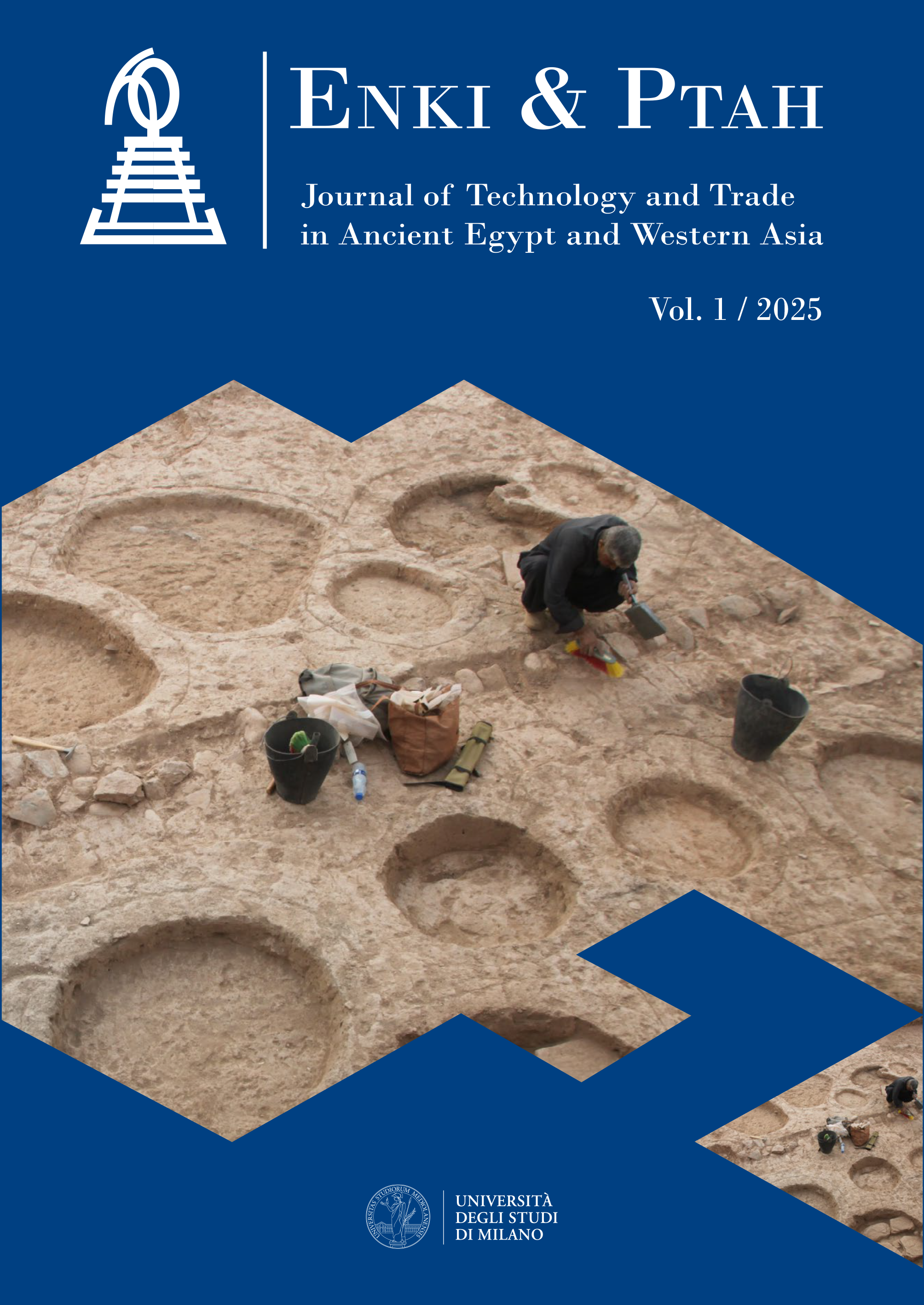
While cuneiform sources from the late 3rd millennium BCE Mesopotamia describe labour-intensive and structured economic systems, relations and means of pottery production remain elusive in archaeological evidence. Few studies have explored the organisation of ceramic workshops from this period,and issues related to kiln technology remain poorly addressed. The recent discovery of complex firing systems integrated into large pottery workshops at the site of Logardan in Iraqi Kurdistan, dating to the last centuries of the 3rd millennium BCE, calls for a reassessment of pottery production organisation and practices within the context of the first empires. The site is a ceramic production centre located at the margins of the Ur III empire, featuring large-scale systems of kiln connections through horizontal ducts to enhance firing efficiency and optimisation of fuel and heat. Ongoing excavations provide new sets of archaeological data (spatial, architectural, pottery typologies and techniques), which makes it possible to revise traditional political, technical and socio-economic paradigms about ceramic production. This paper investigates the integration of such mundane craft into the Ur III state economic system, highlighting an emerging path towards proto-industrialisation.
Downloads
Downloads
Published
How to Cite
Issue
Section
License
Copyright (c) 2025 Claire Padovani, Melania Zingarello

This work is licensed under a Creative Commons Attribution-ShareAlike 4.0 International License.



