
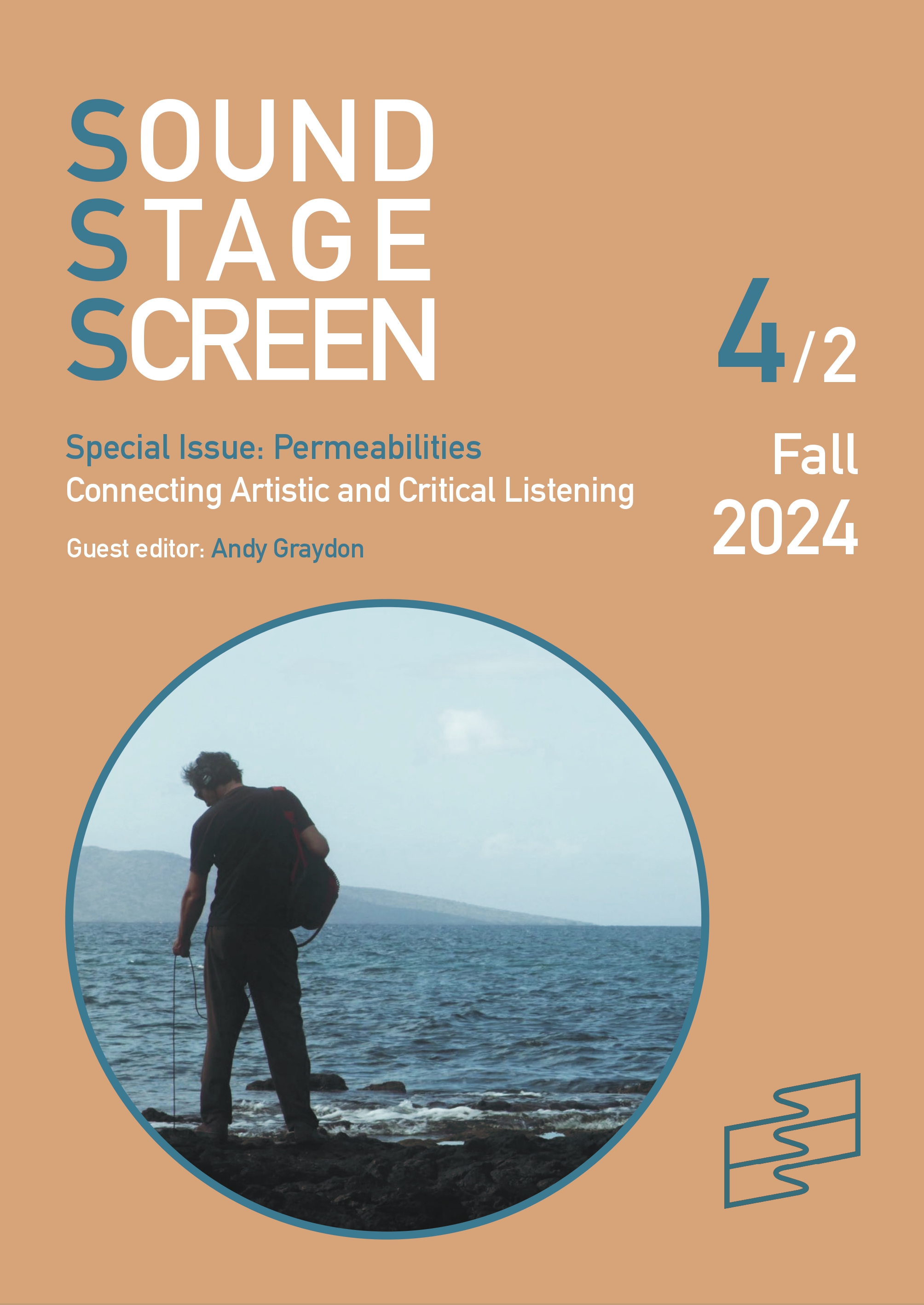
How to Cite
Abstract
In speculating on how an infant human emerges into consciousness, William James deployed the active acoustic and haptic metaphor of a buzzing confusion, resonating in a sensing body. Resonance enters us as music, sound, acousma, timbre, and even subaural inputs. Per Veit Erlmann, resonance opens us to different ways of listening and being and thinking in a world of oscillating matter. As Erlmann chronicles, the body’s equipment (eye and ear, but also soul and viscera) have a history – most pointedly, the moment in which they were understood to be capable of sympathetic vibrations. Thus, by the time of James, the resonating subject is one posited by science as possessing strings and hairs, hammers and drums, rods and cones – all of which resonate with various energies coming from the world. Still, despite the fact that much of the physics of sound developed around water experiments, those studying how the human body captured those resonant properties ignored all the fluids in human bodies (notably, different fluid densities deployed by the basilar membrane in the inner ear). The Helmholtzian “piano key” approach dominated how music and sound were understood well up until the mid-20th century. To understand resonance viscerally, we would need Pauline Oliveros to compose music from the unpitched, uncoordinated, but moistly vocalizing co-resonating humans (Teach Yourself to Fly,1970). We would need Max Neuhaus to appeal to our fluid interfaces by resonating us under water (Water Whistle, 1971). And emergently, we might want Jana Winderen reminding us that creaturely resonances vibrate in frequencies and places we need our techno-prostheses to access (Aquaculture, 2010; Planktonium 2024).
References
Agrawal, Tanushree and Adena Schachner. “Hearing Water Temperature: Characterizing the Development of Nuanced Perception of Sound Sources.” Developmental Science 26, no. 3 (2023): e13321.
Bennett, Jane. Vibrant Matter: A Political Ecology of Things. Durham, NC: Duke University Press, 2010.
Bruss, David M. and Jack A. Shohet. “Neuroanatomy, Ear.” StatPearls (2023). https://www.ncbi.nlm.nih.gov/books/NBK551658/.
Cage, John. Silence: Lectures and Writings. Middletown, CT: Wesleyan University Press, 1961.
Chion, Michel. “The Three Listening Modes.” In Audio-Vision: Sound on Screen, 25–34. Translated by Claudia Gorbman. New York: Columbia University Press, 2019.
Cott, Jonathan. “Max Neuhaus, the Floating Composer.” Rolling Stone, August 19, 1971, 18.
Cox, Christoph. Sonic Flux: Sound, Art and Metaphysics. Chicago: University of Chicago Press, 2018.
Denes, Peter B. and Elliot N. Pinson. The Speech Chain: The Physics and Biology of Spoken Language. Long Grove: Waveland Press, 2015.
Eidsheim, Nina. “Sensing Voice: Materiality and the Lived Body in Singing and Listening.” The Senses and Society, 6, no. 2 (2011): 133–55.
Erlmann, Veit. Reason and Resonance: A History of Modern Aurality. New York: Zone, 2010.
Goodman, Steve. Sonic Warfare: Sound, Affect, and the Ecology of Fear. Cambridge, MA: MIT Press, 2009.
Heller-Roazen, Daniel. The Fifth Hammer: Pythagoras and the Disharmony of the World. New York: Zone, 2011.
Helmreich, Stefan. “Gravity’s Reverb: Listening to Space-Time, or Articulating the Sounds of Gravitational-Wave Detection.” Cultural Anthropology 31, no. 4 (2016): 464–92.
Hendren, Sara. “The White Cane as Technology.” The Atlantic. November 6, 2013. https://www.theatlantic.com/technology/archive/2013/11/the-white-cane-as-technology/281167/.
Kane, Brian. “Sound Studies without Auditory Culture: A Critique of the Ontological Turn.” Sound Studies 1, no. 1 (2015): 2–21.
Kruss, Aleksandra. “Underwater Sound: Discovering a Liquid Reality.” Leviathan Cycle. https://leviathan-cycle.com/essays/underwater-sound/. Accessed November 23, 2024.
Lenoir, Timothy. “Helmholtz & the Materialities of Communication.” Osiris 9 (1994): 184–207.
Lucier, Alvin and Brian Kane. “Resonance.” In Experience: Culture, Cognition, and the Common Sense, 134–42. Cambridge, MA: MIT Press, 2016.
Oliveros, Pauline. Sonic Meditations. Sharon: Smith Publications, 1971.
Pantalony, David. “Variations on a Theme: The Movement of Acoustic Resonators through Multiple Contexts.” Sound & Science (July 17, 2019). https://soundandscience.net/contributor-essays/variations-on-a-theme-the-movement-of-acoustic-resonators-through-multiple-contexts/.
Princenthal, Nancy. “The Sounds of Violence: Max Neuhaus’ Project.” Artforum (May 1982): 70–1.
Robinson, Dylan. Hungry Listening: Resonant theory for Indigenous sound studies. Minneapolis: University of Minnesota Press, 2020.
Rosa, Harmut. Resonance: A Sociology of our Relation to the World. Cambridge: Polity, 2019.
Seeley, Thomas. Honeybee Democracy. Princeton: Princeton University Press, 2010.
Sherman, Robert. “N.Y.U. Concert Wets Whistles for More.” The New York Times, May 9, 1971, 61.
Voegelin, Salomé. Sonic Possible Worlds: Hearing the Continuum of Sound. London: Bloomsbury, 2021.
Ziporyn, Evan. “Visiting Artist Arnold Dreyblatt’s Magnetic Resonances.” MIT Center for Art, Science & Technology, March 19, 2013. https://arts.mit.edu/arnold-dreyblatts-magnetic-resonances/.

This work is licensed under a Creative Commons Attribution-ShareAlike 4.0 International License.
Copyright (c) 2025 Caroline A. Jones