Mapping the distribution of the Eurasian Hoopoe Upupa epops and the Pine Processionary Moth in Lebanon based on a Citizen Science approach
DOI:
https://doi.org/10.30456/avo.2023104Parole chiave:
Citizen Science, Eurasian Hoopoe, Pine Processionary Moth, Distribution maps, Lebanon BiodiversityAbstract
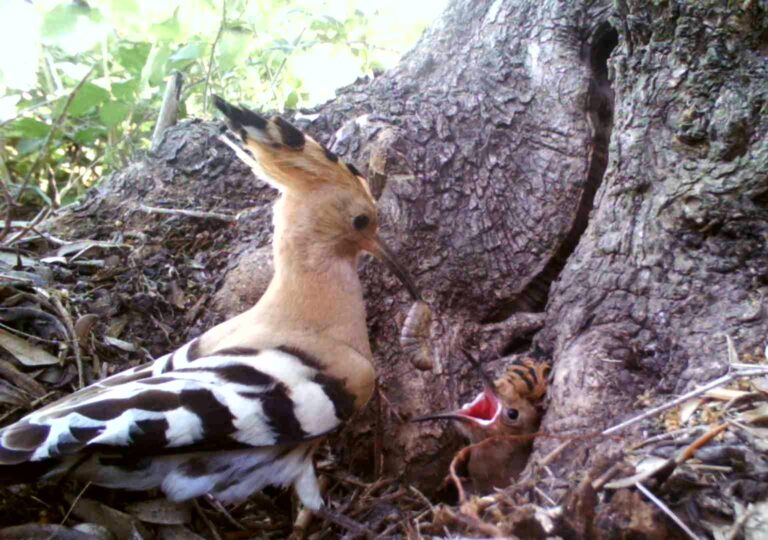
The Pine Processionary Moth (PPM) Thaumetopoea wilkinsoni has long been attacking Mediterranean forests. In its management strategy, Lebanon has focused mainly on pesticides, leaving natural predators as an understudied control option. This study aims to understand the distribution of the Eurasian Hoopoe Upupa epops, by assessing the damage caused by the PPM. We attempted to explain the distribution of the two species, their relation to other factors and, with a Citizen Science (CS) approach, we developed their distribution maps. We found that the varying PPM damage between cadastral units was linked to Important Bird Areas (IBAs), highlighting the importance of multiple birds, including the Eurasian Hoopoe, as natural predators of this pest and calling for their conservation. As understudied species in Lebanon, this paper sets the path and offers guidelines for future researchers willing to work on similar crucial research in a climate change context and reveal the underlying relation between the two species.Downloads
Riferimenti bibliografici
Annessi M., De Biase A. & Montemaggiori A., 2022. Diet and foraging ecology of the Hoopoe Upupa epops in a Mediterranean area of Central Italy. Avocetta 46: 77-85.
Barbaro L. & Battisti A., 2011. Birds as predators of the pine processionary moth (Lepidoptera: Notodontidae). Biological Control 56: 107-114. DOI: https://doi.org/10.1016/j.biocontrol.2010.10.009
Battisti A., 1986. Observations on the predation of Thaumetopoea pityocampa by the Hoopoe Upupa epops. Avocetta 10: 119 121.
Battisti A., Bernardi M. & Ghiraldo C., 2000. Predation by the Hoopoe (Upupa epops) on pupae of Thaumetopoea pityocampa and the likely influence on other natural enemies. BioControl 45: 311-323. DOI: https://doi.org/10.1023/A:1009992321465
Battisti A., Stastny M., Netherer S., Robinet C, […] & Larsson S., 2005. Expansion of geographic range in the pine processionary moth caused by increased winter temperatures. Ecological Applications 15: 2084-2096. DOI: https://doi.org/10.1890/04-1903
Battisti A., Avci M., Avtzis D., Lahbib M, […] & Zamoum M., 2015. Natural history of the Processionary Moths (Thaumetopoea spp.): New insights in relation to climate change. In: Roques A., Processionary Moths and Climate Change: An Update. Springer-Quae, Dordrecht-Versailles: 15-80. DOI: https://doi.org/10.1007/978-94-017-9340-7_2
Battisti A., Larsson S., & Roques A., 2017. Processionary Moths and Associated Urtication Risk: Global Change Driven Effects. Annual Review of Entomology 62: 323 342. DOI: https://doi.org/10.1146/annurev-ento-031616-034918
Bonamonte D., Foti C., Vestita M. & Angelini G., 2013. Skin reactions to Pine Processionary Moth Thaumetopoea pityocampa Schiff. Scientific World Journal 27: 867431. DOI: https://doi.org/10.1155/2013/867431
Bonney R., Cooper C., Dickinson J., Kelling S., […] & Shirk J., 2009. Citizen Science: A Developing Tool for Expanding Science Knowledge and Scientific Literacy. BioScience 59: 977-984. DOI: https://doi.org/10.1525/bio.2009.59.11.9
Brochet A., Van Den Bossche W., Jbour S. Ndang’ang’a P., […] & Butchart S., 2016. Preliminary assessment of the scope and scale of illegal killing and taking of birds in the Mediterranean. Bird Conservation International 26: 1-28. DOI: https://doi.org/10.1017/S0959270915000416
Démolin G., 1969. Comportement des adultes de Thaumetopoea pityocampa Schiff. Dispersion spatiale, importance écologique. Annales des sciences forestières 26: 81-102. DOI: https://doi.org/10.1051/forest/19690104
ESRI, 2014. ArcMap Desktop version 10.3. Environmental Systems Research Institute, California, USA.
GPAI, 2022. Biodiversity & Artificial Intelligence, Opportunities and Recommendations. Global Partnership on AI, Paris, France.
Habre R.M., 1992. Nature of Lebanon: The Human Environment. UNICEF Peace Education Program, Beirut, Lebanon, pp. 74-82.
Hodar J. & Zamora R., 2004. Herbivory and climatic warming: A Mediterranean outbreaking caterpillar attacks a relict, boreal pine species. Biodiversity and Conservation 13: 493-500. DOI: https://doi.org/10.1023/B:BIOC.0000009495.95589.a7
Houri A. & Doughan D., 2006. Behaviour Patterns of the Pine Processionary Moth (Thaumetopoea wilkinsoni Tams; Lepidoptera: Thaumetopoeidae). American Journal of Agricultural and Biological Sciences 1: 1-5. DOI: https://doi.org/10.3844/ajabssp.2006.1.5
Huchon H. & Démolin G., 1970. La bioécologie de la Processionnaire du pin: dispersion potentielle, dispersion actuelle. Revue Forestière Française 22: 220-234. DOI: https://doi.org/10.4267/2042/20421
Lebanese Environment Forum. 2015. CEPF Final Completion Report of the “Promoting Responsible Hunting Practices in Lebanon using Community Based Approach” project. LEF, Beirut, Lebanon.
Mitri G., 2007. The State of Lebanon’s Forests. Association for Forest Development and Conservation, Beirut, Lebanon.
MoA Ministry of Agriculture, 2005. National Forest and Tree Assessment and Inventory. Ministry of Agriculture, Beirut, Lebanon. MoE Ministry of Environment, 2014. Field guide to the soaring birds in Lebanon. Dar Bilal for Printing and Publishing. Beirut, Lebanon.
MoE, 2015. Fifth national report of Lebanon to the convention on biological diversity. Ministry of Environment, Beirut, Lebanon.
MoE, UNEP & GEF, 2016. National Biodiversity Strategy and Action Plan – NBSAP. Ministry of Environment, Beirut, Lebanon.
Raine A., Hirschfeld A., Attard G., Scott L., […] & Driskill S., 2021. The international dimension of illegal bird hunting in Lebanon. Sandgrouse 43 (2): 230-240.
Ramadan-Jaradi G. & Itani F., 2019. Birds of Lebanon a Photographic Guide to 404 Species. Association for Bird Conservation in Lebanon, Beirut, Lebanon.
SPNL, 2015. Responsible Hunting Areas Distribution in Lebanon. Beirut, Lebanon.
StatSoft, 2013. STATISTICA 12.0: Data Analysis and Visualization Program. Oklahoma, USA.
Tohme G. & Tohme H., 1986. Birds of Lebanon. Lebanese University Publications, Natural Science Division, Beirut, Lebanon.
Wilkinson D.S., 1926. The Cyprus Processionary Caterpillar. (Thaumetopoea wilkinsoni, Tams.). Bulletin of Entomological Research 17(2): 163-182. DOI: https://doi.org/10.1017/S0007485300019209
Zalles J.L. & Bildstein K.L., 2000. Raptor Watch: A global directory of raptor migration sites. Birdlife International, Cambridge, UK.
Ziprkowski L. & Rolant F., 1972. Study of Toxins from Poison Hairs of Thaumetopoea wilkinsoni Caterpillars. Journal of Investigative Dermatology 58: 247-277. DOI: https://doi.org/10.1111/1523-1747.ep12540278
Pubblicato
Come citare
Fascicolo
Sezione
Licenza
Copyright (c) 2025 Leila Rossa Mouawad, Salim Kattar, Jad Rizkallah, Dany El Obeid, Samara P. El Haddad, Karma Bou Azza

Questo lavoro è fornito con la licenza Creative Commons Attribuzione - Condividi allo stesso modo 4.0.