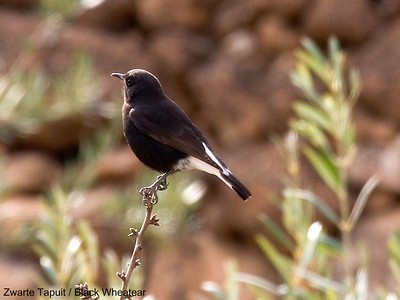
Diet and prey availability of the Black Wheatear Oenanthe leucura in the El Hodna region (M’Sila, Algeria)
DOI:
https://doi.org/10.30456/avo.2023106Keywords:
Black Wheatear, food availability, diet, faecal samples, M’Sila, AlgeriaAbstract
The Black Wheatear Oenanthe leucura is distributed in the arid rocky landscapes of the Iberian Peninsula and North Africa. The species is insectivorous in the South of Europe, while its diet has not yet been studied in the North-African population. In this study, we looked into its prey choice and availability in the El Hodna area of M’Sila, Algeria. Prey availability was estimated during the breeding season 2020 by means of Pitfall traps, butterfly net, sweep net and sight hunting method. The prey groups consumed by the species in winter 2019 and spring 2020 were determined by using 219 faecal samples found on the different perches. Faecal samples analysis revealed 1656 prey items. The species’ diet is dominated by insects, which may be related to the great abundance of this prey group in the habitat. The Black Wheatear’s main food resources were ants, orthopterans and beetles. In the winter, the most consumed prey groups ranged in size from 7.31 to 13.25 mm, whereas in the spring, they ranged from 1.5 to 7.37 mm. The most abundant taxonomic group during the breeding season were insects (RA = 97.64%), and Hymenoptera was the most widely accessible (RA = 72.6%) in the habitat of the species because of the apparent abundance of ants (RA = 71.14%). We determined the Ivlev index (Li), which enables a comparison between the species’ diet and the prey abundance in the habitat. According to the Ivlev Index, the Black Wheatear is an opportunistic bird, catching the majority of the area’s available prey.
Downloads
References
A.N.A.T. 2007. Town planning, Commune of M’sila. Albouy V. & Richard D., 2017. Guide des Coléoptères d’Europe. Paris: Deachaux et Niestlé.
Aznar F.J. & Ibáñez-Agulleiro M. 2016. The function of stones in nest building: The case of Black Wheatear (Oenanthe leucura) revisited. Avian Biology Research 9:3–12. DOI: https://doi.org/10.3184/175815516X14453568107719
Belovsky G.E. & Slade J.B. 1993. The role of vertebrate and invertebrate predators in a grasshopper community. Oikos: 193–201. DOI: https://doi.org/10.2307/3544830
Belkacem R., Bougaham A.F., Gagaoua M. & Moulaï R. 2019. Food profile of Grey Wagtail Motacilla cinerea during an annual cycle in the Algerian Babors Mountains of North Africa. Ostrich 90: 45–52. DOI: https://doi.org/10.2989/00306525.2018.1543214
Benkhelil M.L. 1992. Les techniques de récolte et de piégeage utilisées en Entomologie terrestre. Ed. Off. Pub. Univ, Alger, 60 p.
Blanchet A. & Heldt J. 1951. Oiseaux de Tunisie. I. Région de Sousse et Sahel. Mémoires de la Société des Sciences Naturelles de Tunisie.
Blondel J., Ferry C. & Frochot B. 1973. Avifaune et végétation, essai d’analyse de la diversité. Alauda 41: 63-84.
Boudeffa K. 2015. Ecologie d’une population de gobemouches de l’Atlas Ficedula speculigera dans la région d’El Kala: reproduction, régime alimentaire et parasitose. PhD thesis. Université Badji Mokhtar, Annaba, Algeria.
Brennan L.A. & Morrison M.L. 1990. Influence of sample size on interpretations of foraging patterns by Chestnut-Backed Chickadees. Studies in avian biology 13: 187–192.
Calver M.C. & Wooller R.D. 1982. A technique for assessing the taxa, length, dry weight and energy content of the arthropod prey of birds. Wildlife Research 9: 293–301. DOI: https://doi.org/10.1071/WR9820293
Charrier S. 2002. Clé de détermination des Coléoptères Lucanides et Scarabéides de Vendée et de l’Ouest de la France. Le Naturaliste Vendéen 2: 61-93.
Chinery M. 2005. Insectes de France et d’Europe Occidentale. Flammarion.
Clarke K.R. & Warwick R.M. 2001. Change in marine communities. An approach to statistical analysis and interpretation 2: 1–68.
Cooper R.J. Martinat P.J. & Whitmore R.C., 1990. Dietary similarity among insectivorous birds: influence of taxonomic versus ecological categorization of prey. Studies in Avian Biology 13: 104–109.
Costello M.J. 1990. Predator feeding strategy and prey importance: a new graphical analysis. Journal of Fish Biology 36: 261–263. DOI: https://doi.org/10.1111/j.1095-8649.1990.tb05601.x
Cooper R.J. & Whitmore R.C. 1990. Arthropod sampling methods in ornithology. Studies in avian biology 13, 29–37.
Cramp S.I. (ed). 1988. Handbook of the birds of Europe, the Middle East and North of Africa: the birds of Western Paleartic. Vol. 5: Tyrant flycatchers to thrushes. Oxford Univ. Press, New York.
Dajoz R. 1982. Précis d’écologie. ed. Gauthier-Villars: 522 p.
Estévanez C.A.B.A. 2021. Case of spatial coexistence among Black Wheatear Oenanthe leucura, Black-eared Wheatear Oenanthe hispanica and Blue Rock Thrush Monticola solitarius in the Western Mediterranean. Avocetta 45:95-103.
Ferguson-lees J. 1960. Studies of less familiar birds, 109. Black Wheatear. Brit. Birds 53: 553–558.
Géroudet P. 1963. La vie des oiseaux: les passereaux 2. Niestlé, Neuchâtel.
Heim De Balsac H. & Mayaud N. 1962. Oiseaux du nordouest de l’Afrique. Paris, Lechevalier.
Hódar J.A. 1993. Relaciones tróficas entre los passeriformes insectívorosen dos zonas semiáridas del surestepeninsular. PhD. Diss. Univ. Granada.
Hódar J.A. 1994. La alimentación de Sylvia undata y Sylvia conspicillata en una zona semiàrida del sureste peninsular. Ardeola, 41: 55–58.
Hódar J.A. 1995. Diet of the Black Wheatear Oenanthe leucura in two shrub steppe zones of south eastern Spain. Alauda, 63: 229–235.
Hódar J.A. 1998. Diet of the Black-eared Wheatear Oenanthe hispanica in relation to food availability in two shrub steppes. Avocetta, 22: 35–40.
Hódar J.A. 2006. Diet composition and prey choice of the Southern grey shrike Lanius meridionalis L. in South-eastern Spain: the importance of vertebrates in the diet. Ardeola, 53 (2): 237–249.
Holmes R.T. 1986. Foraging patterns of forest birds: malefemale differences. The Wilson Bulletin: 196–213.
Hutto R.L. 1990. Measuring the availability of food resources. Studies in avian biology 13: 20–28.
Isenmann P. & Moali A. 2000. Oiseaux d’Algérie. Birds of Algeria. Ed. SEOF, Paris: 336 p.
Ivlev V.S. 1961. Experimental Ecology of the Feeding of Fishes. New Haven, CT: Yale Univ. Press: 302 p.
Jacobs J. 1974. Quantitative measurement of food selection: a modification of the forage ratio and Ivlev’s electivity index. Oecologia 14: 413–417. DOI: https://doi.org/10.1007/BF00384581
Jones D. Emerit M. & Ledoux J.C., 2001. Présentation guide des araignées et des opilions d’europe-anatomie, biologie, habitat, distribution. Delachaux et Niestlé.
Ledant J.N. Jacob J.N., Jacob J., Malher F., Ochando B. & Roché J., 1981. Mise à jour de l’avifaune algérienne. Le Gerfaut 71: 295–398.
Le Houérou H.N. 1995. Bioclimatologie et biogéographie des steppes arides du Nord de l’Afrique. Options Méditerr. B (10): 1-396.
Le Houérou H.N. 2009. Bioclimatology and biogeography of Africa. Ed. Springer-Verlag, Berlin Heidelberg: 241 p. DOI: https://doi.org/10.1007/978-3-540-85192-9
Moreno J., Soler M. Møller A.P. & Linden M. 1994. The function of stone carrying in the Black Wheatear, Oenanthe leucura. Animal Behaviour 47: 1297–1309. DOI: https://doi.org/10.1006/anbe.1994.1178
Moreno J. 1997. Collalba Negra. Oenanthe leucura. In: Purroy F.J. (eds). Atlas de las aves de España (1975-1995). Lynx Edicions, Barcelona. pp. 376-377.
Morrison M.L. Ralph C.J. & Verner J., 1990. Avian foraging: theory, methodology, and applications. Studies in avian biology 13: 1–2.
Noguera M., Aute F.X. & Santaeufemia F.X. 2014. Situació del Còlitnegre Oenanthe leucura al massís del Garrafi paper de les pedreres costaneresen la seva conservació. Revista Catalana d’Ornitologia 30: 41–53.
P.D.A.U. 2007. Master line of Installation and Town planning, Commune of M’sila.
Peris S.J. 1980. Biología del estornino negro (Sturnus unicolor Temm.): 1. Alimentación y variación de la dieta. Ardeola 25: 207–240.
Picot-lapeyrouse Baron P. 1790. Description et histoire du Traquet montagnard. Histoire et mémoires de l’Académie royale des Sciences, inscriptions et Belles-lettres de Toulouse 4: 186–188.
Polchaninova N.Y. 2012. Assemblages of herb-dwelling spiders (Araneae) of various steppe types in Ukraine and the Central Chernozem region of Russia. Arachnologische Mitteilungen 43: 66–78. DOI: https://doi.org/10.5431/aramit4312
Prodon R. 1985. Introduction à la biologie du Traquet rieur (Oenanthe leucura) en France. Alauda 53: 295–305.
Ralph C.P., Nagata S.E. & Ralph C.J. 1985. Analysis of droppings to describe diets of small birds. Journal of Field Ornithology 56: 165–174.
Ramade F. 1984. Eléments d’écologie – écologie fondamentale. Ed. McGraw-Hill Inc, Paris, 397 p.
Ramírez J. & Soler M. 2004. Collalba Negra. In: Martí R. & del Moral J.C. (eds): Atlas de las aves reproductoras de España. Madrid: SEO-Ministerio de Medio Ambiente. Pp 436-437.
Richardson F. 1965. Breeding and feeding habits of the Black Wheatear Oenanthe leucura in Southern Spain. Ibis 107: 1–17. DOI: https://doi.org/10.1111/j.1474-919X.1965.tb07278.x
Royama T. 1970. Factors governing the hunting behaviour and selection of food by the great tit (Parus major L.). The Journal of Animal Ecology: 619–668. DOI: https://doi.org/10.2307/2858
Sanz J. & Fernández J. 1996. Proceedings of the International Symposium on Conservation of Steppe birds and their habitat. Junta de Castilla y León, Valladolid.
Scherrer B. 1984. Biostatistique. Ed. Gaetan Morin. 850 p.
Soler M., Zúñiga J.M. & Camacho L. 1983. Alimentación y reproducción de algunas aves de la Hoya de Guadix (Sur de España). Trab. Monogr. Dep. Zool. Univ. Granada (S.N.) 6: 27-100.
Soler M., Moreno J., Møller A.P., Lindén M. & Soler J.J. 1995. Determinants of reproductive success in a Mediterranean multi-brooded passerine: the Black Wheatear Oenanthe leucura. Journal für Ornithologie 136: 17–27. DOI: https://doi.org/10.1007/BF01647204
Soler M. 1997. Oenanthe leucura Black wheater. In: Hagemeijer W.J.M. & Blair M.J. (eds). The EBCC Atlas of European breeding birds: Their distribution and abundance. T. &. Poyser AD. London.
Sörensen T. 1948. A method of establishing groups of equal amplitude in plant sociology based on similarity of species content and its application to analyses of the vegetation on Danish commons. Videnski Selsk. Biol. Skr. 5: 1–34.
Sturges H.A. 1926. The choice of a class interval. Journal of the American Statistical Association 21: 65–66. DOI: https://doi.org/10.1080/01621459.1926.10502161
Tatner P., 1983. The diet of urban Magpies Pica pica. Ibis 125: 90–107. DOI: https://doi.org/10.1111/j.1474-919X.1983.tb03086.x
Todó F.X.A. & Ribot J.C. 2009. Estat de la població de Còlit Negre (Oenanthe leucura) al Parc natural de la Muntanya de Montserrat i voltants.
Ueckert D.N., Yang S.P. & Albin R.C. 1972. Biological value of rangeland grasshoppers as a protein concentrate. Journal of economic entomology 65: 1286–1288. DOI: https://doi.org/10.1093/jee/65.5.1286
Vaurie C. 1959. The Birds of the Palearctic Fauna. A Systematic Reference. Order Passeriformes. HF. Witherby Ltd., London.
Vignes J.-C. 2011. Succès de la reproduction et rythmes de nourrissage de la Bergeronnette des ruisseaux (Motacilla cinerea) en nichoir artificiel. 0001_FA2011/ fauneaquitaine. org. 4pp, Bordeaux.
Voos K.H. 1960. Atlas of European Birds. New York: Nelson.
Winchester N.N. & Scudder G.G.E. 1993. Methodology for sampling terrestrial arthropods in British Columbia. Resource Inventory Committee, BC Ministry of Environment, Lands and Parks.
Witherby H.F., Jourdaifn C.R., Ticehursnt F. & Tuckerb W. 1938. The handbook of British birds 2: 165–167. London: Witherby.
Yi Z., Jinchao F., Dayuan X., Weiguo S. & Axmacher J.C. 2012. A comparison of terrestrial arthropod sampling methods. Journal of Resources and Ecology 3: 174–182. DOI: https://doi.org/10.5814/j.issn.1674-764x.2012.02.010
Zaime A. & Gautier J.Y. 1989. Comparaison des régimes alimentaires de trois espèces sympatriques de Gerbillidae en milieu saharien au Maroc. Rev. Ecol. Terre et vie 44:263-278. DOI: https://doi.org/10.3406/revec.1989.5510
Zamora R. 1990. Interspecific aggression by the Wheatear in a high-mountain passerine community. Ornis scandinavica 21: 57–62. DOI: https://doi.org/10.2307/3676379
Zemouri M., Asloune L., Adrar A., Bouchareb A. & Bougaham A.F. 2021. Nestling diet of the Algerian Nuthatch Sitta ledanti, an endemic threatened bird in Babors’ Kabylia region (north-eastern Algeria). Ostrich: 1-9. DOI: https://doi.org/10.2989/00306525.2021.1923582
Downloads
Published
How to Cite
Issue
Section
License

This work is licensed under a Creative Commons Attribution-ShareAlike 4.0 International License.