First deployment of IoT tracking devices on Common swift Apus apus: a pilot study
DOI:
https://doi.org/10.30456/avo.2024117Keywords:
tracking, IoT devices, movement ecology, bio-logging, Apus apusAbstract
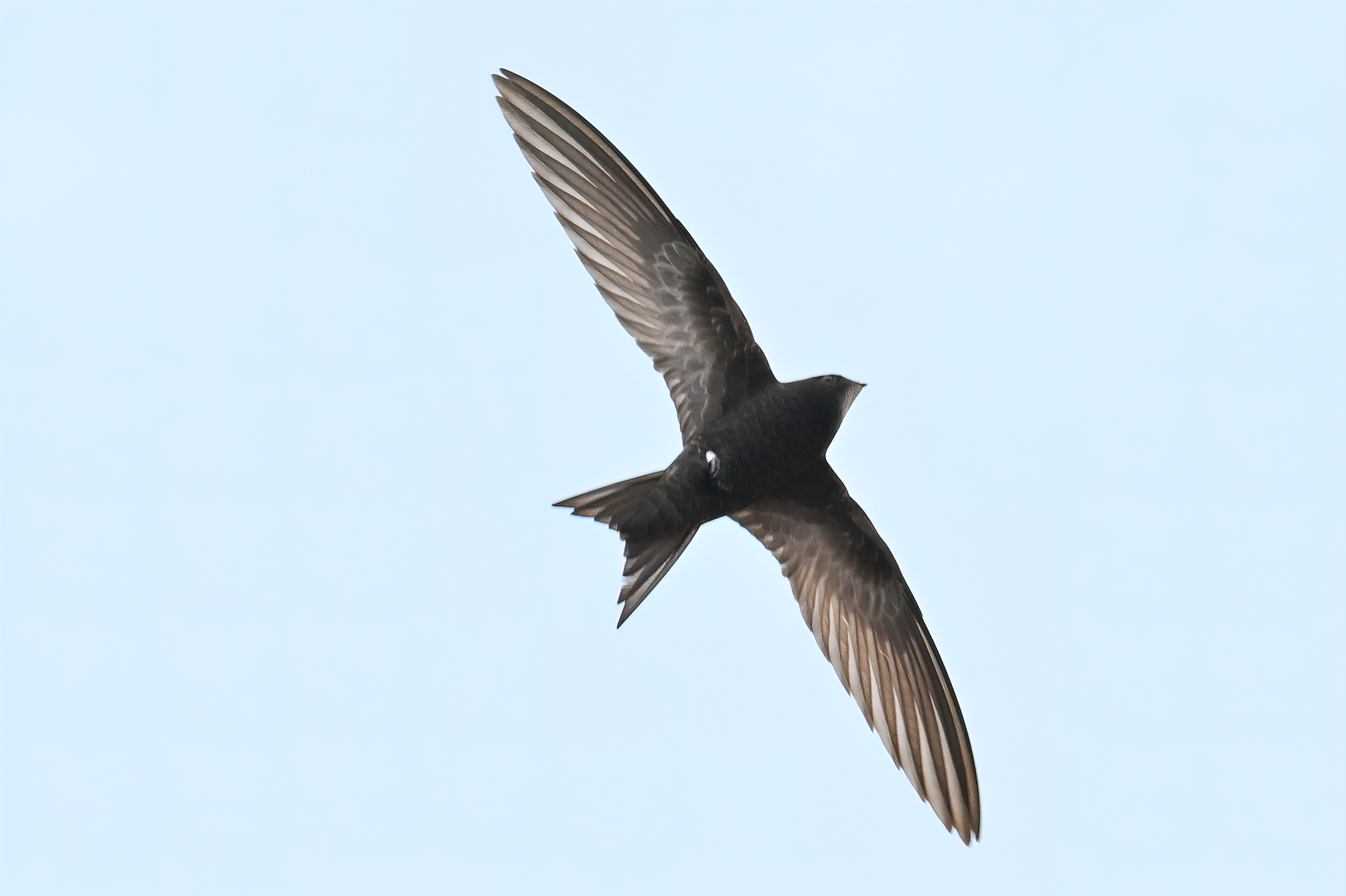
Five breeding adults of Common swift Apus apus from a north Italian colony were equipped with lightweight (1.2 g) tracking devices based on IoT (Internet of Things) technology, collecting location data and transmitting them through the Sigfox network of base stations. The main novelty is that these devices enable the real-time transmission of locations with no need for re-capturing. The devices were glued to the back feathers, which were to be lost during moult at the latest. The devices transmitted over variable periods (3-25 days, mean ± SD: 9.31 ± 11.8), collecting in total a mean ± SD of 17.58 ± 18.4 locations per individual. These data mostly recorded movements around the colony, except for one bird that migrated immediately after tagging. This bird was successfully tracked until reaching southern Spain, where transmissions ended because the IoT network is not available out of continental Europe, with a few exceptions. This pilot study demonstrates that swifts can be successfully tagged with lightweight devices without harnessing. While single-direction migration displacements can be successfully tracked over the EU with these devices, researchers need improvements in both the location quality of the Sigfox IoT network and the life length of the devices if they aim to study the details of foraging movements. Eventually, we stress that beyond pure research purposes, tracking swifts through IoT devices—which transmit real-time data to the Animal Tracker mobile app—may also effectively engage the public and enhance conservation awareness.
Downloads
References
Amichai E. & Kronfeld-Schor N. 2019. Artificial light at night promotes activity throughout the night in nesting common swifts (Apus apus). Scientific Reports 9: 11052. DOI: https://doi.org/10.1038/s41598-019-47544-3
Åkesson S., Klaassen R., Holmgren J., Fox J.W. & Hedenström A. 2012. Migration routes and strategies in a highly aerial migrant, the common swift Apus apus, revealed by light-level geolocators. PloS One 7: e41195 DOI: https://doi.org/10.1371/journal.pone.0041195
Biles K.S., Bednarz J.C., Schulwitz S.E. & Johnson J.A. 2023. Tracking device attachment methods for American Kestrels: Backpack versus leg-loop harnesses. Journal of Raptor Research 57: 304-313. DOI: https://doi.org/10.3356/JRR-22-13
Bloch I., Troupin D., Toledo S., Nathan R. & Sapir N. 2024 (preprint). Combining radio-telemetry and radar measurements to test optimal foraging in an aerial insectivore bird eLife 13:RP96573https://doi.org/10.7554/eLife.96573.1 DOI: https://doi.org/10.7554/eLife.96573
Brlík V., Kolecek J., Burgess M., […] & Procházka P. 2020. Weak effects of geolocators on small birds: A metaanalysis controlled for phylogeny and publication bias. Journal of Animal Ecology 89:207-220. DOI: https://doi.org/10.1111/1365-2656.12962
Carere C. & Alleva E. 1998. Sex differences in parental care in the common swift (Apus apus): effect of brood size and nestling age. Canadian Journal of Zoology 76: 1382-1387. DOI: https://doi.org/10.1139/z98-073
Demongin, L. 2016. Identification guide to birds in the hand. Privately published.
FranceDokter A.M., Åkesson S., Beekhuis H., Bouten W., Buurma L., van Gasteren H. & Holleman I. 2013. Twilight ascents by common swifts, Apus apus, at dawn and dusk: acquisition of orientation cues? Animal Behaviour 85: 545–552. DOI: https://doi.org/10.1016/j.anbehav.2012.12.006
Ferrari A. 2021. BSc thesis - Cure parentali in una coppia di Rondone Comune Apus apus in provincia di Varese. Università degli Studi dell’ Insubria, Corso di Laurea in Scienze dell’Ambiente e della Natura, aa. 2021/2022.
Ferri M. 2018. Le «rondonare»: come attrarre i rondoni negli edifici, dal medioevo ai nostri giorni. Atti Società dei Naturalisti e dei Matematici di Modena vol. 149.
Geen G.R., Robinson R.A. & Baillie S.R. 2019. Effects of tracking devices on individual birds–a review of the evidence. Journal of Avian Biology 50: e01823. DOI: https://doi.org/10.1111/jav.01823
Hedenström A., Norevik G., Warfvinge K., Andersson A., Bäckman J. & Åkesson S. 2016. Annual 10-Month Aerial Life Phase in the Common Swift Apus apus. Current Biology 26: 3066-3070. DOI: https://doi.org/10.1016/j.cub.2016.09.014
Hedenström A., Norevik G., Boano G., Andersson A., Bäckman J. & Åkesson S. 2019. Flight activity in pallid swifts Apus pallidus during the non‐breeding period. Journal of Avian Biology 50: e01972. DOI: https://doi.org/10.1111/jav.01972
Hedenström A., Sparks R.A., Norevik G., Woolley C., Levandoski G.J. & Åkesson S. 2022. Moonlight drives nocturnal vertical flight dynamics in black swifts. Current Biology 32: 1875-1881. DOI: https://doi.org/10.1016/j.cub.2022.03.006
Hijmans R.J., Karney C., Williams E. & Vennes C. 2022. geosphere: Spherical Trigonometry version 1.5.18. R package https://cran.rproject.org/web/packages/geosphere/index.html
Huang X., Zhao Y. & Liu Y. 2021. Using light-level geolocations to monitor incubation behaviour of a cavity-nesting bird Apus apus pekinensis. Avian Research 12: 1-6. DOI: https://doi.org/10.1186/s40657-021-00245-w
Hufkens, K., Meier, C. M., Evens, R., […] & Kearsley, L. 2023. Evaluating the effects of moonlight on the vertical flight profiles of three western Palaearctic swifts. Proceedings of the Royal Society B 290: 20230957. DOI: https://doi.org/10.1098/rspb.2023.0957
Jukema J., van de Wetering H. & Klaassen, R.H. 2015. Primary moult in non-breeding second-calendar-year Swifts Apus apus during summer in Europe. Ringing & Migration 30: 1-6. DOI: https://doi.org/10.1080/03078698.2015.1059632
Liechti F., Witvliet W., Weber R. & Bächler E. 2013. First evidence of a 200-day non-stop flight in a bird. Nature Communications 4: 2554. DOI: https://doi.org/10.1038/ncomms3554
Kiat Y. & Bloch I. 2023. The relationship of moult timing, duration and sequence to the aerial lifestyle of the Little Swift (Apus affinis). Ibis 165: 1331-1342. DOI: https://doi.org/10.1111/ibi.13209
Klaassen R., Klaassen H., Berghuis A., Berghuis M., Schreven K., van der Horst Y., Verkade H. & Kearsley L. 2014. Trekroutes en overwinteringsgebieden van Nederlandse Gierzwaluwen ontrafeld met geolocators. Limosa 87:173-181.
Kays R., Crofoot M.C., Jetz W. & Wikelski M. 2015. Terrestrial animal tracking as an eye on life and planet. Science 348:6240 aaa2478. DOI: https://doi.org/10.1126/science.aaa2478
Kays R., Davidson S.C., Berger M., Bohrer G., Fiedler W., Flack A., Hirt J., Hahn C., Gauggel D. & Russell B. 2022. The Movebank system for studying global animal movement and demography. Methods in Ecology and Evolution 13:419-431. DOI: https://doi.org/10.1111/2041-210X.13767
Kolzsch A., Davidson S.C., Gauggel D., […] & Safi K. 2022. MoveApps: a serverless no-code analysis platform for animal tracking data. Movement ecology 10:30. DOI: https://doi.org/10.1186/s40462-022-00327-4
Manica M., Casola D., Colombo L., Stocchetti A., Cavallaro C., Villa S., Morganti M., Parnell A., 2022. Birds tower and walls: three successful examples of rehabilitation in the province of Varese, Italy. 6th International Swift Conference, Segovia (Spain).
McKinlay S.E., Morganti M., Mazzoleni A., Labate A., Sorrenti M. & Rubolini D. 2024. Non-breeding ranging behaviour, habitat use, and pre-breeding migratory movements of Fieldfares (Turdus pilaris) wintering in southern Europe. Journal of Ornithology 165: 337-346. DOI: https://doi.org/10.1007/s10336-023-02136-x
Meier C.M., Karaardıç H., Aymí R., Peev S.G., Bächler E., Weber R., Witvliet W. & Liechti F. 2018. What makes Alpine swift ascend at twilight? Novel geolocators reveal year-round flight behaviour. Behavioral Ecology and Sociobiology , 72: 1-13. DOI: https://doi.org/10.1007/s00265-017-2438-6
Morganti M., Assandri G., Aguirre J.I., Ramirez Á., Caffi M. & Pulido F. 2017. How residents behave: home range flexibility and dominance over migrants in a Mediterranean passerine. Animal Behaviour 123: 293-304. DOI: https://doi.org/10.1016/j.anbehav.2016.10.021
Morganti M., Rubolini D., Åkesson S., Bermejo A., De la Puente J., […] & Ambrosini R. 2018. Effect of light‐level geolocators on apparent survival of two highly aerial swift species. Journal of Avian Biology 49: jav-01521. DOI: https://doi.org/10.1111/jav.01521
Nathan R., Getz W.M., Revilla E., Holyoak M., Kadmon R., Saltz D. & Smouse P.E. 2008. A movement ecology paradigm for unifying organismal movement research. Proceedings of the National Academy of Sciences 105: 19052-19059. DOI: https://doi.org/10.1073/pnas.0800375105
Nilsson C., Bäckman J. & Dokter A.M. 2019. Flocking behaviour in the twilight ascents of Common Swifts Apus apus. Ibis 161:674-678. DOI: https://doi.org/10.1111/ibi.12704
Norevik G., Boano G., Hedenström A., Lardelli R., Liechti F. & Åkesson S. 2019. Highly mobile insectivorous swifts perform multiple intra‐tropical migrations to exploit an asynchronous African phenology. Oikos 128: 640-648. DOI: https://doi.org/10.1111/oik.05531
O’Connell M. J., Squirrell F.I. & Greening M. 2023. A preliminary study of the winter roosting behaviour of four woodland passerines. Bird Study 70: 243–250. DOI: https://doi.org/10.1080/00063657.2023.2269329
Qasem L., Cardew A., Wilson A., Griffiths I., Halsey L.G., […] & Wilson R. 2012. Tri-axial dynamic acceleration as a proxy for animal energy expenditure; should we be summing values or calculating the vector? PloS one 7: e31187. DOI: https://doi.org/10.1371/journal.pone.0031187
R core team 2022. R: A language and environment for statistical computing. R foundation for statistical computing, Vienna, Austria. Version 4.2.2
Raim A. 1978. A radio transmitter attachment for small passerine birds. Bird-Banding 49: 326-332. DOI: https://doi.org/10.2307/4512391
Schaub T., Meffert P.J. & Kerth G. 2016. Nest-boxes for Common Swifts Apus apus as compensatory measures in the context of building renovation: efficacy and predictors of occupancy. Bird Conservation International 26: 164-176. DOI: https://doi.org/10.1017/S0959270914000525
Schaub T., Wellbrock A.H.J., Rozman, J. & Witte K. 2020. Light data from geolocation reveal patterns of nest visit frequency and suitable conditions for efficient nest site monitoring in Common Swifts Apus apus, Bird Study 66: 519. DOI: https://doi.org/10.1080/00063657.2020.1732862
Wild T.A., van Schalkwyk L., Viljoen P., Heine G., […] & Wikelski M. 2023. A multi -species evaluation of digital wildlife monitoring using the Sigfox IoT network. Animal Biotelemetry 11:13. DOI: https://doi.org/10.1186/s40317-023-00326-1
Wellbrock A.H.J., Bauch C., Rozman J. & Witte K. 2017. 'Same procedure as last year?' Repeatedly tracked swifts show individual consistency in migration pattern in successive years. Journal of Avian Biology 48: 897-903 DOI: https://doi.org/10.1111/jav.01251
Wellbrock A.H.J., Armer H., Bäuerlein C., Bäuerlein K., Brünner K., Kelsey N.A., Rozman J. & Witte K. 2017. GPS macht´s möglich! – Pilotstudie zur Identifizierung der Jagdgebiete von Mauerseglern Apus apus aus Kolonien im Landkries Roth. Vogelwarte 56: 413-414.
Wellbrock A.H.J. & Witte K. 2022. No “carry-over” effects of tracking devices on return rate and parameters determining reproductive success in once and repeatedly tagged common swifts (Apus apus), a long-distance migratory bird. Movement Ecology 10:58 DOI: https://doi.org/10.1186/s40462-022-00357-y
Zhao Y., Zhao X., Wu L., Mu T., Yu F., […] & Liu Y. 2022. A 30,000-km journey by Apus apus pekinensis tracks arid lands between northern China and south-western Africa. Movement Ecology 10: 29. DOI: https://doi.org/10.1186/s40462-022-00329-2
Downloads
Published
How to Cite
Issue
Section
License

This work is licensed under a Creative Commons Attribution-ShareAlike 4.0 International License.