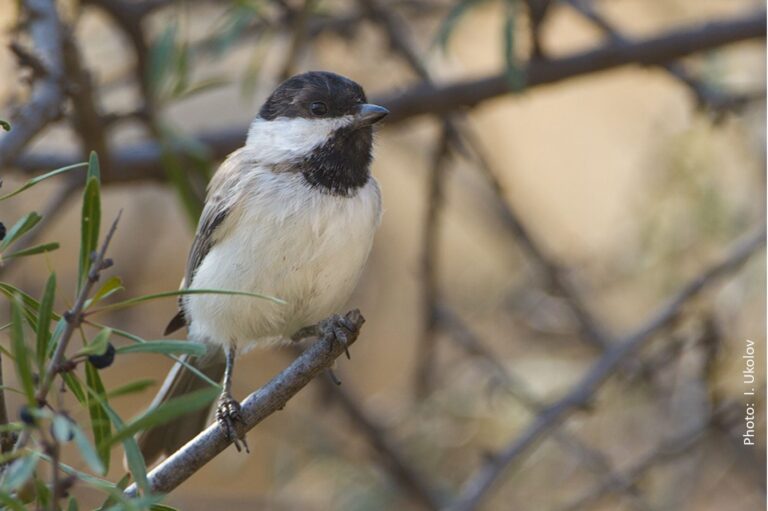
The state of Sombre Tit Poecile lugubris Temminck, 1820 in Armenia
DOI:
https://doi.org/10.30456/avo.2024107Parole chiave:
Sombre Tit, Poecile lugubris, Armenia, Conservation status, Population dynamics, ThreatsAbstract
The Sombre Tit Poecile lugubris is very little studied species, and within Armenia, it occurs only in the south-eastern regions of the country. The current study aims at providing data for the next assessment of the conservation status of Sombre Tit in Armenia, based on the data collected from 2003-2019. The obtained data show that Sombre Tits have slightly expanded their distribution to the north; their current Area of Occupancy makes 94 km2, while the Extent of Occurrence covers 1,065 km2. The population of Sombre Tit makes from 910 to 1,350 breeding pairs. During observed 17 years (2003-2019), the population trend of the species computed for the Meghri region of Armenia can be considered stable (Imputed Overall Slope: Additive = 0.0017 ± 0.0109; Multiplicative = 1.0017 ± 0.0109; P > 0.05), although demonstrates relatively strong fluctuations. The conservation status of Sombre Tit in Armenia should be revised, as it can correspond to the category Endangered, according to criteria C2a(ii). The main factors that can influence the species in Armenia are forest fires, which are relatively common in south-eastern Armenia, and the use of pesticides for forest pest control.
Downloads
Riferimenti bibliografici
Adamian M. & Klem D., 1999. Handbook of the Birds of Armenia. American University of Armenia, California.
Aghababyan K., 2024. Birds as potential bioindicators for terrestrial ecosystems. International Journal of Life Science Research Archive 06(01): 001–022. https://doi.org/10.53771/ijlsra.2024.6.1.0112
Aghababyan K., Khanamirian G., Khachatryan A., Martirosyan B., […] & Baloyan S., 2022. Evaluation of Importance of Teksar Mountain of Armenia for Bird and Butterfly Protection. International Journal of Zoology and Animal Biology 5(5): 1-14. https://doi.org/10.23880/izab-16000401
Aghababyan K.E., Ter-Voskanyan H., Tumanyan S. & Khachatryan A., 2015. First National Atlas of the Birds of Armenia. Bird Census News 28 (2): European Atlas News 52–58.
Aghasyan A. & Kalashyan M. (eds.), 2010. The Red Book of Animals of the Republic of Armenia. Yerevan, Ministry of Nature Protection.
Baghdasarian A., Abrahamian G., Alexandrian G. & Zohrabian L., 1971. Physical geography of the Armenian SSR, soil cover. Academy of Sciences of the Armenian SSR, Yerevan. Armenia. [In Russian]
BirdLife International, 2015. Parus lugubris. In: European Red List of Birds. Retrieved from http://datazone.birdlife.org/userfiles/file/Species/erlob/summarypdfs/22711698_parus_lugubris.pdf on 30th of Aug 2023.
BirdLife International, 2017. Poecile lugubris (amended version of 2016 assessment). The IUCN Red List of Threatened Species 2017: e.T103761494A112869701. Retrieved from https://dx.doi.org/10.2305/IUCN. UK.2017-1.RLTS.T103761494A112869701.en. on 25th of Jan 2024.
BirdLife International, 2021. Poecile lugubris (Europe assessment). The IUCN Red List of Threatened Species 2021: e.T103761494A200217700. Retrieved from https://dx.doi.org/10.2305/IUCN.UK.2021-3.RLTS. T103761494A200217700.en. on 25th of Jan 2024.
Burfield I. & van Bommel F. (eds.), 2004. Birds in Europe: Population Estimates, Trends and Conservations Status. BirdLife Conservation Series 12. BirdLife International, Cambridge, UK.
Catsadorakis G. & Källander H., 1999 Densities, habitat and breeding parameters of the Sombre Tit Parus lugubris in Prespa National Park, Greece. Bird Study 46:3, 373-375, DOI: 10.1080/00063659909461153
Cramp S. & Perrins C.M., 1993. Handbook of the birds of Europe, the Middle East and Africa. The birds of the western Palearctic vol VII: flycatchers to shrikes. Oxford University Press, Oxford.
Dahl S.K., 1954. Fauna of the Armenian SSR. Vertebrates. Academy of Sciences of Armenian SSR, Yerevan, Armenia. [In Russian]
Dimitrova M., Brambilla M. & Nikolov B.P., 2020. Habitat preferences of Sombre Tit (Poecile lugubris) in a karst environment. Ornis Fennica 97: 79–88.
ESRI, 2011. ArcGIS Desktop: Release 10. Redlands, CA: Environmental Systems Research Institute.
Gillings S., Balmer D.E. & Fuller R.J., 2015. Directionality of recent bird distribution shifts and climate change in Great Britain. Global Change Biology 21: 2155–2168. https://doi.org/10.1111/gcb.12823
Gosler A., Clement P. & Kirwan G.M., 2019. Sombre Tit (Poecile lugubris). In: del Hoyo J., Elliott A., Sargatal J.,Christie D.A. & de Juana E. (eds.). Handbook of the Birds of the World Alive. Lynx Edicions, Barcelona. (retrieved from https://www.hbw.com/node/59858 on 8 December 2023).
Hitch A.T. & Leberg P.L., 2007. Breeding Distributions of North American Bird Species Moving North as a Result of Climate Change. Conservation Biology 21: 534–539. https://doi.org/10.1111/j.1523-1739.2006.00609.x
IUCN Standards and Petitions Committee, 2019. Guidelines for Using the IUCN Red List Categories and Criteria. Version 14. Prepared by the Standards and Petitions Committee.
Lehikoinen A. & Virkkala R., 2016. North by north-west: climate change and directions of density shifts in birds. Global Change Biology 22: 1121–1129. https://doi.org/10.1111/gcb.13150
Leonovich V., Zhuravlev M. & Adamian M., 1970. The distribution and biology of Sombre Tit in Southern Transcaucasia. Academy of Science of Armenian SSR. Biological Journal of Armenia 23(8): 71-78.
Pannekoek J. & van Strien A.J., 2005. TRIM 3 Manual (TRends & Indices for Monitoring data). Statistics Netherlands, Voorburg, the Netherlands. Retrieved from https://www.ebcc.info/art-13/ on 16 December 2021).
Peifer H., 2011. About the EEA reference grid. European Environment Agency. Retrieved from https://www.eionet.europa.eu/workspace/docs/about-the-eea-referencegrid.pdf on 21st of Sep 2020.
Rakovic M. 2005. Sombre Tit Parus lugubris in Serbia and Montenegro – a review of historical and recent data with suggestions regarding its distribution and habitat. Acrocephalus 26(126): 139–145.
Stewart P.S., Voskamp A., Santini L., Biber M.F., […] & Tobias J.A., 2022. Global impacts of climate change on avian functional diversity. Ecology Letters 25: 673–685.
Van Strien A., Pannekoek J., Hagelmeijer W. & Verstrael T., 2004. A loglinear Poisson regression method to analyse bird monitoring data. In: Anselin A. (ed.), Bird Numbers 1995, Proceedings of the International Conference and 13th Meeting of the European Bird Census Council, Pärnu, Estonia. Bird Census News 13(2000): 33–39.
Voříšek P., Klvaňová A., Wotton S. & Gregory R.D., 2008. A best practice guide for wild bird monitoring schemes. First edition. RSPB/CSO.
Dowloads
Pubblicato
Come citare
Fascicolo
Sezione
Licenza

Questo lavoro è fornito con la licenza Creative Commons Attribuzione - Condividi allo stesso modo 4.0.