Gardening on oceanic islands: the non-native Great Kiskadee Pitangus sulphuratus as a potential seed disperser of the alien invasive Murraya paniculata in Bermuda
DOI:
https://doi.org/10.30456/avo.2023107Parole chiave:
Alien species, Bermuda, Invasive species, Kiskadee, Mutualism, Murraya paniculata, Oceanic island, Seed dispersalAbstract
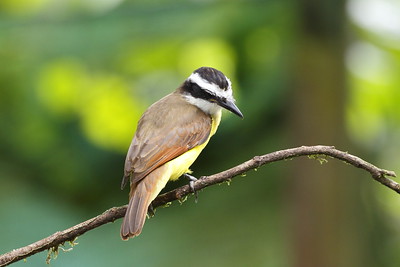
On vulnerable oceanic island ecosystems, non-native species may form novel mutualistic interactions with one another and foster establishment. On Bermuda, the omnivorous Great Kiskadee Pitangus sulphuratus was introduced to control the invasive Anolis lizard population, but feeds on many other species of plants and animals. Here we investigated whether the Kiskadee may act as an effective seed disperser of the introduced alien plant, the Orange Jessamine Murraya paniculata. In 2022 and 2023 we collected pellets regurgitated by Kiskadees, and found that 96% (N=26) contained Jessamine seeds. In 2023 we carried out an experiment to compare the germination rates of whole Jessamine fruits with manually de-fleshed seeds and those extracted from Kiskadee regurgitates. Across groups, Jessamine seeds germinated 52.6% of the time. We found only a non-significant tendency for de-fleshed seeds to germinate more often than seeds with flesh (67% vs 49%). Our study highlights that Kiskadee can act as an effective seed disperser of Jessamine in an oceanic island ecosystem.
Downloads
Riferimenti bibliografici
Aslan C.E., Zavaleta E.S., Tershy B. & Croll D. 2013. Mutualism Disruption Threatens Global Plant Biodiversity: A Systematic Review. PLoS ONE 8(6): e66993. https://doi.org/10.1371/journal.pone.0066993 DOI: https://doi.org/10.1371/journal.pone.0066993
Barnea A., Yom-Tov Y. & Friedman J. 1990. Differential germination of two closely related species of Solanum in response to bird ingestion. Oikos 57: 222-228. DOI: https://doi.org/10.2307/3565943
Bates D., Maechler M., Bolker B. & Walker S. 2015. Fitting Linear Mixed-Effects Models Using lme4. Journal of Statistical Software 67: 1-48. DOI: https://doi.org/10.18637/jss.v067.i01
Bermuda’s Plantfinder: Invasive and Indigenous Plants 2016. https://www.gov.bm/sites/default/files/plantfinder-april-2016.pdf
Brush T. & Fitzpatrick J.W. 2002. Great Kiskadee (Pitangus sulphuratus). In: Poole A.F. & Gill F.B. (eds), Birds of North America. Cornell Lab of Ornithology, Ithaca, New York. https://doi.org/10.2173/bna.622 DOI: https://doi.org/10.2173/bna.622
CABI Invasive Species Compendium 2020. Wallingford, UK: CAB International. https://doi.org/10.1079/cabicompendium.35178 DOI: https://doi.org/10.1079/cabicompendium.35178
Crowell K. & Crowell M. 1976. Bermuda’s abundant, beleaguered birds. Natural History 85: 48-56.
da Paz Pereira Z. & Melo C. 2012. Nestling’s pellets of the Great Kiskadee (Pitangus sulphuratus) in Brazilian urban environment. Ornitologia Neotropical 23: 269-276.
Dodson C.G. & Gentry A.H. 1978. Flora of the Rio Palenque Science Centre. Selbyana 4: 1-623.
Downs C.T. & Hart L.A. 2020. Invasive Birds: Global Trends and Impacts. CABI: Wallingford, UK; Boston, MA, USA. DOI: https://doi.org/10.1079/9781789242065.0000
Elton C.S. 1958. The Ecology of Invasions by Animals and Plants. Methuen Co., London. 181 pp. DOI: https://doi.org/10.1007/978-1-4899-7214-9
Gilman E.F. 1999. Murraya paniculata. (Fact Sheet FPS-416). Gainesville, Florida, USA: Environmental Horticulture Department, Florida Cooperative Extension Service, Institute of Food and Agricultural Sciences, University of Florida.3 pp. http://hort.ufl.edu/shrubs/MURPANA.pdf
Gleditsch J.M. & Sperry J.H. 2019. Rapid morphological change of nonnative frugivores on the Hawaiian island of O'ahu. Evolution 73: 1456-1465 https://doi.org/10.1111/evo.13744 DOI: https://doi.org/10.1111/evo.13744
Hoddle M.S. 2004. Restoring Balance: Using Exotic Species to Control Invasive Exotic Species. Conservation Biology 18: 38-49. DOI: https://doi.org/10.1111/j.1523-1739.2004.00249.x
Latino S. & Beltze R.A. 1999. Ecologia tróficadel benteveo Pitangus sulphuratus (Aves: Tyrannidae) en el valle de inundación del río Paraná, Argentina. Orsis 14: 69-78.
Lieberman M. & Lieberman D. 1986. An experimental study of seed ingestion and germination in a plan-animal assemblage in Ghana. Journal of Tropical Ecology 2: 113-126. DOI: https://doi.org/10.1017/S0266467400000717
Mejías M. & Nol E. 2020. Woodland size and vegetation effects on resident and non-resident woodland birds in Bermuda. Journal of Caribbean Ornithology 33: 22-32. DOI: https://doi.org/10.55431/jco.2020.33.22-32
National Parks Board 2020. Flora and fauna web. In: Flora and fauna web, Singapore: National Parks Board. http://florafaunaweb.nparks.gov.sg/Home.aspx
PIER 2018. Pacific Islands Ecosystems at Risk. In: Pacific Islands Ecosystems at Risk Honolulu, Hawaii, USA: HEAR, University of Hawaii. http://www.hear.org/pier/index.html
Pikart T.G., Souza G.K., Serrão J.E. & Zanuncio J.C. 2011. Leafcutter ants: a small dispersal agent of the invasive plant Murraya paniculata. Weed Research 51: 548-551. DOI: https://doi.org/10.1111/j.1365-3180.2011.00881.x
R Core Team 2023. R: A Language and Environment for Statistical Computing. R Foundation for Statistical Computing, Vienna, Austria. https://www.R-project.org
Reed C.I. & Reed B.P. 1928. The mechanism of pellet formation in the Great Horned Owl (Bubo virginianus). Science 68: 359-360. DOI: https://doi.org/10.1126/science.68.1763.359
Sterrer W. 1998. How many species are there in Bermuda? Bulletin of Marine Science, 62(3): 809-840.
Traveset A. & Richardson D.M. 2006. Biological invasions as disruptors of plant reproductive mutualisms. Trends in Ecology and Evolution 21: 208-216. DOI: https://doi.org/10.1016/j.tree.2006.01.006
Traveset A., Riera N. & Mas R.E. 2001. Passage through bird guts causes interspecific differences in seed germination characteristics. Functional Ecology 15: 669-675 https://doi.org/10.1046/j.0269-8463.2001.00561.x DOI: https://doi.org/10.1046/j.0269-8463.2001.00561.x
Van der Pijl L. 1972. Principles of Dispersal in Higher Plants. Springer-Verlag, New York. DOI: https://doi.org/10.1007/978-3-642-96108-3
Vitousek P.M. 1988. Diversity and biological Invasions of Oceanic Islands. In: Wilson E.O. & Frances M.P. (eds), Biodiversity. National Academies Press, Harvard University, Washington (DC), pp 181-189.
Wang L.K., Chan M., Chan YM., Tan G.C. & Wee Y.C. 2009. Pellet-casting by non-raptorial birds of Singapore. Nature in Singapore 2: 97-106.
White E.M., Vivian-Smith G. & Gosper C.R. 2006. In: 15th Australian Weeds Conference, Papers and Proceedings, Adelaide, South Australia, Managing weeds in a changing climate pp. 63-66.
Wolsak S., Wingate D. & Cronk Q. 2018. Environmental change in the terrestrial vegetation of Bermuda: Revisiting Harshberger (1905). Brittonia 70: 257-275. https://doi.org/10.1007/s12228-017-9509-x DOI: https://doi.org/10.1007/s12228-017-9509-x
Wood J.R., Alcover J.A., Blackburn T.M., Bover P., [...] & Wilmshurst J.M. 2017. Island extinctions: Processes, patterns, and potential for ecosystem restoration. Environmental Conservation 44: 348-358. https://doi. org/10.1017/S037689291700039X DOI: https://doi.org/10.1017/S037689291700039X
Pubblicato
Come citare
Fascicolo
Sezione
Licenza

Questo lavoro è fornito con la licenza Creative Commons Attribuzione - Condividi allo stesso modo 4.0.