Population size and breeding success of the Scopoli’s Shearwater on Lampione Islet
DOI:
https://doi.org/10.30456/avo.2024113Parole chiave:
Italy, Pelagie islands, breeding success, Scopoli’s Shearwater, Calonectris diomedeaAbstract
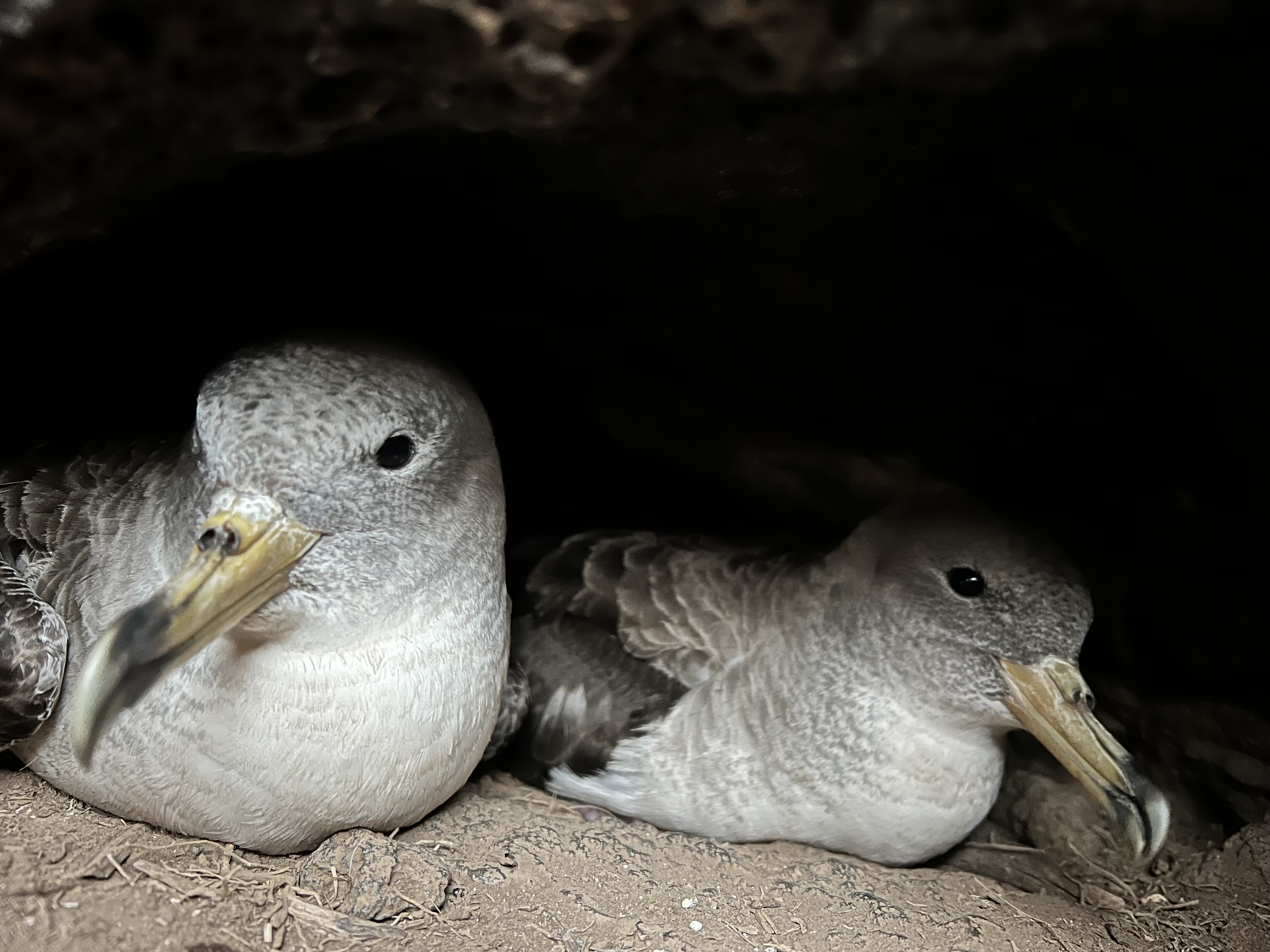
The islet of Lampione, located in the archipelago of the Pelagie islands (Sicily channel), is known to be the Italian southernmost breeding site for the Scopoli’s Shearwater Calonectris diomedea. So far, there was little information on the number of Shearwaters attending the islet and on the status of this breeding population. Therefore, during an eight-year study period, we determined the active nests used by the birds and assessed the annual breeding success of the population on a subset of study nests. Counts of the active nests and of the birds attending the rafts at sea revealed a breeding population of approx. 230 pairs, which makes the islet the fifth-largest breeding colony among the Italian islands. Breeding success on Lampione ranged from 39.7% and 70.8% and was about 30% lower compared to that measured in the nearby colony of Linosa. Breeding failure on Lampione in 2018 was mainly due to predation on chicks by Yellow-legged Gulls Larus michaellis, but predation was later reduced by improving the concealing of existing burrows and the construction of artificial nests. We also observed intraspecific competition for nest sites. Our findings show the importance of the islet of Lampione, and of the Pelagie archipelago, for the conservation of this species.
Downloads
Riferimenti bibliografici
Baccetti N., Capizzi D., Massa B. & Nissardi S. 2009. Breeding shearwaters on Italian islands: population size, island selection and co-existence with their main alien predator, the black rat. Rivista italiana di Ornitologia 78: 83-100.
BirdLife International, European Red List of Birds, 2021.
Capizzi D., Baccetti N. & Sposimo P. 2010. Prioritizing rat eradication on islands by cost and effectiveness to protect nesting seabirds. Biological Conservation, 143: 1716-1727. DOI: https://doi.org/10.1016/j.biocon.2010.04.020
Dell’Omo G. 2020. State of the knowledge on the Scopoli Shearwater Calonectris Diomedea breeding on Linosa island (Pelagie Archipelago, Sicilian Channel). In: La Mantia T., Badalamenti E., Carapezza A., Lo Cascio P. & Troia A. (eds.), Life on islands. 1. Biodiversity in Sicily and surrounding islands. Studies dedicated to Bruno Massa. Edizioni Danaus, Palermo, pp 331-339.
Du Rau P.D., Bourgeois K., Thévenet M., Ruffino L., […] & Renou S. 2015. Reassessment of the size of the Scopoli’s Shearwater population at its main breeding site resulted in a tenfold increase: Implications for the species conservation. Journal of Ornithology 156: 877-892. DOI: https://doi.org/10.1007/s10336-015-1187-4
Giglioli H.E. 1889. Primo resoconto dei risultati dell’Inchiesta Ornitologica. Parte I. Avifauna Italica. Le Monnier, Firenze.
Giglioli H.E. 1890. Primo resoconto dei risultati dell’Inchiesta Ornitologica. Parte II. Avifaune locali. Le Monnier, Firenze. DOI: https://doi.org/10.5962/bhl.title.8360
Giglioli H.E., 1907. Secondo resoconto dei risultati dell'Inchiesta Ornitologica in Italia. Avifauna Italica. Tip. S. Giuseppe, Firenze.
Karris G., Xirouchakis S., Grivas K., Voulgaris M.D., […] & Giokas S. 2017. Estimating the population size of Scopoli’s shearwaters (Calonectris diomedea) frequenting the Strofades islands (Ionian Sea, Western Greece) by raft counts and survey of breeding pairs. North-Western. Journal of Zoology 13: 101-108.
Lo Cascio P. & Pasta S., 2012. Lampione, a paradigmatic case of Mediterranean island biodiversity. Journal of Biodiversity 3: 311-330.
Massa B., Lo Cascio P., Ientile R., Canale E.D. & La Mantia T. 2015. Gli Uccelli delle isole circumsiciliane. Il Naturalista Siciliano 39: 105-373.
Massa B. & Lo Valvo M. 1986. Biometrical and Biological Considerations on the Cory’s Shearwater Calonectris diomedea. in: MEDMARAVIS & Monbailliu X. (eds.), Mediterranean Marine Avifauna. NATO ASI Series (Series G: Ecological Sciences). Vol. 12, Springer, Berlin, Heidelberg, pp. 293-313. DOI: https://doi.org/10.1007/978-3-642-70895-4_18
Moltoni E. 1970. Gli uccelli ad oggi riscontrati nelle isole di Linosa, Lampedusa e Lampione (lsole Pelagie, Canale di Sicilia, Mediterraneo). Rivista Italiana di Ornitologia 40: 77-283.
Mougin J.L., Jouanin C. & Roux F. 2000. Demography of Cory’s shearwater Calonectris diomedea on Selvagem Grande. Revue d’Ecologie (Le Terre et la Vie) 55: 275-290. DOI: https://doi.org/10.3406/revec.2000.2331
Rodríguez B., Siverio F., Yarci Acosta Y. & Rodríguez A. 2022. Breeding success of Cory's Shearwater in relation to nest characteristics and predation by alien mammals. Ardeola 69: 115-128. DOI: https://doi.org/10.13157/arla.69.1.2022.sc1
Dowloads
Pubblicato
Come citare
Fascicolo
Sezione
Licenza

Questo lavoro è fornito con la licenza Creative Commons Attribuzione - Condividi allo stesso modo 4.0.