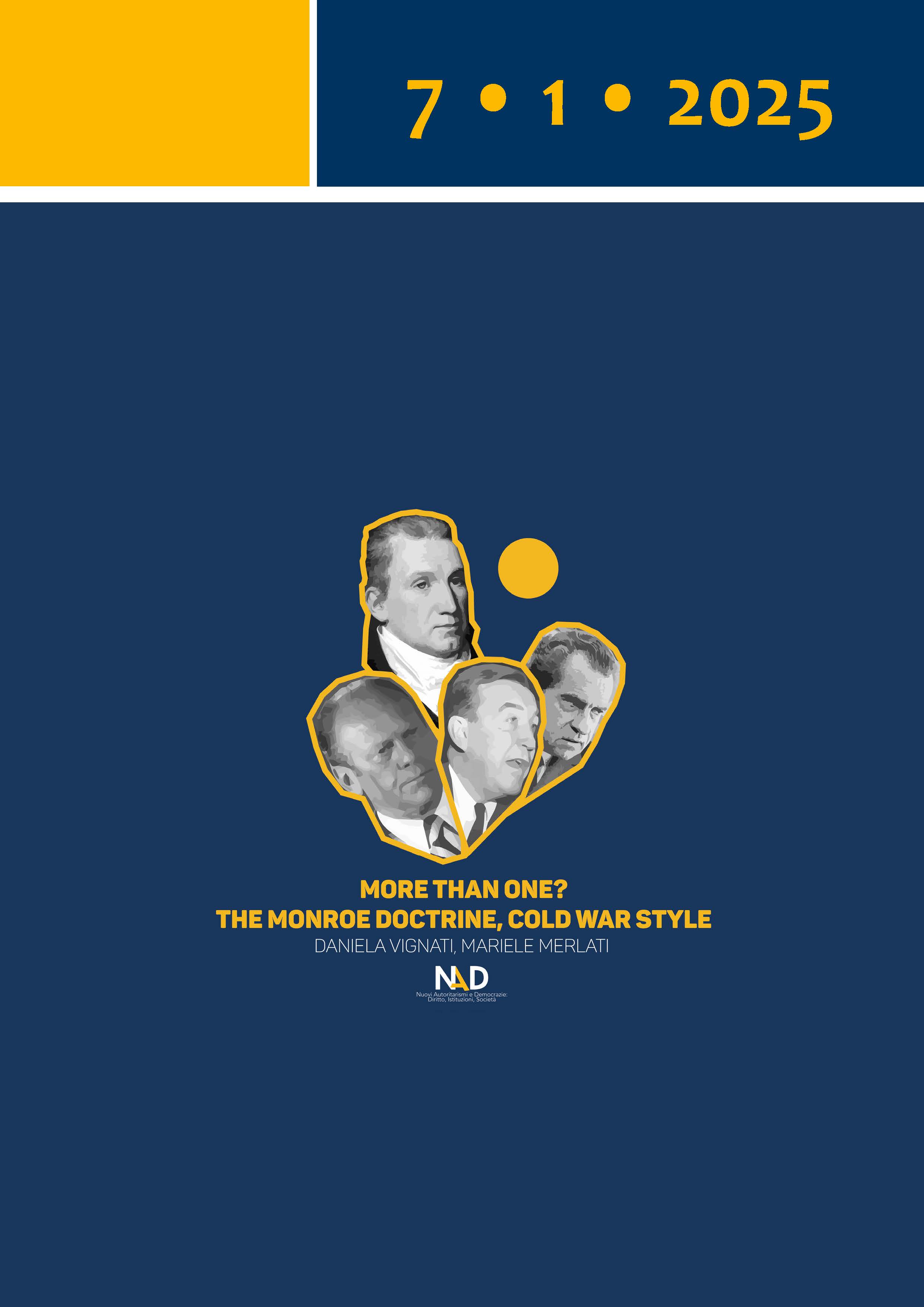
More than One? The Monroe Doctrine, Cold War Style
DOI:
https://doi.org/10.54103/2612-6672/28321Parole chiave:
Stati Uniti, India, Italia, Guerra fredda, Dottrina MonroeAbstract
La Dottrina Monroe ha continuato a ispirare la politica estera statunitense anche nel corso del XX secolo. Se da un lato è stata spesso esplicitamente citata come paradigma di politica estera, dall’altro il graduale ampliamento del perimetro di sicurezza degli Stati Uniti, soprattutto negli anni della Guerra Fredda, è stato interpretato come tacita espansione della sua portata. Considerando la Dottrina Monroe in questa duplice prospettiva, il saggio affronta due differenti momenti della politica estera statunitense in epoca bipolare: la prima parte analizza l’esplicito richiamo alla Dottrina proposto dall’ambasciatore Chester Bowles, che nel 1954 invocò una “Dottrina Monroe per l’Asia”; la seconda si sofferma su un esempio di “allargamento de facto” della Dottrina Monroe, individuabile nella politica delle amministrazioni Nixon e Ford rispetto alla questione comunista in Italia, volta a prevenire l’ingerenza dell’URSS in un'area che dalle origini della Guerra Fredda rientrava pienamente nel perimetro di sicurezza statunitense.
Dowloads
Pubblicato
Come citare
Fascicolo
Sezione
Licenza
Copyright (c) 2025 Mariele Merlati, Daniela Vignati

Questo lavoro è fornito con la licenza Creative Commons Attribuzione - Non commerciale - Non opere derivate 4.0 Internazionale.