Freedom of Press and Dictatorships in the 20th Century
DOI:
https://doi.org/10.54103/2612-6672/28655Keywords:
Chain Novel, Dictatorship, Fake News, Freedom of Press, Fundamental Rights.Abstract
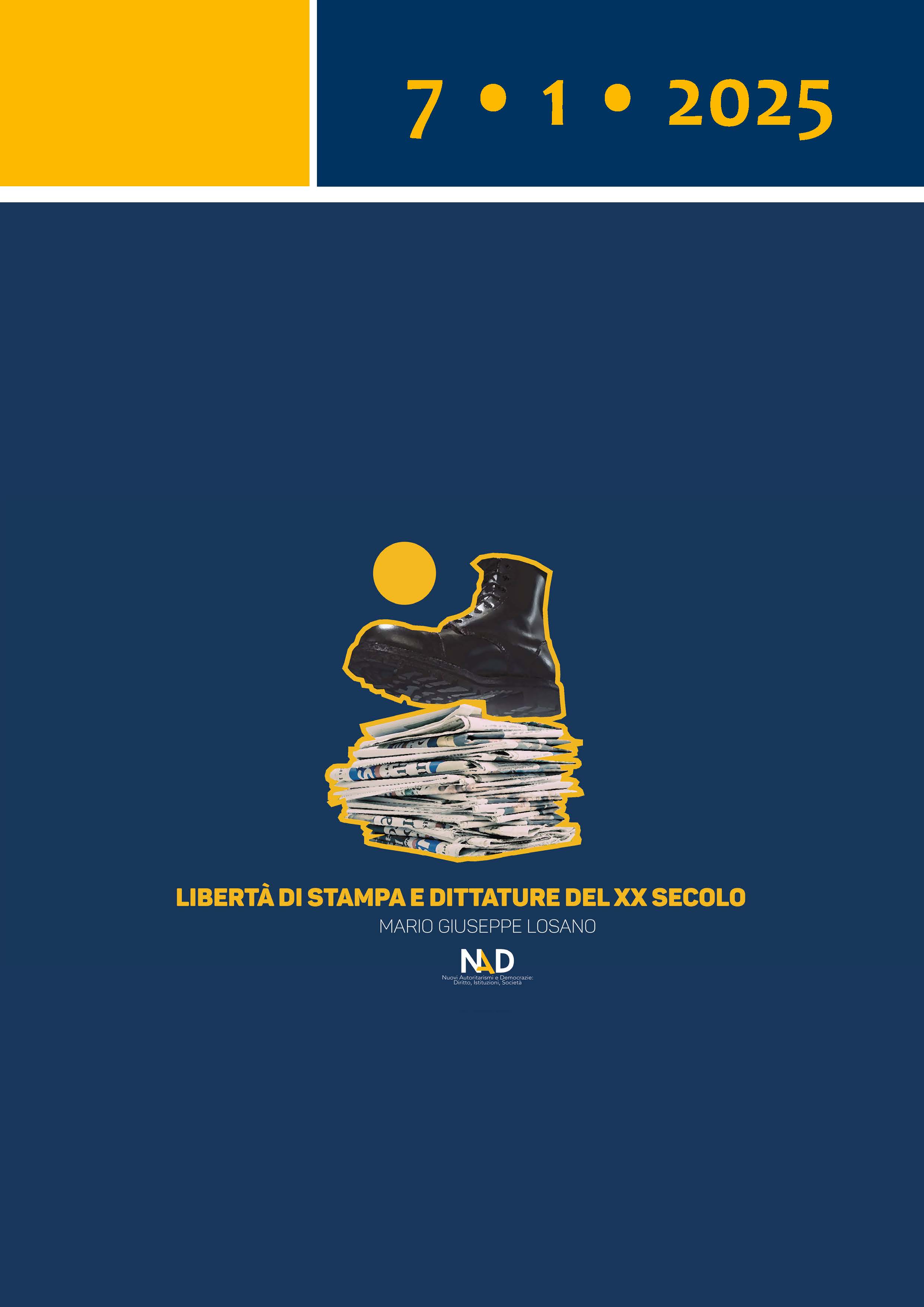
Dictatorships are always contrary to fundamental freedoms, in particular to freedom of expression. Under the autocratic governments of the 20th century, the constitutions of Spain, Portugal and Brazil provided for freedom of the press, which however was not respected. Spreading false news is always punishable. However, their diffusion has increased with social networks, and today’s judiciary of Brazil, for example, reacted against this diffusion.
References
- A.L. Deveza Martins da Rocha, Liberdade de imprensa durante as ditaduras de Salazar, Franco e Vargas e seus efeitos, Autografia, 2023
- M.G. Losano, Un modello italiano per l’economia nel Brasile di Getúlio Vargas: la “Carta del Lavoro” del 1927, in Rechtsgeschichte – Legal History. Zeitschrift des Max-Planck-Instituts für Europäische Rechtsgeschichte, 2012
- M.G. Losano, Alla ricerca della Terza Via: la “Carta del Lavoro” italiana del 1927 e la “Consolidação” di Getúlio Vargas, in J.A. Fontoura Costa et al. (eds.), Direito: Teoria e experiência. Estudos em homenagem a Eros Roberto Grau, Malheiros Editores, 2013, Tomo II
- H.-G. Gadamer, Ermeneutica e metodica universale, Nota e cura di Umberto Margiotta, Marietti, 1973
- R. Wacks, Understanding Jurisprudence. An Introduction to Legal Theory, Oxford University Press, 2005
Downloads
Published
How to Cite
Issue
Section
License
Copyright (c) 2025 Mario Giuseppe Losano

This work is licensed under a Creative Commons Attribution-NonCommercial-NoDerivatives 4.0 International License.