FOSSIL SNAKEFLY PUPAE FROM ABOUT 100 MILLION YEARS OLD AMBER REVEAL AN UNUSUAL MORPHOLOGY OF THE ANTENNAE
DOI:
https://doi.org/10.54103/2039-4942/22151Keywords:
Cretaceous; diversity; larva; Kachin amber; Raphidioptera.Abstract
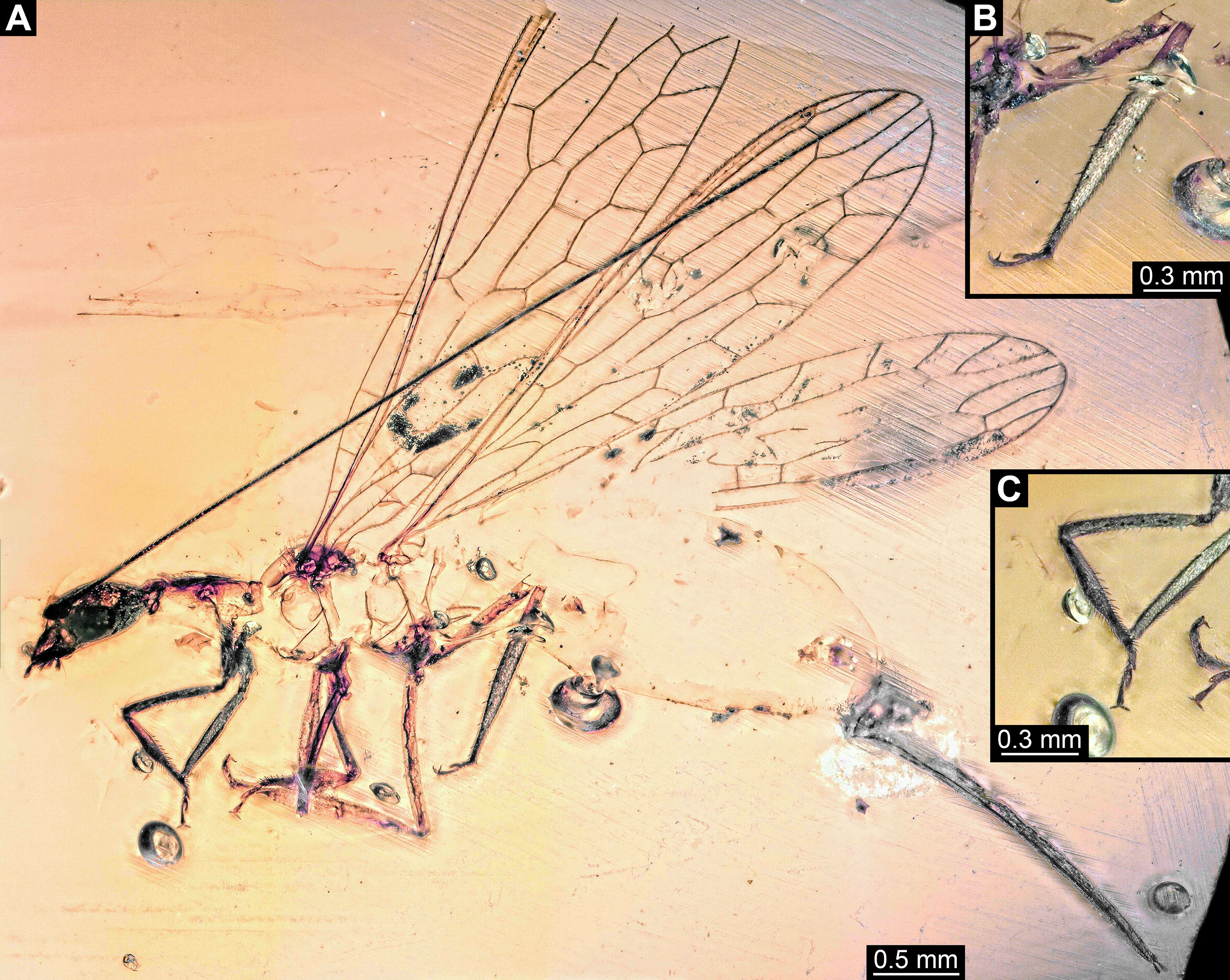
A key aspect of the holometabolan evolutionary success is their metamorphosis. It allows larvae and adults to exploit quite different resources and reduce competition between the two. The often strongly differing morphology of larvae and adults is mediated by the specific intermediate stage, the pupa. Fossil pupae provide valuable information for the reconstruction of the evolutionary history of this so important developmental stage. However, pupae are relatively rarely found in the fossil record, and they seem even less often depicted in the literature. Here, we report two new fossil pupae preserved in about 100 million years old Kachin amber, Myanmar. These represent the first fossil pupae of the group of snakeflies, Raphidioptera. The two specimens resemble modern snakefly pupae in overall morphology and especially in the morphology of the ovipositor. However, they also differ in certain aspects, indicating differences in developmental timing. One specimen is particularly notable for its long, curled antennae. Extant snakeflies have rather short antennae in all life stages. Yet, in the Cretaceous few species have long antennae as adults, and also some larvae are known with rather long antennae. The other pupa has shorter antennae and is preserved in the same amber specimen as another snakefly, a larva with rather long antennae. The new snakefly pupa with its extraordinarily long antennae underpins the exceptional evolutionary radiations in the Cretaceous.
Downloads
References
Amaral A.P., Stotzem L., Haug G.T., Haug C. & Haug J.T. (2024) - Immature planthoppers had longer mouthparts 100 million years ago as exemplified by quantitative morphology. Spixiana, 46: 201–226.
Aspöck H., Abbt V., Aspöck U. & Gruppe A. (2018) - The phenomenon of metathetely, formerly known as prothetely, in Raphidioptera (Insecta: Holometabola: Neuropterida). Entomologia Generalis, 37(3–4): 197–230. DOI: https://doi.org/10.1127/entomologia/2018/0646
Aspöck H., Aspöck U. & Gruppe A. (2019) - Metathetely and its implications for the distribution of Raphidioptera (Insecta, Holometabola: Neuropterida). In: Proceedings of the XIII International Symposium of Neuropterology, 17-22 June 2018, Laufen, Germany: 79-93. https://doi.org/10.5281/zenodo.3569383
Aspöck U. & Aspöck H. (1999) - Kamelhälse, Schlammfliegen, Ameisenlöwen. Wer sind sie? (Insecta: Neuropterida: Raphidioptera, Megaloptera, Neuroptera). Stapfia, 60(138): 1–34.
Aspöck U. & Aspöck H. (2007) - Verbliebene Vielfalt vergangener Blüte. Zur Evolution, Phylogenie und Biodiversität der Neuropterida (Insecta: Endopterygota). Denisia, 20: 451–516.
Aspöck U., Haring E. & Aspöck H. (2012) - The phylogeny of the Neuropterida: long lasting and current controversies and challenges (Insecta: Endopterygota). Arthropod Systematics & Phylogeny, 70: 119–129. https://doi.org/10.3897/asp.70.e31758 DOI: https://doi.org/10.3897/asp.70.e31758
Baranov V.A., Schädel M. & Haug J.T. (2019) - Fly palaeo-evo-devo: immature stages of bibionomorphan dipterans in Baltic and Bitterfeld amber. PeerJ, 7: e7843. https://doi.org/10.7717/peerj.7843 DOI: https://doi.org/10.7717/peerj.7843
Benefer C., Andrew P., Blackshaw R., Ellis J. & Knight M. (2010) - The spatial distribution of phytophagous insect larvae in grassland soils. Applied Soil Ecology, 45: 269–274. https://doi.org/10.1016/j.apsoil.2010.05.002 DOI: https://doi.org/10.1016/j.apsoil.2010.05.002
Beutel R.G., Friedrich F., Yang X.K. & Ge S.Q. (2013) - Insect Morphology and Phylogeny: a Textbook for Students of Entomology. Walter de Gruyter, Berlin, Boston, 516 pp. DOI: https://doi.org/10.1515/9783110264043
Cruickshank R.D. & Ko K. (2003) - Geology of an amber locality in the Hukawng Valley, northern Myanmar. Journal of Asian Earth Sciences, 21: 441–455. https://doi.org/10.1016/s1367-9120(02)00044-5 DOI: https://doi.org/10.1016/S1367-9120(02)00044-5
Dangles O. & Casas J. (2019) - Ecosystem services provided by insects for achieving sustainable development goals. Ecosystem Services, 35: 109–115. https://doi.org/10.1016/j.ecoser.2018.12.002 DOI: https://doi.org/10.1016/j.ecoser.2018.12.002
Emeljanov A.F. & Shcherbakov D.E. (2018) - The longest-nosed Mesozoic Fulgoroidea (Homoptera): A new family from mid-Cretaceous Burmese amber. Far Eastern Entomologist, 354: 1–14. https://doi.org/10.25221/fee.354.1 DOI: https://doi.org/10.25221/fee.354.1
Engel M.S. (2002) - The smallest snakefly (Raphidioptera: Mesoraphidiidae): A new species in Cretaceous amber from Myanmar, with a catalog of fossil snakeflies. American Museum Novitates, 3363: 1–22. https://doi.org/10.1206/0003-0082(2002)363%3C0001:tssrma%3E2.0.co;2 DOI: https://doi.org/10.1206/0003-0082(2002)363<0001:TSSRMA>2.0.CO;2
Grimaldi D. (2000) - A diverse fauna of Neuropterodea in amber from the Cretaceous of New Jersey. In: Grimaldi D. (Ed.) - Studies on Fossils in Amber, with Particular Reference to the Cretaceous of New Jersey: 259–303. Backhuys Publishers, Leiden.
Grimaldi D.A. & Engel M.S. (2005) - Evolution of the Insects. Cambridge University Press, Cambridge, 755 pp.
Gröhn C. (2015) - Einschlüsse im baltischen Bernstein. Wachholtz, Kiel and Hamburg, 424 pp.
Hammer T.J. & Moran N.A. (2019) - Links between metamorphosis and symbiosis in holometabolous insects. Philosophical Transactions of the Royal Society B, 374: 20190068. https://doi.org/10.1098/rstb.2019.0068 DOI: https://doi.org/10.1098/rstb.2019.0068
Haug C., Haug G.T., Kiesmüller C. & Haug J.T. (2023c) - Convergent evolution and convergent loss in the grasping structures of immature earwigs and aphidlion-like larvae as demonstrated by about 100-million-year-old fossils. Swiss Journal of Palaeontology, 142: 21. https://doi.org/10.1186/s13358-023-00286-2 DOI: https://doi.org/10.1186/s13358-023-00286-2
Haug C., Herrera-Flórez A.F., Müller P. & Haug J.T. (2019c) - Cretaceous chimera-an unusual 100-million-year old neuropteran larva from the “experimental phase” of insect evolution. Palaeodiversity, 12: 1–11. https://doi.org/10.18476/pale.v12.a1 DOI: https://doi.org/10.18476/pale.v12.a1
Haug C., Pérez-de la Fuente R., Baranov V., Haug G.T., Kiesmüller C., Zippel A., Hörnig M.K. & Haug J.T. (2023a) - The first fossil record of a mantis lacewing pupa, and a review of pupae in Mantispidae and their evolutionary significance. Rivista Italiana di Paleontologia e Stratigrafia, 129: 185–205. https://doi.org/10.54103/2039-4942/18275 DOI: https://doi.org/10.54103/2039-4942/18275
Haug G.T., Haug J.T. & Haug C. (2024b) - Convergent evolution of defensive appendages – a lithobiomorph-like centipede with a scolopendromorph-type ultimate leg from about 100 million-year-old amber. Palaeobiodiversity and Palaeoenvironments, 104: 131–140. https://doi.org/10.1007/s12549-023-00581-3 DOI: https://doi.org/10.1007/s12549-023-00581-3
Haug J.T. (2020a) - Why the term “larva” is ambiguous, or what makes a larva? Acta Zoologica, 101: 167–188. https://doi.org/10.1111/azo.12283 DOI: https://doi.org/10.1111/azo.12283
Haug J.T. (2020b) - Metamorphosis in crustaceans. In: Anger K., Harzsch S. & Thiel M. (Eds.) - Developmental Biology and Larval Ecology, The Natural History of the Crustacea 7: 254–283. Oxford University Press, Oxford.
Haug J.T., Baranov V., Müller P. & Haug C. (2021) - New extreme morphologies as exemplified by 100 million-year-old lacewing larvae. Scientific Reports, 11: 20432. https://doi.org/10.1038/s41598-021-99480-w DOI: https://doi.org/10.1038/s41598-021-99480-w
Haug J.T., Engel M.S., Mendes dos Santos P., Haug G.T., Müller P. & Haug C. (2022) - Declining morphological diversity in snakefly larvae during last 100 million years. PalZ, 96: 749–780. https://doi.org/10.1007/s12542-022-00609-7 DOI: https://doi.org/10.1007/s12542-022-00609-7
Haug J.T., Haug G.T. & Haug C. (2023b) - Reconstructing the history of lacewing diversification: shape heterochrony and core tree as tools for reconstructing evolutionary processes. Neues Jahrbuch für Geologie und Paläontologie, Abhandlungen, 308/1: 1–21. https://doi.org/10.1127/njgpa/2023/1126 DOI: https://doi.org/10.1127/njgpa/2023/1126
Haug J.T., Müller P. & Haug C. (2019a) - A 100-million-year old predator: a fossil neuropteran larva with unusually elongated mouthparts. Zoological Letters, 5: 29. https://doi.org/10.1186/s40851-019-0144-0 DOI: https://doi.org/10.1186/s40851-019-0144-0
Haug J.T., Müller P. & Haug C. (2019b) - A 100-million-year old slim insectan predator with massive venom-injecting stylets - a new type of neuropteran larva from Burmese amber. Bulletin of Geosciences, 94: 431–440. https://doi.org/10.3140/bull.geosci.1753 DOI: https://doi.org/10.3140/bull.geosci.1753
Haug J.T., Müller P. & Haug C. (2020) - A 100 million-year-old snake-fly larva with an unusually large antenna. Bulletin of Geosciences, 95, 167–177. https://doi.org/10.3140/bull.geosci.1757 DOI: https://doi.org/10.3140/bull.geosci.1757
Haug J.T., Nagler C., Haug C. & Hörnig M.K. (2017) - A group of assassin fly pupae preserved in a single piece of Eocene amber. Bulletin of Geosciences, 92: 283–295. https://doi.org/10.3140/bull.geosci.1621 DOI: https://doi.org/10.3140/bull.geosci.1621
Haug J.T., Zippel A, Linhart S., Müller P. & Haug C. (2024a) - Unusual snakefly larvae in about 100 million-year-old amber and the evolution of the larva-pupa transition. Palaeoentomology, 007: 104–111. https://doi.org/10.11646/palaeoentomology.7.1.7 DOI: https://doi.org/10.11646/palaeoentomology.7.1.7
Hershey A.E., Lamberti G.A., Chaloner D.T. & Northington R.M. (2010) - Aquatic insect ecology. In: Thorp J.H. & Covich A.P. (Eds) - Ecology and Classification of North American Freshwater Invertebrates: 659–694. Academic Press, Amsterdam. DOI: https://doi.org/10.1016/B978-0-12-374855-3.00017-0
Hynes, H.B.N. (1970) - The ecology of stream insects. Annual Review of Entomology, 15: 25–42. DOI: https://doi.org/10.1146/annurev.en.15.010170.000325
Jindra M. (2019) - Where did the pupa come from? The timing of juvenile hormone signalling supports homology between stages of hemimetabolous and holometabolous insects. Philosophical Transactions of the Royal Society B, 374: 20190064. https://doi.org/10.1098/rstb.2019.0064 DOI: https://doi.org/10.1098/rstb.2019.0064
Liu X.Y., Lu X.M. & Zhang W.W. (2016) - New genera and species of the minute snakeflies (Raphidioptera: Mesoraphidiidae: Nanoraphidiini) from the mid Cretaceous of Myanmar. Zootaxa, 4103: 301–324. https://doi.org/10.11646/zootaxa.4103.4.1 DOI: https://doi.org/10.11646/zootaxa.4103.4.1
Makarkin V.N. (2016) - Enormously long, siphonate mouthparts of a new, oldest known spongillafly (Neuroptera, Sisyridae) from Burmese amber imply nectarivory or hematophagy. Cretaceous Research, 65: 126–137. https://doi.org/10.1016/j.cretres.2016.04.007 DOI: https://doi.org/10.1016/j.cretres.2016.04.007
Makarkin V.N. (2017) - New taxa of unusual Dilaridae (Neuroptera) with siphonate mouthparts from the mid-Cretaceous Burmese amber. Cretaceous Research, 74: 11–22. https://doi.org/10.1016/j.cretres.2016.12.019 DOI: https://doi.org/10.1016/j.cretres.2016.12.019
Monserrat V.J. & Papenberg D. (2015) - Los rafidiópteros de la península ibérica (Insecta, Neuropterida: Raphidioptera). Graellsia, 71(1): e024. DOI: https://doi.org/10.3989/graellsia.2015.v71.116
Morimoto J. (2020) - Addressing global challenges with unconventional insect ecosystem services: Why should humanity care about insect larvae? People and Nature, 2: 582–595. https://doi.org/10.1002/pan3.10115 DOI: https://doi.org/10.1002/pan3.10115
Perrichot V. & Engel M.S. (2007) - Early Cretaceous snakefly larvae in amber from Lebanon, Myanmar, and France (Raphidioptera). American Museum Novitates, 3598: 1–11. https://doi.org/10.1206/0003-0082(2007)3598[1:ecslia]2.0.co;2 DOI: https://doi.org/10.1206/0003-0082(2007)3598[1:ECSLIA]2.0.CO;2
Pierre F. (1952) - Morphologie, milieu biologique et comportement de trois Crocini nouveaux du Sahara nord-occidental (Planipennes, Nemopteridae). Annales de la Société entomologique de France, 119: 1-22. DOI: https://doi.org/10.1080/21686351.1950.12279046
Saltin B.D., Haug C. & Haug J.T. (2016) - How metamorphic is holometabolous development? Using microscopical methods to look inside the scorpionfly (Panorpa) pupa (Mecoptera, Panorpidae). Spixiana, 39: 105–118.
Scheven J. (2004) - Bernstein-Einschlüsse: Eine untergegangene Welt bezeugt die Schöpfung, Erinnerungen an die Welt vor der Sintflut. Kuratorium Lebendige Vorwelt e.V., Hofheim a.T., 160 pp.
Schmitt M. (2022) - Insektenwunderwelt - Einstieg in die Entomologie. Springer, Berlin, Heidelberg, 348 pp. DOI: https://doi.org/10.1007/978-3-662-64077-7
Schowalter T.D., Noriega J.A. & Tscharntke T. (2018) - Insect effects on ecosystem services—Introduction. Basic and Applied Ecology, 26: 1–7. https://doi.org/10.1016/j.baae.2017.09.011 DOI: https://doi.org/10.1016/j.baae.2017.09.011
Shi G., Grimaldi D.A., Harlow G.E., Wang J., Wang J., Yang M., Lei W., Li Q. & Li X. (2012) - Age constraint on Burmese amber based on U–Pb dating of zircons. Cretaceous Research, 37: 155–163. https://doi.org/10.1016/j.cretres.2012.03.014 DOI: https://doi.org/10.1016/j.cretres.2012.03.014
Soriano C., Archer M., Azar D., Creaser P., Delclòs X., Godthelp H., Hand S., Jones A., Nel A., Néraudeau D., Ortega- Blanco J., Pérez-de la Fuente R., Perrichot V., Saupe E., Solórzano Kraemer M. & Tafforeau P. (2010) - Synchrotron X-ray imaging of inclusions in amber. Comptes Rendus Palevol, 9: 361–368. https://doi.org/10.1016/j.crpv.2010.07.014 DOI: https://doi.org/10.1016/j.crpv.2010.07.014
Szwedo J. (2009) - First discovery of Neazoniidae (Insecta, Hemiptera, Fulgoromorpha) in the Early Cretaceous amber of Archingeay, SW France. Geodiversitas, 31: 105–116. https://doi.org/10.5252/g2009n1a9 DOI: https://doi.org/10.5252/g2009n1a9
Wachmann E. & Saure C. (1997) - Netzflügler, Schlamm-und Kamelhalsfliegen. Beobachtung–Lebensweise. Naturbuch-Verlag, Augsburg, 155 pp.
Webster M. & Zelditch M.L. (2005) - Evolutionary modifications of ontogeny: heterochrony and beyond. Paleobiology, 31: 354–372. https://doi.org/10.1666/0094-8373(2005)031[0354:emooha]2.0.co;2 DOI: https://doi.org/10.1666/0094-8373(2005)031[0354:EMOOHA]2.0.CO;2
Weitschat W. & Wichard W. (2002) - Atlas of Plants and Animals in Baltic Amber. Friedrich Pfeil, München, 256 pp.
Whiting M.F. (2003) - Phylogeny of the holometabolous insects: the most successful group of terrestrial organisms. In: Cracraft J. & Donoghue M.J. (Eds) - Assembling the Tree of Life: 345–361. Oxford University Press, Oxford. DOI: https://doi.org/10.1093/oso/9780195172348.003.0022
Woglum R.S. & McGregor E.A. (1958) - Observations on the life history and morphology of Agulla bractea Carpenter (Neuroptera: Raphidiodea: Raphidiidae). Annals of the Entomological Society of America, 51: 129–141. https://doi.org/10.1093/aesa/52.5.489 DOI: https://doi.org/10.1093/aesa/51.2.129
Xia F., Yang G., Zhang Q., Shi G. & Wang B. (2015) - Amber: Life Through Time and Space. Science Press, Beijing, 197 pp.
Yu T., Kelly R., Mu L., Ross A., Kennedy J., Broly P., Xia F., Zhang H., Wang B. & Dilcher D. (2019) - An ammonite trapped in Burmese amber. Proceedings of the National Academy of Sciences, 116: 11345–11350. https://doi.org/10.1073/pnas.1821292116 DOI: https://doi.org/10.1073/pnas.1821292116
Zhang W.W. (2017) - Frozen Dimensions. The Fossil Insects and Other Invertebrates in Amber. Chongqing University Press, Chongqing, 697 pp.
Zhao C., Ang Y., Wang M., Gao C., Zhang K., Tang C., Liu X., Li M., Yang D. & Meier R. (2020) - Contribution to understanding the evolution of holometaboly: transformation of internal head structures during the metamorphosis in the green lacewing Chrysopa pallens (Neuroptera: Chrysopidae). BMC Evolutionary Biology, 20: 79. https://doi.org/10.1186/s12862-020-01643-2 DOI: https://doi.org/10.1186/s12862-020-01643-2
Zippel A., Kiesmüller C., Haug G.T., Müller P., Weiterschan T., Haug C., Hörnig M.K. & Haug J.T. (2021) - Long-headed predators in Cretaceous amber-fossil findings of an unusual type of lacewing larva. Palaeoentomology, 4(5): 475–498. https://doi.org/10.11646/palaeoentomology.4.5.14 DOI: https://doi.org/10.11646/palaeoentomology.4.5.14
Downloads
Published
How to Cite
Issue
Section
License
Copyright (c) 2025 JOACHIM T. HAUG, FLORIAN BRAIG, PATRICK MÜLLER, CAROLIN HAUG

This work is licensed under a Creative Commons Attribution-ShareAlike 4.0 International License.
The journal allow the author(s) to hold the copyright without restrictions.
Accepted 2025-09-18
Published 2025-10-02