
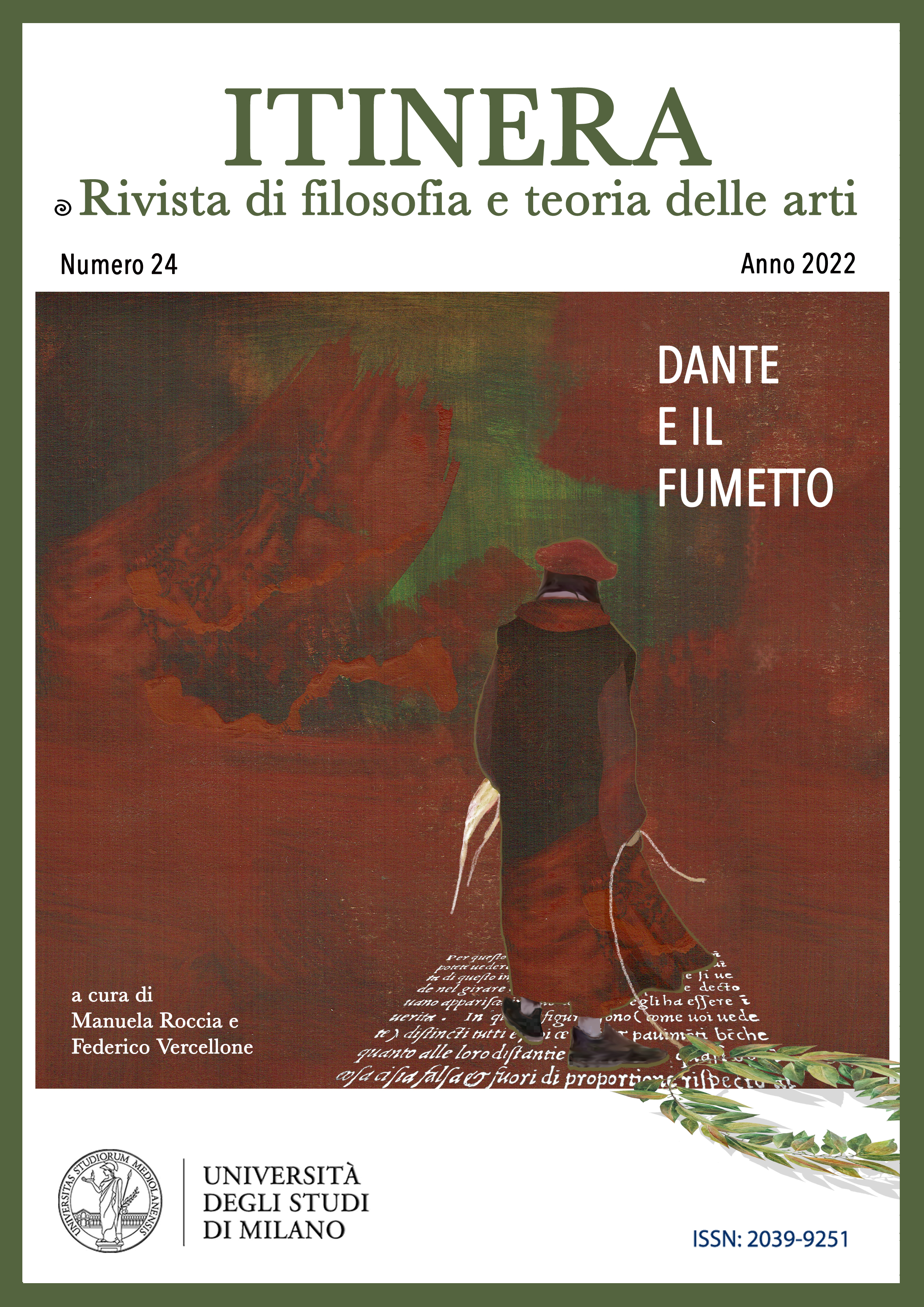
The Commedia between text and image: a brief journey through Dante’s comic book literature
DOI:
https://doi.org/10.54103/2039-9251/19756Keywords:
Comics, illustrations, Divine Comedy, reinterpretation.Abstract
Dante Alighieri's Divine Comedy is rich in visual and imaginative suggestions, capable of intertwining in total harmony with words and triplets in alternating rhyme, giving life to a unique and fascinating work. Over the centuries, the “divine poem” has inspired generations of authors and artists, who have re-proposed Dante's journey into the afterlife through different languages and expressive codes, first of all representative art. Above all, the visual and artistic translations of Dante’s work have influenced many writers and cartoonists who, starting from lithographs and ancient tables - think of the Divine Comedy illustrated by Gustave Doré in the second half of the nineteenth century - have developed their own transposition of the poem, in the wake of innovation and experimentation.
In fact, the tradition of Dante in comics has its roots in the early twentieth century and knows an extraordinary development throughout the century both in Italy and abroad. From Disney’s Mickey’s Inferno to Marcello Toninelli’s Divine Comedy, from Go Nagai’s monumental manga work to Hunt Emerson’s Dante’s Inferno, Dante's triplets capture the attention of comic book fans all over the world, presenting themselves not only as an interesting reading for pleasure, but also as an effective didactic-pedagogical tool for students. In fact, the comic is not only synonymous with entertainment, but also a means capable of adapting the complex content of the Divine Comedy to an audience of primary school pupils, from which it is possible to start a profitable didactic planning, which sees protagonists and “cartoonists” the children themselves.
Downloads
References
Alighieri, D., La Divina Commedia, Camerini, E (a cura di) e illustrata da Doré, G., European Book, Milano 2011.
Barbieri, D., Breve storia della letteratura a fumetti, Carocci Editore, Roma 2019.
Carboni, S. (a coordinamento editoriale di), L’Inferno di Topolino e altre storie ispirate a Dante Alighieri, Giunti Editore, Milano 2016.
Catelli, N. e Rizzarelli, G. (a cura di), Poemi a fumetti. La poesia narrativa da Dante a Tasso nelle trasposizioni fumettistiche, in "Rivista Internazionale di Studi su Letteratura e Visualità" Arabeschi 2016, n.7, www.arabeschi.it/introduzione-a-poemi-fumetti-la-poesia-narrativa-da-dante-tasso-nelle-trasposizioni-fumettistiche/.
D’Uva, A., Rossi, F. & Astrid, Dante Alighieri. “Amor mi mosse”, Kleiner Flug, Firenze 2018.
Fecchio, E., Carboni, S. (a coordinamento editoriale di), PaperDante, Giunti Editore, Milano 2021.
Lange, H. e Lange, K., Dante per chi ha fretta, Salani, Milano 2015.
Nagai, G., La Divina Commedia. Omnibus, Edizioni BD, Milano 2019.
Nembrini, F. (a cura di) e Dell’Otto, G. (illustrato da), Dante Alighieri. Inferno, Mondadori, Milano 2018.
Toninelli, M., Dante. La Divina Commedia a fumetti, Shockdom, Brescia 2015.
Tornotti, G. (a cura di), La mente innamorata. La Divina Commedia di Dante, Pearson Paravia Bruno Mondadori, Padova 2009.
Tosti, A., Graphic novel. Storia e teoria del romanzo a fumetti e del rapporto fra parola e immagine, Tunuè 2016.
Saez de Adana, F., An interview with Hunt Emerson, in "Rivista Dante e l’arte" 2018, n.5, https://ddd.uab.cat/pub/dea/dea_a2018v5/dea_a2018v5p263.pdf.
Sones, W.W.D., The comics as an Educational Medium, in "Journal of Educational Sociology" 1944, Vol.18, n.4, American Sociological Association, www.jstor.org/stable/2262696.
Sitografia
https://disney-comics.fandom.com/it/wiki/Inferno_di_Topolino.
Downloads
Published
How to Cite
Issue
Section
License
The authors who publish in Itinera are required to accept the following conditions:
1. The authors retain the rights on their paper and lincese the journal the right of first publication. The paper is also licensed under a Creative Commons License, which allows others to share it, by indicating intellectual authorship and its first publication in Itinera.
2. Authors may adhere to other non-exclusive license agreements for the distribution of the published version of the paper (ex. deposit it in an institutional archive or publish it in a monograph), provided that its first publication in Itinera is indicated.
3. Authors can disseminate their paper online (ex. in institutional repositories or on their website) before and during the submission process, since this can lead to productive exchanges and increase quotations of the published work (See “The Effect of Open Access”).