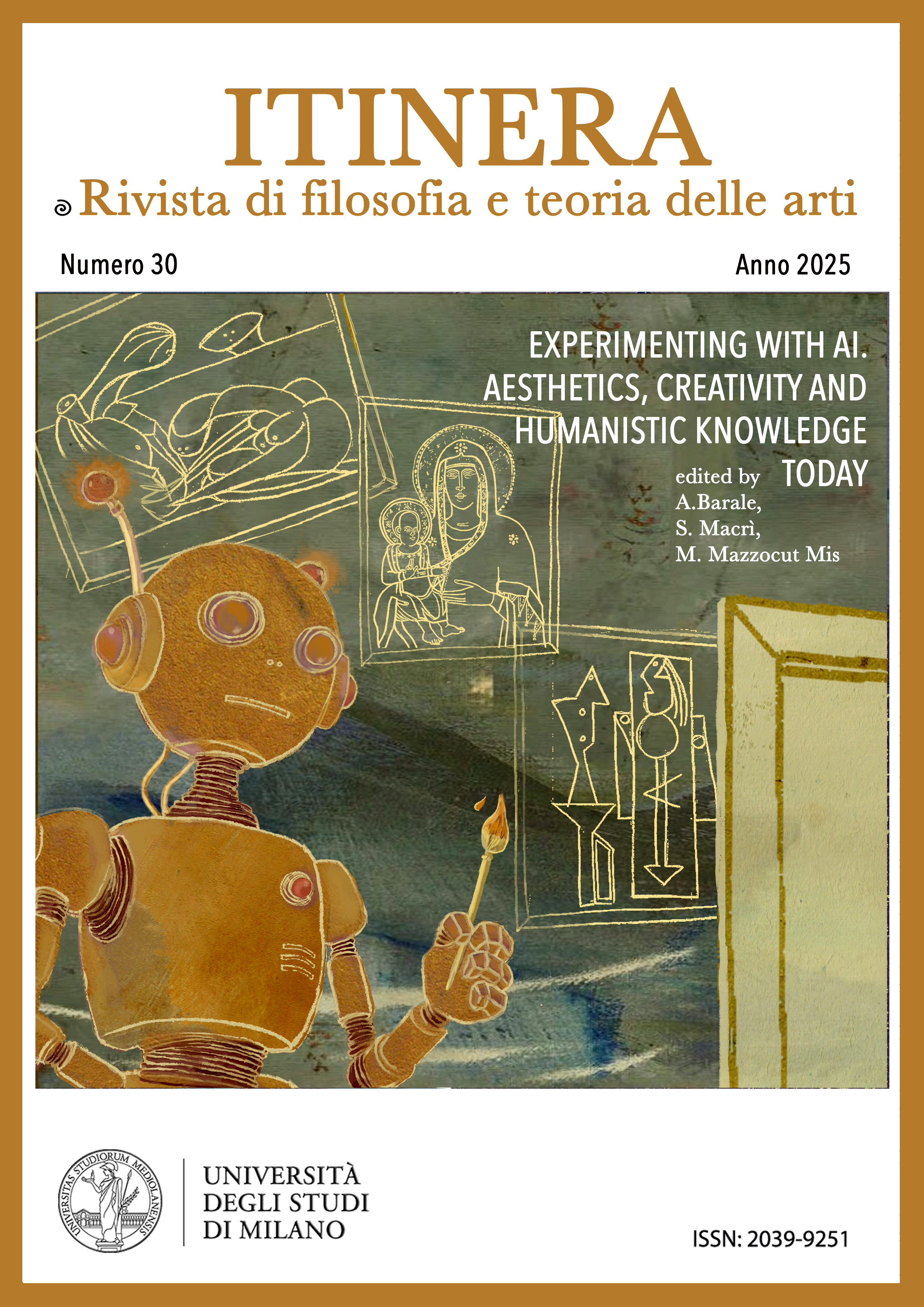
Experimenting with AI Aesthetics, Creativity and Humanistic Knowledge Today
DOI:
https://doi.org/10.54103/2039-9251/30238Abstract
The following introduction opens the present issue of Itinera by gathering a selection of the papers presented at the conference Artificial Intelligence to the Test. Creativity and Humanistic Knowledge Today (Università degli Studi di Milano, May 8–9, 2025). The issue examines how contemporary art engages with artificial intelligence not as a neutral instrument but as a dialogical partner in thought and creation. Moving beyond polarized narratives that cast AI either as a threat or as an enhancement of human capacities, the introduction explores the relational space in which human and machine agencies interact, generating new meanings and aesthetic possibilities. By foregrounding interaction rather than autonomy or technical performance, it proposes a framework for understanding AI-based artistic practice as a site for rethinking authorship, intention, and the co-constitutive evolution of humans and their technologies.
Downloads
Downloads
Published
How to Cite
Issue
Section
License
Copyright (c) 2025 Saverio Macrì

This work is licensed under a Creative Commons Attribution-ShareAlike 4.0 International License.
The authors who publish in Itinera are required to accept the following conditions:
1. The authors retain the rights on their paper and lincese the journal the right of first publication. The paper is also licensed under a Creative Commons License, which allows others to share it, by indicating intellectual authorship and its first publication in Itinera.
2. Authors may adhere to other non-exclusive license agreements for the distribution of the published version of the paper (ex. deposit it in an institutional archive or publish it in a monograph), provided that its first publication in Itinera is indicated.
3. Authors can disseminate their paper online (ex. in institutional repositories or on their website) before and during the submission process, since this can lead to productive exchanges and increase quotations of the published work (See “The Effect of Open Access”).