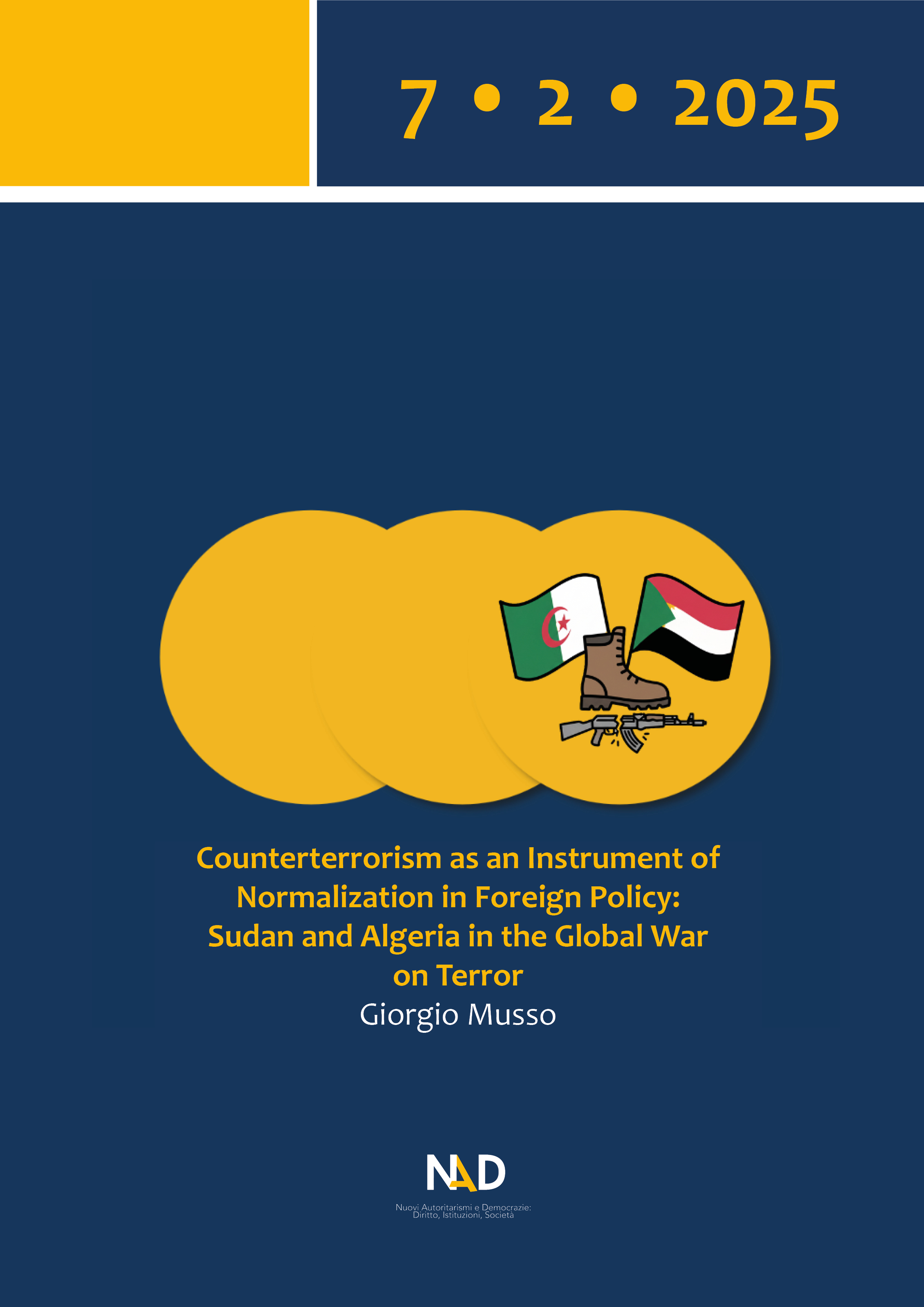
Counterterrorism as an instrument of normalization in foreign policy: Sudan and Algeria in the Global War on Terror
DOI:
https://doi.org/10.54103/2612-6672/30256Keywords:
Global War on Terror, September 11th, counterterrorism, Sudan, AlgeriaAbstract
The Global War on Terror (GWOT), launched by the United States in the aftermath of the terrorist attacks of September 11th, 2001, presented countries all over the world with threats and opportunities, and each one tried to adapt to the situation and exploit it to its own advantage. Apparently, the choice was clear: either stand with Washington or against it. What we argue in this paper, through a comparison between the Algerian and Sudanese case, is that before 9/11 counterterrorism had already become a common ground for cooperation between the U.S. and regimes it deemed “untouchable” in the 1990s. The GWOT accelerated and intensified this trend, but this didn’t result – at least for the cases considered – into the forging of new strategic partnerships, due to domestic “red lines”, enduring mistrust and path-dependence from traditional regional alliances.
Downloads
Published
How to Cite
Issue
Section
License
Copyright (c) 2025 Giorgio Musso

This work is licensed under a Creative Commons Attribution-NonCommercial-NoDerivatives 4.0 International License.