THE EARLIEST RECORD FOR HONEYGUIDES (AVES: INDICATORIDAE), FROM THE EARLY PLIOCENE OF SOUTH AFRICA
DOI:
https://doi.org/10.54103/2039-4942/28693Keywords:
Piciformes; Upper Varswater Formation; Langebaanweg; West Coast Fossil Park; PalaeoenvironmentAbstract
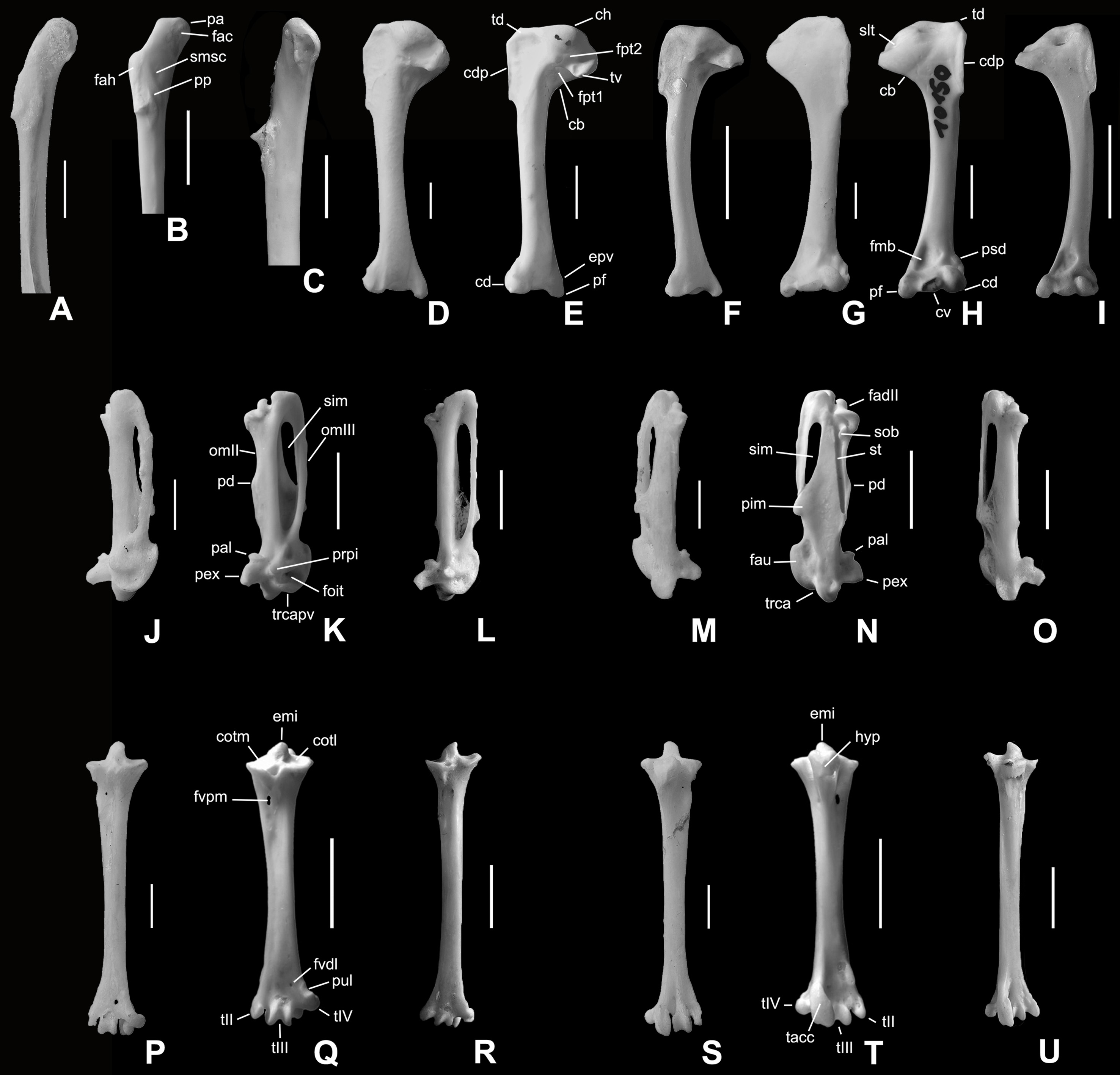
Two new species of honeyguides (Indicatoridae) are described from the Lower Pliocene Upper Varswater Formation at Langebaanweg, South Africa. One of these species is referred to the genus Indicator, as Indicator sp. (taxon A), and comparable in size to the Lesser Honeyguide (I. minor). It is represented by a partial coracoid as well as 12 humeri, eight carpometacarpi, and two tarsometatarsi. The second species is slightly smaller than the Least Honeyguide (I. exilis). It is known from a fragmentary proximal humerus, a carpometacarpus and two tarsometatarsi, and cannot be referred to a particular genus of modern Indicatoridae, hence it is referred to Indicatoridae indet. (taxon B). Both species form the as yet earliest record of honeyguides in Africa and the world, and confirm the presence of woodland with mature trees suitable for cavity-nesting species at Langebaanweg during the Early Pliocene.
Downloads
References
Ballmann P. (1969) - Die Vögel aus der altburdigalen Spaltenfüllung von Wintershof (West) bei Eichstätt in Bayern. Zitteliana, 1: 5-60.
Baumel J.J. & Witmer L.M. (1993) - Osteologia. In: Baumel J.J., King A.S., Breazile J.E., Evans H.E. & Vanden Berge J.C. (Eds) - Handbook of Avian Anatomy: Nomina Anatomica Avium. second edition: 45-132. Nuttall Ornithological Club, Cambridge, Massachusetts.
Chapin J.P. (1962) - Sibling species of small African honey-guides. Ibis, 104: 40-44.
De Pietri V.L., Manegold A., Costeur L. & Mayr G. (2011) - A new species of woodpecker (Aves; Picidae) from the early Miocene of Saulcet (Allier, France). Swiss Journal of Palaeontology, 130: 307-314.
Friedmann H. (1955) - The honey-guides. United States National Museum Bulletin, 208: 1-292.
Friedmann H. (1963) - Morphological data on two sibling species of small honey-guides. Los Angeles County Museum Contributions to Science, 79: 1-5.
Friedmann H. (1968a) - Additional data on brood parasitism in the honey-guides. Proceedings of the United States National Museum, 124: 1-8.
Friedmann H. (1968b). Parallel evolution in the small species of Indicator (Aves). Proceedings of the United States National Museum, 125: 1-10.
Fry C.H., Keith S. & Urban E.K. (1988) - The Birds of Africa. Volume 3. Parrots to Woodpeckers, Academic Press, London, 611 pp.
Harrison J.A., Allan D.G., Underhill L.G., Herremans M., Tree A.J., Parker V. & Brown C.J. (Eds) (1997) - The Atlas of Southern African Birds. Volume 1: Non-passerines. BirdLife South Africa, Johannesburg.
Hendey Q.B. (1981) - Palaeoecology of the late Tertiary fossil occurrences in ‘E’ Quarry, Langebaanweg, South Africa, and a reinterpretation of their geological context. Annals of the South African Museum, 84: 1-104.
Jetz W., Thomas G.H., Joy J.B., Hartmann K. & Mooers A.O. (2012) - The global diversity of birds in space and time. Nature, 491: 444-448.
Johansson U.S. & Ericson P.G.P. (2003) - Molecular support for a sister group relationship between Pici and Galbulae (Piciformes sensu Wetmore 1960). Journal of Avian Biology, 34: 185-197.
Lowther P.E. (2020) - Host list of avian brood parasites. - 4 - Piciformes; Indicatoridae. (accessed in November 2024). https://www.datocms-assets.com/44232/1632764065-host-list-honeyguide-16sep2020-revised.pdf.
Manegold A. (2010) - Two Swallow Species from the Early Pliocene of Langebaanweg (South Africa). Acta Palaeontologica Polonica, 55: 765-768.
Manegold A. (2013) - Two new parrot species (Psittaciformes) from the early Pliocene of Langebaanweg, South Africa, and their palaeoecological implications. Ibis, 155: 127-139.
Manegold A. & Louchart A. (2012) - Biogeographic and paleoenvironmental implications of a new woodpecker species (Aves, Picidae) from the early Pliocene of South Africa. Journal of Vertebrate Paleontology, 32: 926-938.
Manegold A., Louchart A., Carrier J. & Elzanowski A. (2013) - The Early Pliocene avifauna of Langebaanweg (South Africa): a review and update. In: Göhlich U.B. & Kroh A. (Eds) - Paleornithological Research 2013 Proceedings of the 8th International Meeting of the Society of Avian Paleontology and Evolution, Vienna, Austria, 11th -16th June 2012: 135-152. Naturhistorisches Museum Wien, Vienna.
Mayr G. (2004) - The phylogenetic relationships of the early Tertiary Primoscenidae and Sylphornithidae and the sister taxon of crown group piciform birds. Journal of Ornithology, 145: 188-198.
Mayr G. (2005) - A tiny barbet-like bird from the Lower Oligocene of Germany: the smallest species and earliest substantial fossil record of the Pici (woodpeckers and allies). Auk, 122: 1055-1063.
Meyer B. & Wolf J. (1810) - Taschenbuch der deutschen Vögelkunde oder kurze Beschreibung aller Vögel Deutschlands, Erster Theil. Friedrich Wilmans, Frankfurt, 310 pp.
Moreau R.E. (1966) - The bird faunas of Africa and its islands. Academic Press, London and New York.
Olson S.L. (1985) - The fossil record of birds. In: Farner D.S., King J.R. & Parkes K.C. (Eds) - Avian Biology, Volume 8: 79-238. Academic Press, New York and London.
Olson S.L. (1994) - Early Pliocene Grebes, button-quail, and kingfishers from south-western Cape Province, South Africa (Aves: Podicipedidae, Turnicidae, Halcyonidae). Annals of the South African Museum, 104: 49-61.
Pavia M., Manegold A. & Haarhoff P. (2015) - New early Pliocene owls from Langebaanweg, South Africa, with first evidence of Athene south of the Sahara and a new species of Tyto. Acta Palaeontologica Polonica, 60: 815-828.
Pavia M., Louchart A., Govender R. & Delfino M. (2025) - A new species of swift (Aves, Apodidae) from the Early Pliocene of Langebaanweg, South Africa. PalZ, 99:185-192.
Rich P.V. (1980) - Preliminary report on the fossil avian remains from late Tertiary sediments at Langebaanweg (Cape Province), South Africa. South African Journal of Science, 76: 166-170.
Roberts D.L., Matthews T., Herries A.I.R., Boulter C., Scott L., Musekiwa C., Mthembi P., Browning C., Smith R.M.H., Haarhoff P. & Bateman M.D. (2011) - Regional and global context of the Late Cenozoic Langebaanweg (LBW) Palaeontological Site: West Coast of South Africa. Earth-Science Reviews, 106: 191-214.
Rosindell J. & Harmon L.J. (2012) - OneZoom: A Fractal Explorer for the Tree of Life. PLoS Biol, 10:e1001406. https://doi.org/10.1371/journal.pbio.1001406. Website: http://www.onezoom.org/OZtree/static/OZLegacy/EDGE_birds.htm (accessed 21 February 2025).
Short L.L. & Horne J.F.M. (2002) - Family Indicatoridae (Honeyguides). In: del Hoyo J., Elliot A. & Sargatal J. (Eds) - Handbook of the Birds of the World. Volume 7: 274-295. Jacamars to Woodpeckers. Lynx Edicions, Barcelona.
Simpson S.F. & Cracraft J. (1981) - The phylogenetic relationships of the Piciformes (class Aves). Auk, 98: 481-494.
Sparrman A. (1777) - An account of a journey into Africa from the Cape of Good-Hope, and a description of a new species of cuckow. Philosophical Transactions 67: 38-42.
Spottiswoode C.N. & Koorevaar J. (2012) - A stab in the dark: chick killing by brood parasitic honeyguides. Biology Letters, 8: 241-244.
Stephens J.F. (1815) - Birds. In: Shaw’s General Zoolology or Systematic Natural History. Vol. 9(1). G. Wilkie, J. Walker, J. Stockdale, J. & A. Arch, London.
Swainson W. (1837) - On the natural history and classification of birds. Vol. 2. J. Taylor, London.
von den Driesch A. (1976) - A guide to the measurement of animal bones from archaeological sites. Peabody Museum Bulletin, 1: 1-137.
Winkler D.W., Billerman S.M. & Lovette I. J. (2020) - Honeyguides (Indicatoridae), version 1.0. In: Billerman S.M., Keeney B.K., Rodewald P.G. & Schulenberg T. S. (Eds) - Birds of the World. Cornell Lab of Ornithology, Ithaca, NY, USA. (Accessed in November 2024). https://doi.org/10.2173/bow.indica1.01.
Downloads
Published
Issue
Section
License
Copyright (c) 2026 ANTOINE LOUCHART, ALBRECHT MANEGOLD, MARCO PAVIA

This work is licensed under a Creative Commons Attribution-ShareAlike 4.0 International License.
The journal allow the author(s) to hold the copyright without restrictions.
How to Cite
Accepted 2025-12-17
Published 2026-02-02