TUFANBEYLİ: NEW LOWER PLIOCENE MAMMAL-YIELDING LOCALITY AND FIRST RECORD OF “MAMMUT” BORSONI FROM TURKEY
DOI:
https://doi.org/10.54103/2039-4942/28746Keywords:
Mammutidae; “Mammut” borsoni; Rhinocerotidae; Pliorhinus megarhinus; Early Pliocene.Abstract
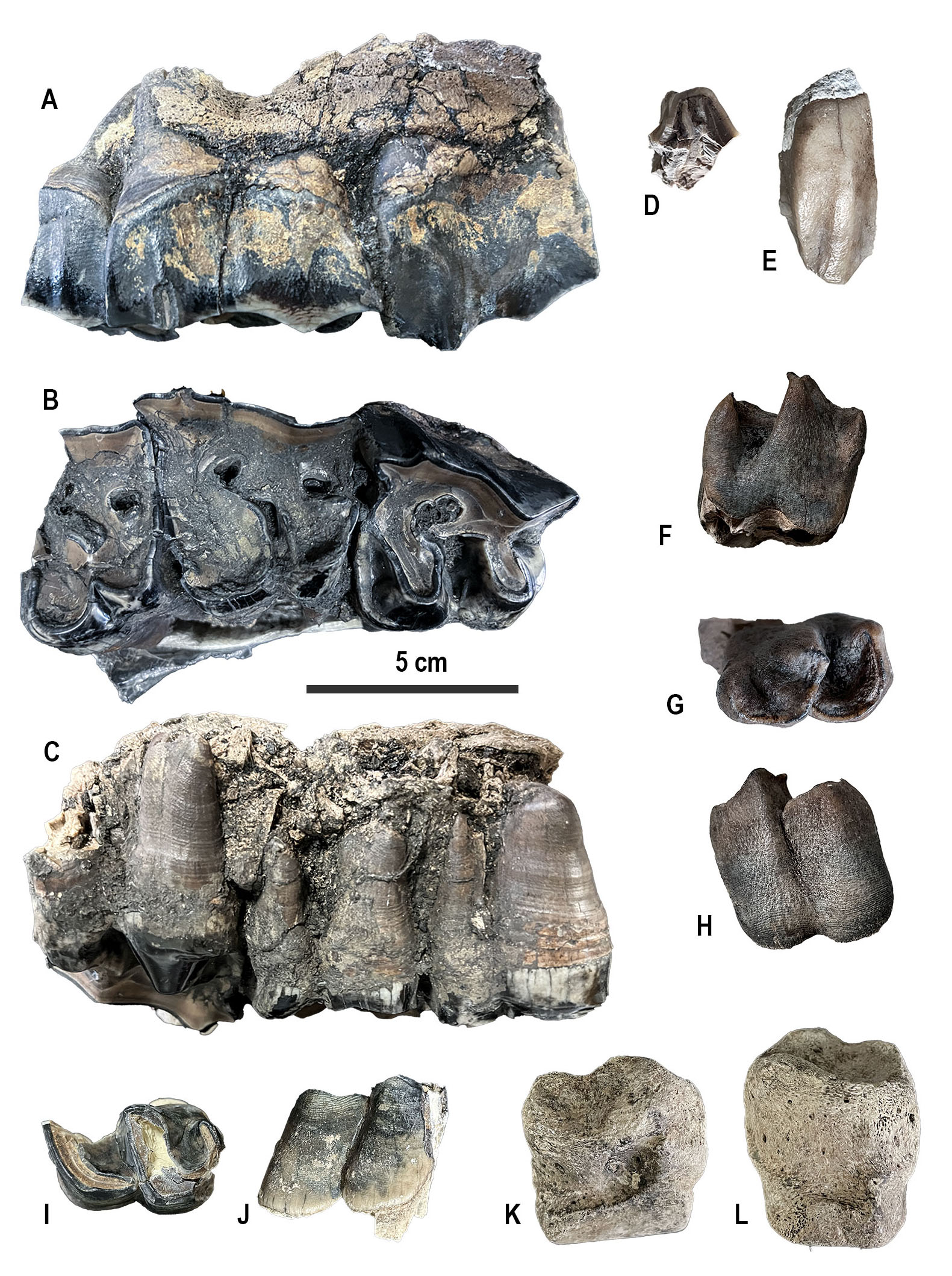
At the crossroads between Africa, Asia, and Europe, Turkey occupies a prominent position regarding terrestrial mammal interchanges. In stark contrast with a wealth of Late Miocene fossil record, the Early Pliocene interval was virtually undocumented for large mammals in Turkey so far, which made it impossible to characterise their biogeographical affinities in the concerned time interval. In this study, we present the first record of the mammutid proboscidean “Mammut” borsoni in Turkey, found in association with the rhinocerotid Pliorhinus megarhinus, in Lower Pliocene lignite beams at the Tufanbeyli Thermal Power Plant Lignite Operation site, Adana. “Mammut” borsoni spans the Pliocene–Early Pleistocene interval in Eurasia while Pliorhinus megarhinus is a conspicuous element of uppermost Miocene-Pliocene faunas in Western Eurasia and Turkey. This megamammal assemblage represents an important advance in our knowledge of the large mammal faunas of the Early Pliocene of Asia Minor, further attesting to close biogeographic affinities between Anatolia and other circum-Mediterranean regions just after the end-Miocene salinity crisis.
Downloads
References
Albayrak E. (2017) - A new primitive elephantid from Turkey. Quaternary International, 445: 43-49. https://doi.org/10.1016/j.quaint.2016.09.029.
Argenti P. (2004) - Plio-quaternary mammal fossiliferous sites of Umbria (Central Italy. Geologica Romana, 37: 67-78.
Antoine P.-O. (2002) - Phylogénie et évolution des Elasmotheriina (Mammalia, Rhinocerotidae). Mémoires du Muséum national d’Histoire naturelle, 188: 1-359.
Antoine P.-O., Downing K.F., Crochet J.Y., Duranthon F., Flynn L.J., Marivaux L., Metais G., Rajpar A.R. & Roohi G. (2010) - A revision of Aceratherium blanfordi Lydekker, 1884 (Mammalia: Rhinocerotidae) from the Early Miocene of Pakistan: postcranials as a key. Zoological Journal of the Linnean Society, 160: 139-94. https://doi.org/10.1111/j.1096-3642.2009.00597.x.
Antoine P.-O., Reyes M.C., Amano N., Claude J., Bautista A.P., Vos J. de & Ingicco T. (2022) - A new clade of rhinoceroses from the Pleistocene of Southeast Asia sheds light on mainland mammal dispersals to the Philippines. Zoological Journal of the Linnean Society, 194: 416-430. https://doi.org/10.1093/zoolinnean/zlab009.
Antoine P.-O., Becker D., Pandolfi L. & Geraads D. (2025) - Chapter 2. Evolution and fossil record of Old World Rhinocerotidae. In: Melletti M., Balfour D. & Talukdar B. (Eds.) - Rhinos of the World: Ecology, Conservation and Management: 31-48. Fascinating Life Sciences, Springer Nature.
Argenti P. (2004) - Plio-quaternary mammal fossiliferous sites of Umbria (Central Italy). Geologica Romana, 37: 67-78.
Azzaroli A. (1983) - Quaternary mammals and “End-Villafranchian” dispersal event-a turning point in the history of Eurasia. Palaeogeography, Palaeoclimatology, Palaeoecology, 44: 113-139. https://doi.org/10.1016/0031-0182(83)90008-1.
Bedi Y., Yusufoğlu H., Tekin U.K. & Usta D. (2017) - Tufanbeyli (Adana), Elbistan (K.Maraş) ve Malatya arasında yüzeylenen otokton ve allokton istiflerin tektono-stratigrafik özellikleri (Doğu Toroslar). Türkiye Jeoloji Kurumu 70. Bilim Teknik Kurultayı Bildiri Özleri, 2017, Ankara, 22-23.
Blumenbach J. F. (1799) - Handbuch der Naturgeschichte. Dieterich, Göttingen.
Čerňanský A. (2006) - Revision of a mastodon find from the Neogene at Kuzmice near Topol’čany (Slovakia). Slovak Geological Magazine, 12(1): 57-62.
Cicioğlu E. (2001) - Çöllolar-Kışlaköy (Afşin-Elbistan) linyitlerinin jeokimyasal özelliklerinin incelenmesi. H.Ü. Fen Bilim. Enst., Doktora Tezi, Ankara.
Codrea V.A. & Diaconu F. (2007) - Mammut borsoni (Hays, 1834) from the Early Pliocene of Husnicioara (Mehedinti district, Romania). Studia Universitatis Babeş-Bolyai, Geologia, 52(2): 73-77. http://dx.doi.org/10.5038/1937-8602.52.2.9.
de Christol J. (1834) - Recherches sur les caractères des grandes espèces de Rhinocéros fossiles. Annales des Sciences Naturelles, Paris, series 2, 4: 44-112. https://doi.org/10.5962/bhl.title.16189.
Erten H. & Koralay D.B. (2020) - A Zygolophodon turicensis (Proboscidea, Mammalia) mandible fragment from the Kale-Tavas basin (Denizli, Turkey). Palaeobiodiversity and Palaeoenvironments, 100: 1077-1082. https://doi.org/10.1007/s12549-020-00422-7.
Fejfar O. (1964) - The lower-Villafranchian vertebrates from Hajnácka near Filákova in southern Slovakia. Rozpravy ustredniho ustavu geologickeho, 30: 1-115.
Ferretti M.P. & Debruyne R. (2011) - Anatomy and phylogenetic value of the mandibular and coronoid canals and their associated foramina in proboscideans (Mammalia). The Zoological Journal of the Linnean Society, 161: 391-413. https://doi.org/10.1111/j.1096-3642.2010.00637.x.
Fortelius M., Mazza P. & Sala B. (1993) - Stephanorhinus (Mammalia: Rhinocerotidae) of the Western European Pleistocene, with a revision of S. etruscus, Falconer, 1868. Palaeontographia Italica, 80: 63-155.
Garevski R., Garevska B. & Markov G.N. (2012) - Remains of Zygolophodon turicensis (Proboscidea, Mammutidae) from the coal mines near Bitola, Republic of Macedonia. Historia Naturalis Bulgarica, 20: 157-162.
Gasparik M. (2010) - Co-occurence of Anancus, Mammut and Mammuthus from Early Pleistocene localities of Hungary [Poster presentation]. The Vth International Conference on Mammoths and Their Relatives, Le Puy-en-Velay, France.
Gaziry A.W. (1976) - Jungtertiäre Mastodonten aus Anatolien (Türkei). Geologisches Jahrbuch, Reihe B, 22: 3-143.
Geraads D., Cerdeño E., García Fernandez D., Pandolfi L., Billia E., Athanassiou A., Albayrak E., Codrea V., Obada T., Deng T., Tong H., Lu X., Pícha S., Marciszak A., Jovanovic G., Becker D., Zervanova J., Chaïd Saoudi Y., Bacon A.-M., Sévêque N., Patnaik R., Brezina J., Spassov N. & Uzunidis A. (2021) - A database of Old World Neogene and Quaternary rhino-bearing localities. Available at www.rhinoresourcecenter.com/about/fossil-rhino-database.php.
Göhlich U.B. (1998) - Elephantoidea (Proboscidea, Mammalia) aus dem Mittel- und Obermiozän der Oberen Süßwassermolasse Süddeutschlands: Odontologie und Osteologie. Münchner Geowissenschaftliche Abhandlungen, A36, 1-245.
Göhlich U.B. (2010) - Tertiäre Urelefantenfunde aus Deutschland. In: Meller H. (Ed.) - Elefantenreich Eine Fossilwelt in Europa Landesamt für Denkmalpflege und Archäologie Sachsen-Anhalt, Halle: 363-372.
Gray J. E. (1821) - On the natural arrangement of vertebrose animals. London Medical Repository, 15: 296-310.
Guérin C. (1980) - Les rhinoceros (Mammalia, Perissodactyla) du Miocene terminal au Pleistocene superieur en Europe occidentale; comparaison avec les especes actuelles. Documents du Laboratoire de Geologie de la Faculte des Sciences de Lyon, 79: 3-1183.
Guérin C. & Santafé-Llopis J.V. (1978) - Dicerorhinus miguelcrusafonti nov. sp., une nouvelle espèce de rhinocéros (Mammalia, Perissodactyla) du gisement Pliocène supérieur de Layna (Soria, Espagne) et de la formation Pliocène de Perpignan (Pyrénées-Orientales, France). Geobios, 11(4): 457-491.
Guérin C. & Şen Ş. (1998) - Le gisement de vertébrés pliocènes de Çalta, Ankara, Turquie. 6. Rhinocerotidae. Geodiversitas, 20(3): 397-408.
Guérin C., Ballesio R. & Méon-Villain H. (1969) - Le Dicerorhinus megarhinus (Mammalia, Rhinocerotidae) du Pliocène de Saint-Laurent-des-Arbres (Gard). Documents des Laboratoires de Géologie de Lyon, 31: 55-145.
Hay I. (1922) - Further observations on some extinct elephants. Proceedings of the Biological Society of Washington, 35: 97-101.
Hays I. (1834) - Descriptions of the specimens of inferior maxillary bones of mastodons in the cabinet of the American Philosophical Society, with remarks on the genus Tetracaulodon (Godman). Transactions of the American Philosophical Society, 4: 317-339.
Heissig K. (1969) - Die Rhinocerotidae (Mammalia) aus der oberoligozänen Spaltenfüllung von Gaimersheim. Bayerische Akademie der Wissenschaften. Mathematisch-Naturwissenschaftliche Klasse. Abhandlungen. Neue Folge, 138: 1-133.
Heissig K. (1972) - Paläontologische und geologische Untersuchungen in Tertiär von Pakistan. 5-Rhinocerotidae (Mammalia) aus den unteren und mittleren Siwalik-Schicten. Abh Bayer Akad Wiss, Math-Naturwiss Kl, NF., 152: 1-112.
Hilgen F.J., Lourense L.J. & Van Dam J.A. (2012) - The neogene period. In: Gradstein F.M., Ogg J.G., Schmitz M.D., Ogg G.M. (Eds.) - The Geologic Time Scale 2012. Vol. 2: 923-978. Elsevier, Oxford.
Hodgson J.A., Allmon W.D., Nester P.L., Sherpa J.M. & Chiment J.J. (2008) - Comparative osteology of Late Pleistocene mammoth and mastodon remians from the Watkins Glen site, Chemung County, New York. In: Warren D.A. Nester P.L. (Eds.) - Mastodon Paleobiology, Taphonomy, and Paleoenvironment in the Late Pleistocene of New York state. Studies on the Hyde Park, Chemung, and North Java Sites: 301-367. Palaeontographica Americana, 61.
Holec P. (1985) - Finds of mastodon (Proboscidea, Mammalia) relics in Neogene and Quaternary. Sediments of Slovakia (CSSR). Zápané Karpaty, Séria Paleontológia, 10:13-53.
Holec P. (1996) - A plio-pleistocene large mammal fauna from Strekov and Nová Vieska, south Slovakia. Acta zoologica cracoviensia, 39, 1: 219-222.
Illiger C. (1811) - Prodromus systematis mammalian et avium additis terminis zoographicis utriusque classic. C. Salfield, Berlin.
Kahlke H.-D, Eismann L. & Wiegank F. (1984) - Die Neogen/Quartar-Grenze auf dem Territorium der Deutschen Demokratischen Republik. Zeitschrift für Angewandte Geologie, 30, 1: 44-48.
Kerr R. (1792) - The animal kingdom or zoological system of celebrated Sir Charles Linnaeus; Class I Mammalia. John Murray, London.
Koenigswald W. von (2016) - The diversity of the mastication patterns in the Neogene and Quaternary Proboscideans. Palaeontographica, A307: 1-41.
Koenigswald W. von & Göhlich U.B. (2019) - Biogeography of Mammutidae (Proboscidea) or What’s your name again? Mammut? 90th Annual Meeting of the Paläontologische Gesellschaft. Staatliche Naturwissenschaftliche Sammlungen Vayerns-Bayerische Staatsammlung für Paläontologie und Geologie, Munich, p. 83.
Koenigswald W. von, Březiana J., Werneburg R. & Göhlich U. B. (2022) - A partial skeleton of “Mammut” borsoni (Proboscidea, Mammlia) from the Pliocene of Kaltensundheim (Germany). Palaeontologia Electronica, 25(1): a10. https://doi.org/10.26879/1188.
Koenigswald W. von, Widga C. & Göhlich U. (2023) - New mammutids (Proboscidea) from the Clarendonian and Hemphillian of Oregon - a survey of Mio-Pliocene mammutids from North America. The Bulletin of the Museum of Natural History of the University of Oregon, 30: 1-63.
Konidaris G.E. & Tsoukala E. (2020) - Proboscideans from the upper Miocene localities of Thermopigi, Neokaisareia and Platania (Northern Greece). Annales de Paléontologie, 106, 2, https://doi.org/10.1016/j.annpal.2019.102380.
Konidaris G. E. & Tsoukala E. (2022) - The fossil record of the Neogene Proboscidea (Mammalia) in Greece. In: Vlachos E. (Ed.) - The Fossil Vertebrates of Greece, vol. 1: 299-344. Springer Nature Publishing Group.
Konidaris G.E., Aytek A.I., Yavuz A.Y., Tarhan E. & Alçiçek M.C. (2023) - First report of “Mammut” (Mammalia, Proboscidea) from the Upper Miocene of Turkey. Journal of Vertebrate Paleontology, 4(6). https://doi.org/10.1080/02724634.2023.2222784.
Konidaris G.E., Răţoi B.G. & Badea D.D. (2024) - New proboscidean specimens from the Late Miocene of Romania: the huge-sized deinothere Deinotherium proavum, the rare “Mammut” cf. obliquelophus and the first description of the shovel-tusker Konobelodon from the country. PalZ, 98: 331-355. https://doi.org/10.1007/s12542-024-00688-8.
Koufos G.D. & Vasileiadou K. (2015) - Miocene/Pliocene mammal faunas of southern Balkans: implications for biostratigraphy and palaeoecology. Palaeobiodiversity and Palaeoenvironments, 95: 285-303. https://doi.org/10.1007/s12549-015-0201-4.
Koufos G. D., Kostopoulos D. & Vlachou T. (2005) - Neogene/Quaternary mammalian migrations in Eastern Mediterranean. Belgian Journal of Zoology, 135(2): 181-190.
Laub R.S. (1996) - The mastication apparatus of the American mastodon (Mammut americanum. In: Stewart K.M. & Stewart K.L. (Eds.) - Palaeoecology and palaeoenvironments of late Cenozoic mammals: tribute to the career of C.S. (rufus) Churcher: 375-405. University of Toronto Press Inc.
Lacombat F., Abbazzi L., Ferretti M.P., Martínez-Navarro B., Moullé P.E., Palombo M.R., Rook L., Tuner A. & Valli A.M.F. (2008) - New data on the Early Villafranchian fauna from Vialette (Haute-Loire, France) based on the collection od the Crozatier Museum (Le Puy-en-Velay, Haute-Loire, France). Quaternary International, 179: 64-71.
Lacombat F. & Mörs T. (2008) - The northernmost occurrence of the rare Late Pliocene rhinoceros Stephanorhinus jeanvireti (Mammalia, Perissodactyla). Neues Jahrbuch für Geologie und Paläontologie, Abhandlungen, 249 (2): 157-165. https://doi.org/10.1127/0077-7749/2008/0249-0157.
Laws R. M. (1966) - Age criteria for the African elephant Loxodonta a. africana. African Journal of Ecology, 4: 1-37. https://doi.org/10.1111/j.1365-2028.1966.tb00878.x.
Lehman U. (1950) – Über Mastodontenreste in der Bayerischen Staatssammlung in München. Palaeontographica Abt A, 99: 121-228.
Lortet L.C.E. & Chantre E. (1878) - Etudes paléontologiques dans le bassin du Rhône, période Tertiaire. Recherches sur les Mastodontes et les Faunes mammalogiques qui les accompagnent. Première partie. Archives du Muséum d’histoire naturelle de Lyon, tome 2: 285-313.
Markov G. N. (2008) - The Turolian proboscideans (Mammalia) of Europe: preliminary observations. Historia naturalis bulgarica, 19: 153-162.
Masisi F. & Sala B (2007) - Large-and small-mammal distribution patterns and chronostratigraphic boundaries from the Late Pliocene to the Middle Pleistocene of the Italian peninsula. Quaternary International, 160: 43-56, https://doi.org/10.1016/j.quaint.2006.09.008.
Mayda S., Titov S.V, Kaya T., Tesakov, A., Halaçlar K, Tan A., Alçiçek M.C., Syromyatnikova E.V. & Karakütük S. (2014). Anancus. VIth International Conference on Mammoths and their Relatives, Scientific Annals of the School of Geology, 102: 127-128.
Metin S., Papak İ., Keskin H., Özsoy İ., Polat N., Altun İ., İnanç A., Hazinadar H., Konuk O. & Karabalık M.N. (1982) - Tufanbeyli-Sarız-Göksun ve Saimbeyli arasının jeolojisi, Doğu Toroslar, MTA Jeoloji Etütleri Dairesi Arşiv no. 180, Ankara.
Mucha B.B. (1980) - A new species of yoke-toothed mastodon from the Pliocene of Southwest USSR. In Negadaev-Nikonov K.N. (Ed.) - Quaternary and Neogene faunas and floras of Moldavskaya SSR: 19-26. Shtiintsa, Kishinev.
Nikolov I. & Kovačev (1966) - Pilozäne Säugetierfauna aus Assenovgrad. Travaux sur la Géologie de Bulgarie – Série Paléontologie, 8: 131-142.
Obada T. (2014) - Preliminary data on the Mammut borsoni (Hays, 1834) from Otman Hill (Colibaşi, Republic of Moldova). VIth International Conference on Mammoths and their Relatives, Scientific Annals of the School of Geology, 102:143-144.
Osborn H.F. (1936) - Proboscidea: a monograph of the discovery, evolution, migration and extinction of the mastodonts and elephants of the world. Vol. I: Moeritherioidea, Deinotherioidea, Mastodontoidea, The American Museum Press, New York. https://doi.org/10.5962/bhl.title.12097.
Owen R.M. (1848) - Description of teeth and proportion of jaws of two extinct anthracotherioid quadrupeds (Hyopotamus vectianus and Hyopotamus bovinus) discovered by the Marchioness of Hastings in the Eocene deposits on the NW coast of the Isle of Wight: with an attempt to develop Cuvier’s idea of the classification of pachyderms by the number of their toes. Quarterly Journal of the Geological Society of London, 4: 103-141. https://doi.org/10.1144/gsl.jgs.1848.004.01-02.21.
Pandolfi L., Gasparik M. & Piras P. (2015) - Earliest occurrence of “Dihoplus” megarhinus (Mammalia, Rhinocerotidae) in Europe (Late Miocene, Pannonian Basin, Hungary): Palaeobiogeographical and biochronological implications. Annales de Paléontologie, 101(4): 325-339. https://doi.org/10.1016/j.annpal.2015.09.001.
Pandolfi L., Cerdeňo E., Codrea V. & Kotsakis T. (2017) - Biogeography and chronology of the Eurasian extinct rhinoceros Stephanorhinus etruscus, Mammalia, Rhinocerotidae. Comptes Rendus Palevol, 16(7): 762-773. https://doi.org/10.1016/j.crpv.2018.04.001.
Pandolfi L., Rivals F. & Rabinovich R. (2020) - A new species of rhinoceros from the site of Bethlehem: “Dihoplus” bethlehemsis sp. nov. (Mammalia, Rhinocerotidae). Quaternary International, 537: 48-60. https://doi.org/10.1016/j.quaint.2020.01.011.
Pandolfi L., Antoine P.-O., Bukhsianidze M., Lordkipanidze D. & Rook L. (2021) - Northern Eurasian rhinocerotines (Mammalia, Perissodactyla) by the Pliocene–Pleistocene transition: phylogeny and historical biogeography. Journal of Systematic Palaeontology, 19(15): 1031-1057. https://doi.org/10.1080/14772019.2021.1995907.
Petronio C. Bellucci L., Martiinetto E., Pandolfi L. & Salari L. (2011) - Biochronology and palaeoenvironmental changes from the Middle Pliocene to the Late Pleistocene in Central Italy. Geodiversitas 33 (3): 485-517. https://doi.org/10.5252/g2011n3a4.
Raffi I., Wade B.S., Pälike H., Beu A.G., Cooper R., Crundwell M.P., Krijgsman W., Moore T., Raine I. & Sardella R. (2020) - Chapter 29-The Neogene period. In Gradstein F.M., Ogg J.G., Schmitz M.D. and Ogg G.M. (Eds.) - Geological Time Scale: 1141-1215. Elsevier, London.
Ros-Montoya S., Martínez-Navarro B., Espigares M.-P., Guerra-Merchán A., García-Aguilar J.M., Piňero P., Rodríguez-Rueda A., Agusti J., Oms O. & Palmqvist P. (2017) - A new Ruscinian site in Europe: Baza-1 (Baza basin, Andalusia, Spain). Comptes Rendus Palevol, 16: 746-761. https://doi.org/10.1016/j.crpv.2017.05.005.
Sanders W.J., Gheerbrant E., Harris J.M., Saegusa H. & Delmer C. (2010) - Proboscidea. In Werdelin L. and Sanders W.J. (Eds.) - Cenozoic Mammals of Africa: 161-251. University of California Press, Berkeley.
Saraç G. (2003) - Turkiye omurgalı fosil yatakları. MTA (Maden Tetkik ve Arama Genel Müdürlüğü) Derleme Rapor, no: 10609.
Schinz H.R. (1824) - Naturgeschichte und Abbildungen der Säugethiere: nach den neuesten Systemen zum gemeinnutzigen Gebrauche entworfen, und mit Berücksichtigung für den Unterricht der Jugend bearbeitet. Brodtmann Lithographische Kunstanstalt, Zürich.
Schlesinger G. (1918) - Die stratigraphische Bedeutung der europäischen Mastodonten. Mitteilungen der Geologischen Gesellschaft in Wien, 11: 129-166.
Schlesinger G. (1922) - Die Mastodonten der Budapester Sammlungen. Geologica Hungarica, 2: 1-284.
Sickenberg O., Becker-Platen J., Benda L., Berg D., Engesser B., Gaziry W., Heissig K., Humermann K.A., Sondaar P.Y., Schmidt-Kittler N., Staesche U., Steffens P. & Tobien H. (1975) - Die Gliederung des höheren Jungtertiärs und Altquartärs in der Türkei nach Vertebraten und ihre Bedeutung für die internationale Neogen-Stratigraphie. Geologisches Jahrbuch, Reihe B, 15: 1-167.
Smuts M.S. & Bezuidenhout A.J. (1993) - Osteology of the thoracic limb of the African elephant (Loxodonta africana). The Ondrestepoort Journal of Veterinary Research, 60: 1-14.
Smuts M.S. & Bezuidenhout A.J. (1994) - Osteology of the pelvic limb of the African elephant (Loxodonta africana). The Ondrestepoort Journal of Veterinary Research, 61: 51-66.
Şen Ş. (Ed.) (1998) - Pliocene vertebrate locality of Çalta, Ankara, Turkey. Geodiversitas, 20 (3).
Şen Ş., Delfino M. & Kazancı N. (2017) - Çeştepe, a new early Pliocene vertebrate locality in Central Anatolia and its stratigraphic context. Annales de Paléontologie, 103, 2: 149-163. https://doi.org/10.1016/j.annpal.2017.01.004.
Şen Ş., Karadenizli L., Antoine P-O. & Saraç G. (2018) - Late Miocene-early Pliocene rodents and lagomorphs (Mammalia) from the southern part of Çankırı-Çorum Basin, Turkey. Journal of Paleontology, 93(1): 173-195. https://doi.org/10.1017/jpa.2018.60.
Tassy P. (1977) - Découverte de Zygolophodon turicensis (Schinz) (Proboscidea, Mammalia) au lieu-dit Malartic a Simorre, Gers (Vindobonien moyen); implications paléoécologiques et biostratigraphiques. Geobios, 10(5): 655-669. https://doi.org/10.1016/S0016-6995(77)80045-4.
Tassy P. (1985) - La place des mastodontes miocènes de l’ancien monde dans la phylogénie des Proboscidea (Mammalia): Hypothèses et conjectures. Unpublished PhD Thesis, Université Pierre et Marie Curie, Paris, France.
Tassy P. (1990) - The “Proboscidean Datum Event”: how many proboscideans and how many events? In: Linsday E.H., Mein P. & Fahlbusch V. (Eds.) - European Neogene Mammal Chronology: 237-252. Plenum Press, New York. https://doi.org/10.1007/978-1-4899-2513-8_16.
Tassy P. (1996) - Who is who among the Proboscidea? In: Shoshani J. & Tassy P. (Eds.) - The Proboscidea: Evolution and palaeoecology of elephants and their relatives: 39-48. Oxford University Press, New York. https://doi.org/10.1093/oso/9780198546528.003.0006.
Thenius V.E. (1978) - Neue Säugetierfunde aus den Pliozän von Niederösterreich. Mitteilungen der Geologischen Gesellschaft in Wien, 68: 109-128.
Tobien H. (1975) - The structure of the Mastodont molar (Proboscidea, Mammalia) Part 2: The zygodont and zygobunodont patterns. Mainzer Geowissenschaftliche Mitteilungen, 4: 195-233.
Tobien H. (1996) - Evolution of zygodons with emphasis on dentition. In: Shoshani J. & Tassy P. (Eds.) - The Proboscidea: Evolution and palaeoecology of elephants and their relatives: 76-85. Oxford University Press, New York. https://doi.org/10.1093/oso/9780198546528.003.0009.
Tsoukala E. (2000) - Remains of a Pliocene Mammut borsoni (Hays, 1834) (Proboscidea, Mammalia), from Milia (Grevena, W. Macedonia, Greece). Annales de Paléontologie, 86(3): 165-191. https://doi.org/10.1016/S0753-3969(00)80007-5.
Tsoukala E. & Mol D. (2016) - The Proboscidea of the Early Villafranchian site of Milia (Grevena, Macedonia, Greece). Quaternary International, 406: 4-24. http://dx.doi.org/10.1016/j.quaint.2014.10.026.
van den Hoek Ostende L.W., Gardner J.D., van Bennekom L., Alçiçek M.C., Murray A., Wesselingh F.P., Alçiçek H. & Tesakov A. (2015) - Ericek, a new Pliocene vertebrate locality in the Çameli Basin (southwestern Anatolia, Turkey). Palaeobiodiversity and Palaeoenvironment, 95: 305-320. https://doi.org/10.1007/s12549-015-0202-3.
Vattenffal (2012) - Mine development plan for Tufanbeyli coal mine and limestone quarries. Enerjisa Üretim report.
Yılmaz Usta D.N., Mayda S. & Kaya T.T. (2019) - Yeni buluntular ışığında Yalvaç (Isparta/Türkiye) Neojen devir omurgalı fosil yatakları [Neogene vertebrate fossil deposits of Yalvaç (Isparta/Turkey) in the light of new finds]. SDÜ Fen-Edebiyat Fakültesi Sosyal Bilimler Dergisi, 47: 79-96.
Yılmaz Usta D.N., Mayda S. & Kaya T.T. (2020) - The first record of Zygolophodon (Mammutidae-Mammalia) from the Late Miocene sediments of Turkey. Proceedings of the XI. International Multidisciplinary Congress of Eurasia (IMCOFE), St. Petersburg: 253-256.
Yusufoğlu H. (2017) - Tufanbeyli (Adana) ve yakın çevresinin neotektonik özellikleri. MTA (Maden Tetkik ve Arama Genel Müdürlüğü) Derleme Rapor, no: 13735.
Yusufoğlu H. (2022) - Tufanbeyli (Adana) ve Elbistan (Kahramanmaraş) Havzalarının Stratigrafisi, Yapısal Özellikleri ve Neotektonik Evrimi. Doğu Toroslar. II Toros Jeolojisi Sempozyumu Bildiri özleri. 20-30 Kasım 2022, MTA-Ankara.
Downloads
Additional Files
Published
How to Cite
Issue
Section
License
Copyright (c) 2025 EBRU ALBAYRAK, PIERRE-OLIVIER ANTOINE, ERDEM ÇÖREKÇİOĞLU

This work is licensed under a Creative Commons Attribution-ShareAlike 4.0 International License.
The journal allow the author(s) to hold the copyright without restrictions.
Accepted 2025-10-20
Published 2025-10-31